



Basic Blackjack Strategy
Basic blackjack strategy chart for 6 decks with the math behind every play, worked examples, and the changes for H17, surrender, no DAS and 1–2 decks.
On this page
Interactive Sweepstakes Blackjack Cheat-Sheet
4–8 decks · Dealer stands on soft 17 · Dealer peek · Double after split · Late surrender · Blackjack pays 3:2
| Your hand | 2 | 3 | 4 | 5 | 6 | 7 | 8 | 9 | 10 | A |
|---|---|---|---|---|---|---|---|---|---|---|
| Hard totals | ||||||||||
| Hard 8 or less | ||||||||||
| Hard 9 | ||||||||||
| Hard 10 | ||||||||||
| Hard 11 | ||||||||||
| Hard 12 | ||||||||||
| Hard 13–14 | ||||||||||
| Hard 15 | ||||||||||
| Hard 16 | ||||||||||
| Hard 17+ | ||||||||||
| Soft hands (Ace counted as 11) | ||||||||||
| Soft 13–14 (A,2–A,3) | ||||||||||
| Soft 15–16 (A,4–A,5) | ||||||||||
| Soft 17 (A,6) | ||||||||||
| Soft 18 (A,7) | ||||||||||
| Soft 19+ | ||||||||||
| Pairs: Aces and 8s | ||||||||||
| Pair of Aces (A,A) | ||||||||||
| Pair of 8s (8,8) | ||||||||||
Select a chart cell to see the recommended action for this rule set.
This chart does not apply unchanged to H17, no-hole-card, Free Bet or other variants.
D falls back to hit. D/S falls back to stand. R/H falls back to hit when late surrender is unavailable.
The chart covers the listed hands. Other pairs require their own split rules. Basic strategy cannot guarantee a prize.
Basic strategy is the best play for every starting hand against every dealer upcard, worked out with maths rather than hunches. Follow it and you give the house the smallest edge the rules allow: about 0.41% at a standard 6-deck table. It doesn't make blackjack a winning game. It just stops you from paying more than you have to.
This page gives you the full chart, then explains why each part of it is right, with the actual numbers behind the close calls, worked hands, edge cases the chart can't show, and exactly what changes when the table rules change.
Affiliate disclosure: SweepsDuke may earn a commission if you sign up through some links on this site. That never changes our charts, math or verdicts. How we make money.
Key takeaways
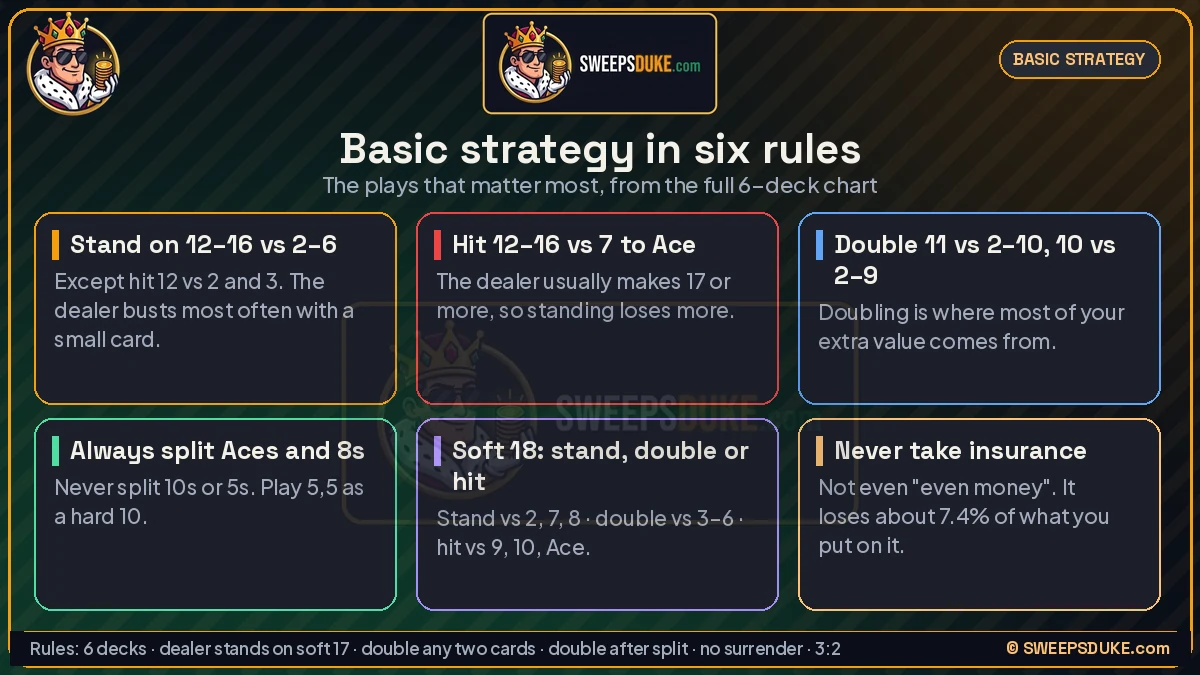
- Stand on hard 12 to 16 against a dealer 2 to 6, and hit them against 7 to Ace. The one exception: hit 12 against a 2 or 3.
- Double 11 against 2 to 10, 10 against 2 to 9, and 9 against 3 to 6. Doubling is where your best hands earn their value.
- Always split Aces and 8s. Never split 10s or 5s.
- Soft 18 (Ace-7) has three answers: stand against 2, 7 and 8, double against 3 to 6, hit against 9, 10 and Ace.
- Never take insurance or even money. Both lose money on average.
- The chart depends on the rules. If the dealer hits soft 17, surrender is offered, doubling after a split isn't allowed or there are only one or two decks, a few cells change. Every change is listed below.
- Basic strategy lowers the house edge; it never removes it. Treat blackjack as entertainment.
The basic strategy chart (6 decks, dealer stands on soft 17)
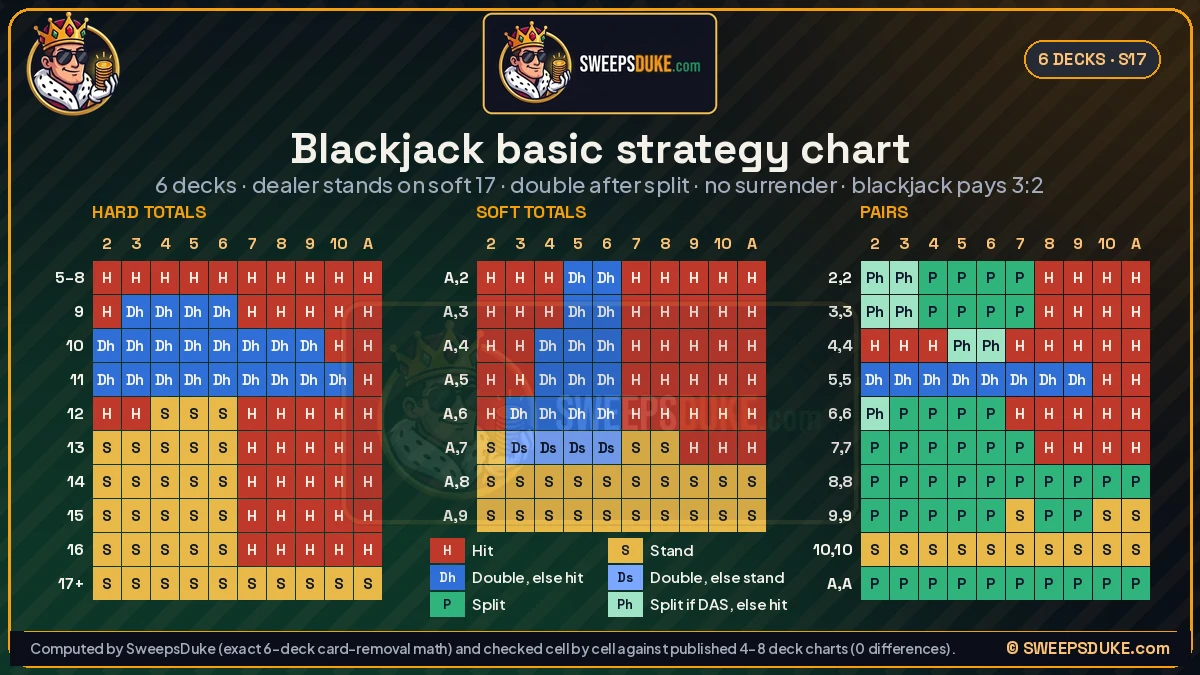
Find your hand on the left and the dealer's upcard across the top. Pairs come first, then soft hands, then hard totals (see how to read the chart for the order). The same chart in text form:
Hard totals
| You | 2 | 3 | 4 | 5 | 6 | 7 | 8 | 9 | 10 | A |
|---|---|---|---|---|---|---|---|---|---|---|
| 5–8 | H | H | H | H | H | H | H | H | H | H |
| 9 | H | Dh | Dh | Dh | Dh | H | H | H | H | H |
| 10 | Dh | Dh | Dh | Dh | Dh | Dh | Dh | Dh | H | H |
| 11 | Dh | Dh | Dh | Dh | Dh | Dh | Dh | Dh | Dh | H |
| 12 | H | H | S | S | S | H | H | H | H | H |
| 13 | S | S | S | S | S | H | H | H | H | H |
| 14 | S | S | S | S | S | H | H | H | H | H |
| 15 | S | S | S | S | S | H | H | H | H | H |
| 16 | S | S | S | S | S | H | H | H | H | H |
| 17+ | S | S | S | S | S | S | S | S | S | S |
Soft totals
| You | 2 | 3 | 4 | 5 | 6 | 7 | 8 | 9 | 10 | A |
|---|---|---|---|---|---|---|---|---|---|---|
| A,2 | H | H | H | Dh | Dh | H | H | H | H | H |
| A,3 | H | H | H | Dh | Dh | H | H | H | H | H |
| A,4 | H | H | Dh | Dh | Dh | H | H | H | H | H |
| A,5 | H | H | Dh | Dh | Dh | H | H | H | H | H |
| A,6 | H | Dh | Dh | Dh | Dh | H | H | H | H | H |
| A,7 | S | Ds | Ds | Ds | Ds | S | S | H | H | H |
| A,8 | S | S | S | S | S | S | S | S | S | S |
| A,9 | S | S | S | S | S | S | S | S | S | S |
Pairs
| You | 2 | 3 | 4 | 5 | 6 | 7 | 8 | 9 | 10 | A |
|---|---|---|---|---|---|---|---|---|---|---|
| 2,2 | Ph | Ph | P | P | P | P | H | H | H | H |
| 3,3 | Ph | Ph | P | P | P | P | H | H | H | H |
| 4,4 | H | H | H | Ph | Ph | H | H | H | H | H |
| 5,5 | Dh | Dh | Dh | Dh | Dh | Dh | Dh | Dh | H | H |
| 6,6 | Ph | P | P | P | P | H | H | H | H | H |
| 7,7 | P | P | P | P | P | P | H | H | H | H |
| 8,8 | P | P | P | P | P | P | P | P | P | P |
| 9,9 | P | P | P | P | P | S | P | P | S | S |
| 10,10 | S | S | S | S | S | S | S | S | S | S |
| A,A | P | P | P | P | P | P | P | P | P | P |
Key: H = hit. S = stand. Dh = double if allowed, otherwise hit. Ds = double if allowed, otherwise stand. P = split. Ph = split if you can double after splitting, otherwise hit.
We computed every cell of this chart ourselves for the rules below and then compared it, cell by cell, with the published 4–8 deck basic-strategy chart for the same rules. All 330 cells matched (see the note at the end of this page for how we checked).
The rules this chart is built for
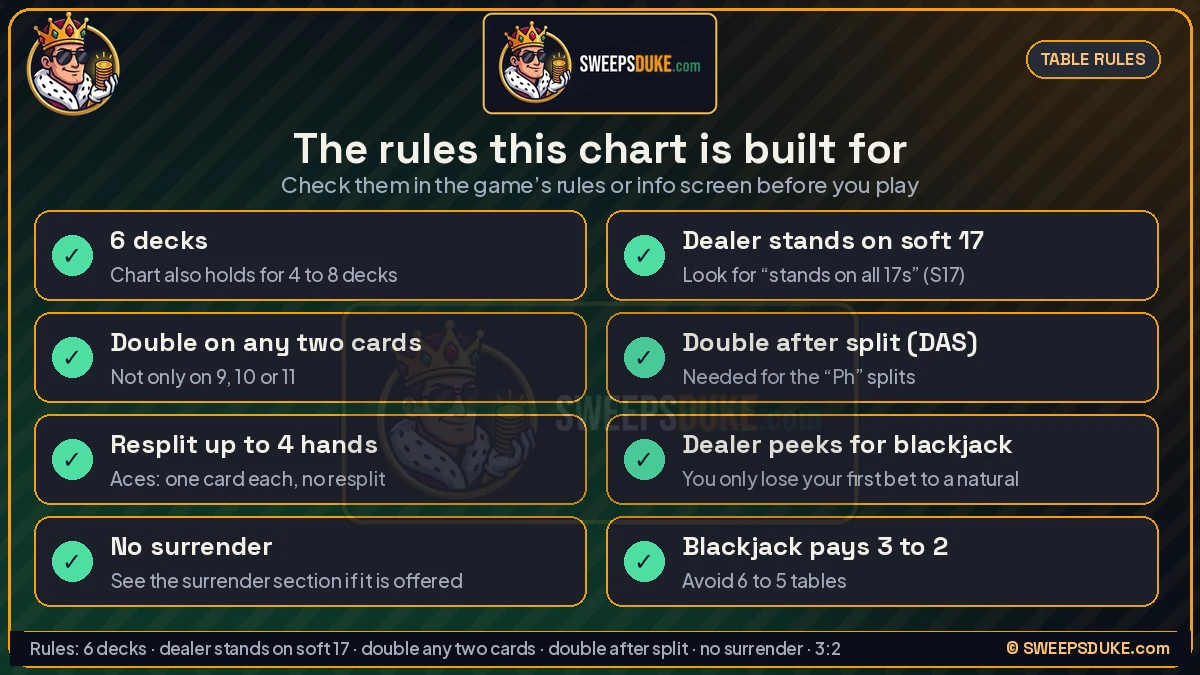
A strategy chart is only right for the rules it was made for. This one assumes:
- 6 decks in the shoe. The published chart for 4 to 8 decks is the same chart, so it also works for 4 and 8 decks at these rules.
- Dealer stands on soft 17 (S17). Look for "Dealer stands on all 17s" on the table.
- Double on any first two cards, and double after split (DAS) allowed.
- Resplit up to 4 hands. Split Aces get one card each and can't be resplit.
- Dealer peeks for blackjack when showing an Ace or a 10, so if the dealer has a natural you only lose your original bet, not doubles or splits.
- No surrender. If your table offers late surrender, use the surrender section.
- Blackjack pays 3:2. At 6:5 the chart barely changes, but the game costs you much more.
Online live-dealer tables often use different rules. A common live format, for example, uses 8 decks, the dealer stands on soft 17, no double after split and one split per hand. Check your table's rules screen, then use the matching section below. Our blackjack rules guide explains each rule in full.
How to read the chart
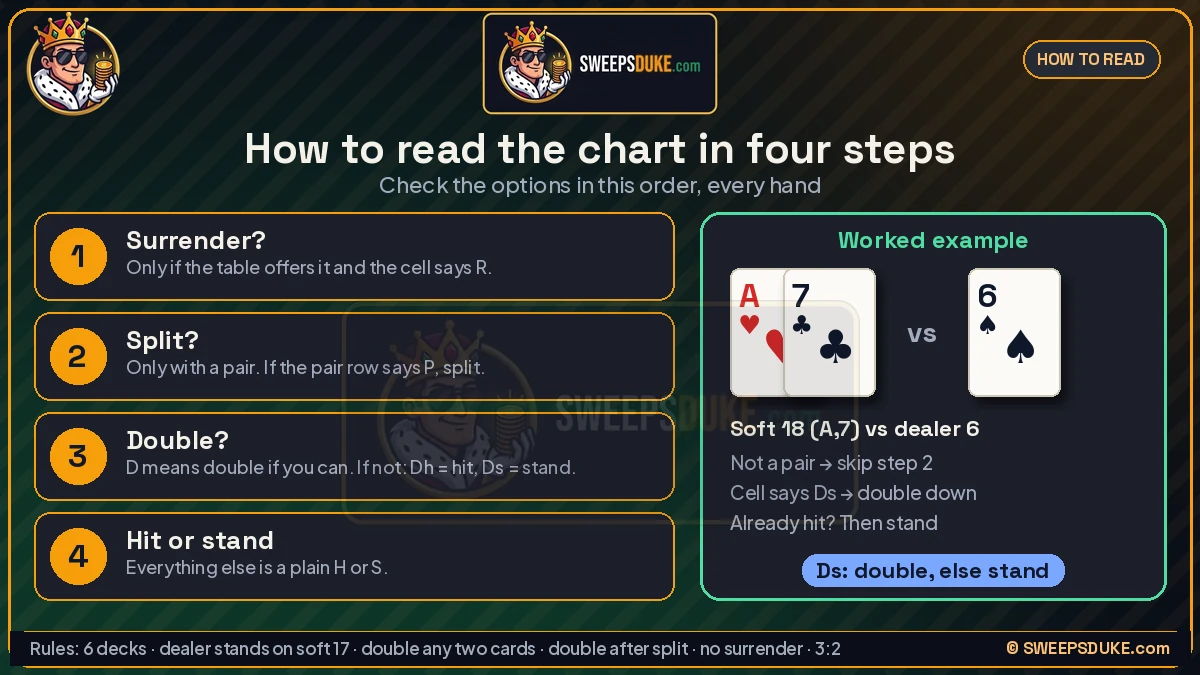
Check your options in this order, every hand:
- Surrender? Only if the table offers it and the cell for your hand says R.
- Split? Only with a pair. If the pair row says P (or Ph with double after split), split. If not, play the hand by its total: 5,5 is a hard 10, 10,10 is a hard 20.
- Double? Dh and Ds mean double if you're allowed. You can usually only double on your first two cards, so on a three-card hand Dh becomes hit and Ds becomes stand.
- Hit or stand. Everything else is a plain H or S.
Soft vs hard: a hand is soft when it has an Ace counted as 11 (Ace-6 is soft 17). If a later card would bust you, the Ace drops to 1 and the hand becomes hard. Ace-6 plus a 9 is a hard 16, so you then read the hard 16 row.
Worked example: you have Ace-7 against a dealer 6. It's not a pair, so skip step 2. The soft 18 row says Ds: double. If you'd already taken a card (say Ace-3-4, also soft 18) you can't double, so you stand.
After you hit: keep reading the chart for your new total. A three-card 12 against a 4 (say 5-3-4) is a stand, the same as a two-card 12.
What basic strategy is (and what it can't do)
For each hand, there are only a few legal moves. For each move, maths can work out the average result over every way the remaining cards could fall. Basic strategy is simply the move with the best average result in every cell. It assumes you don't track which cards have already been played, which is why it's called basic.
The first optimum strategy was published in 1956 by four engineers at the Aberdeen Proving Ground, Roger Baldwin, Wilbert Cantey, Herbert Maisel and James McDermott, in the Journal of the American Statistical Association. Their paper showed that the best play "differs substantially" from how most people played. Later computer work refined their numbers, and today's charts come from exact computer calculations.
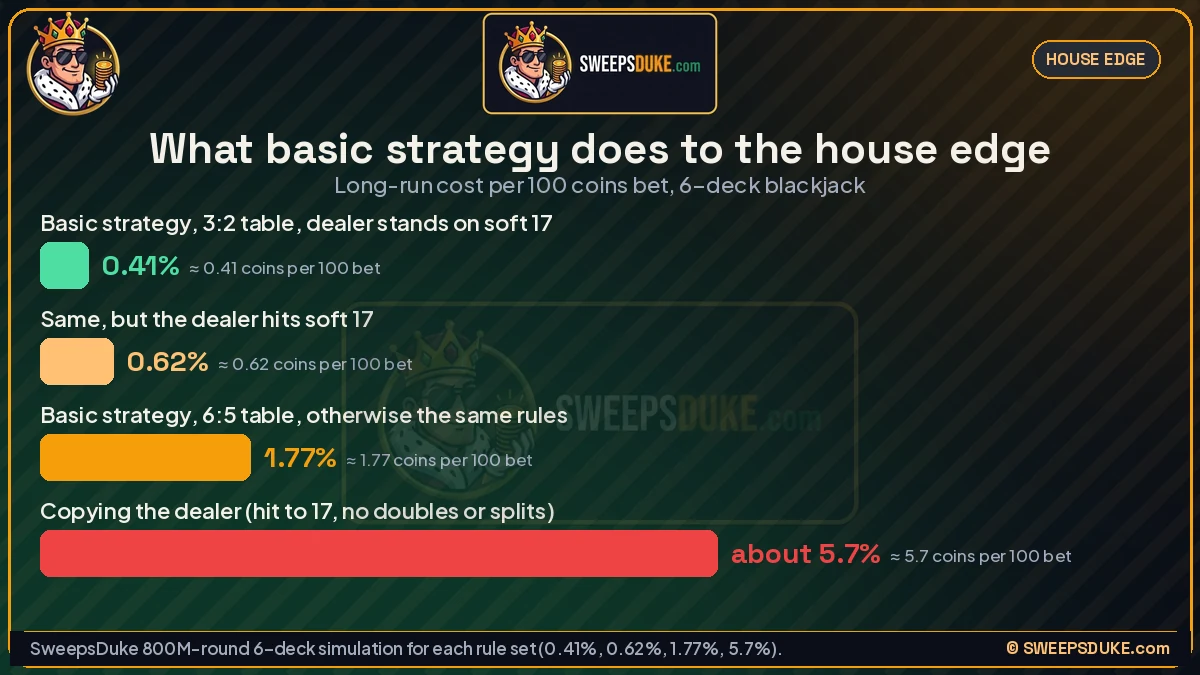
What it does for your coins, at the rules above:
| How you play | House edge | Average loss per 100 coins bet |
|---|---|---|
| Basic strategy, 3:2 blackjack | about 0.41% | about 0.41 coins |
| Basic strategy, dealer hits soft 17 | about 0.62% | about 0.62 coins |
| Basic strategy, blackjack pays 6:5 | about 1.77% | about 1.77 coins |
| Copying the dealer (hit to 17, never double or split) | about 5.7% | about 5.7 coins |
Why copying the dealer is so expensive: the dealer and you follow the same rule, but you act first. When you both bust, you've already lost, so the dealer wins those hands. On top of that you never double or split, which is where your best hands earn extra.
The house edge is a long-run average. Over a single session anything can happen, and results swing a lot. No strategy, system or count turns blackjack into a way to make money. For the full numbers behind each rule, see our blackjack house edge guide.
Why the dealer's upcard drives every decision
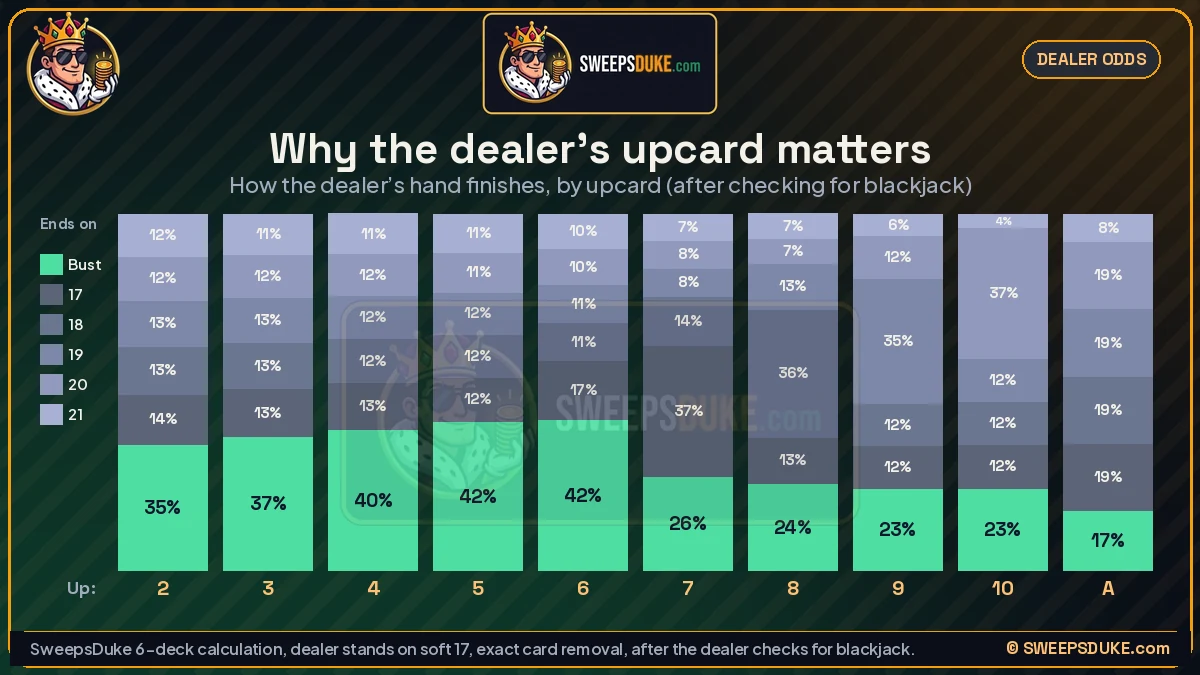
The dealer has no choices: hit until 17 or more, then stand. So the only thing that changes the dealer's chances is the upcard. Here's how the dealer's hand finishes in a 6-deck game after the dealer has checked for blackjack:
| Dealer upcard | Busts | Most likely final total |
|---|---|---|
| 2 | 35.4% | 17 (14.0%) |
| 3 | 37.4% | 17 (13.6%) |
| 4 | 39.6% | 17 (13.1%) |
| 5 | 41.8% | 17 (12.2%) |
| 6 | 42.3% | 17 (16.6%) |
| 7 | 26.2% | 17 (36.9%) |
| 8 | 24.4% | 18 (36.0%) |
| 9 | 22.9% | 19 (35.2%) |
| 10 | 23.0% | 20 (36.8%) |
| Ace | 16.7% | 20 (18.9%), with 17, 18 and 19 close behind |
Two patterns explain most of the chart:
- 2 to 6 are "bust cards". The dealer will usually need to hit at least twice, and every hit risks a bust. Against a 5 or 6 the dealer busts more than 4 times in 10. That's why you stand on stiff hands and double more often against these cards.
- 7 to Ace are "strong cards". With a hidden card that's a 10 nearly a third of the time, the dealer tends to land on upcard + 10. A 7 most often makes 17, an 8 makes 18, a 9 makes 19, and a 10 makes 20. Against these cards a 12 to 16 will usually lose if you stand, so you hit.
Notice the 7: the dealer still makes a hand 74% of the time, but more than a third of those hands are just 17. That one fact explains several "odd" plays, such as standing on 9,9 against a 7 (your 18 beats a 17).
The chance of busting with one hit on your own hard 12 is about 31% (only 10-value cards bust you). On a hard 16 it's about 62% (any 6 or higher). That sets up the hit-or-stand trade-off in the next section.
Hard totals: when to hit and when to stand
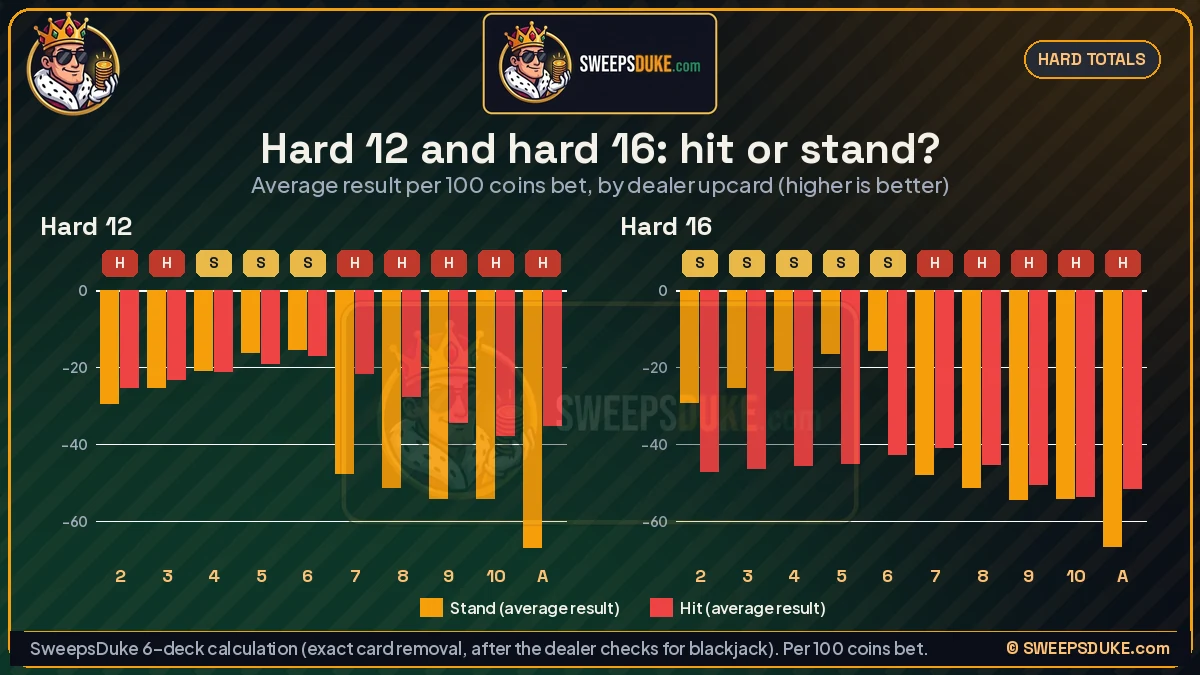
A "stiff" hand (hard 12 to 16) is the worst spot in blackjack. Every option loses on average; the chart just picks the one that loses least. All figures below are the average result per 100 coins bet.
Hard 16 against a 10: stand −54.0, hit −53.5. You hit, but it's the closest call on the chart. If you stand you only win when the dealer busts (23%). If you hit you bust about 62% of the time, but when you survive you have a real hand.
Hard 16 against a 7: stand −47.7, hit −40.9. A much clearer hit. The dealer 7 makes a hand three times in four, so standing on 16 is close to giving up.
Hard 16 against a 6: stand −15.8, hit −42.5. Now standing wins by a mile. The dealer busts 42% of the time with a 6, so you let the dealer take the risk.
Hard 12 against a 2: stand −29.3, hit −25.3. Hit. A 2 isn't weak enough for the dealer (35% bust), and only 10-value cards bust your 12.
Hard 12 against a 3: stand −25.2, hit −23.2. Still a hit.
Hard 12 against a 4: stand −20.9, hit −21.2. Now stand, but only just.
Hard 13 against a 2: stand −29.3, hit −30.8. Stand: at 13 a hit busts you more often (any 9 or 10).
The pattern: stand on 12 to 16 against 2 to 6 (except 12 against 2 and 3), hit them against 7 to Ace. Always hit 11 or less if you're not doubling, and always stand on hard 17 or more.
Worked example: you hold 10-6 and the dealer shows a 9. Standing averages −54.3, hitting −50.5. Hitting saves you about 3.8 coins per 100 bet on this hand, so you hit. You draw a 3 for 19 and stand.
Doubling down: where your best hands come from
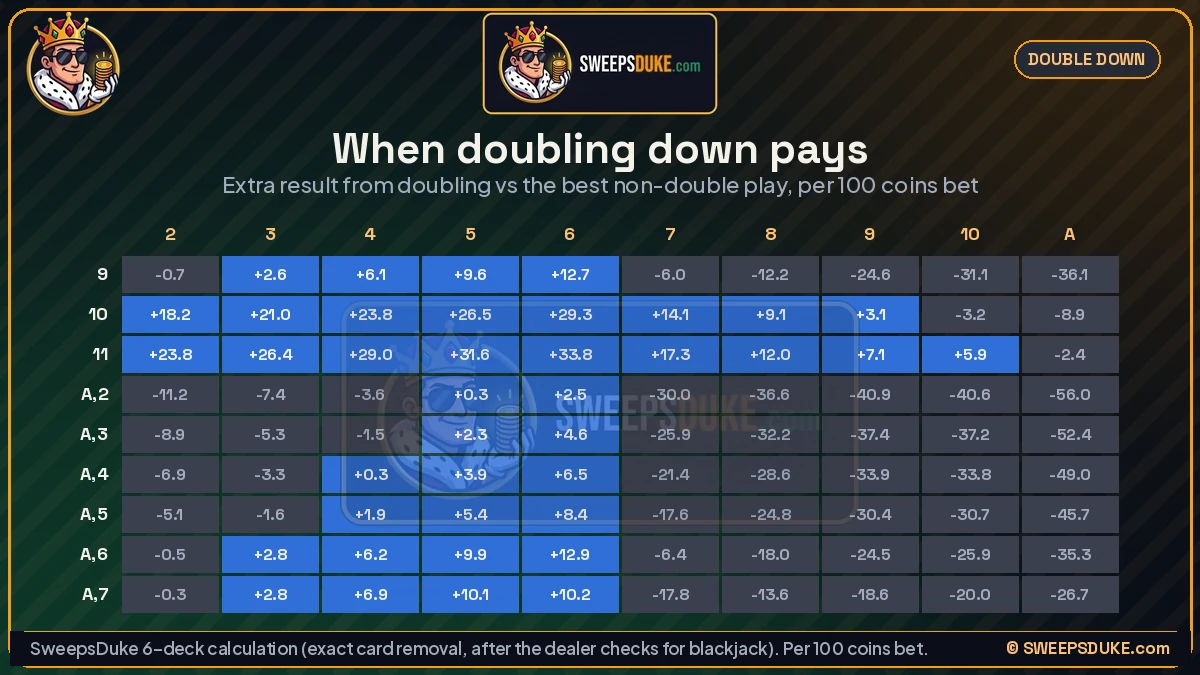
Doubling means putting in a second bet equal to your first and taking exactly one more card. You give up the right to hit again, so you only want it when the extra bet is worth more than that lost flexibility. The chart above shows how much doubling adds (blue) or costs (grey) compared with the best non-double play.
Hard 11: double against everything except an Ace. Against a 6 the double averages +67.7 per 100 coins of your original bet, against +33.8 if you just hit, which makes "hitting 11 against 6" one of the most expensive mistakes in the game. Against a 10 it's +17.7 vs +11.8 for hitting.
11 against an Ace: hit (+14.7) beats double (+12.3) when the dealer stands on soft 17. The dealer Ace is strong and has already shown it's not a blackjack, so you keep the option to draw again. If the dealer hits soft 17, the dealer gets worse and doubling becomes right (+11.8 vs +10.7).
Hard 10: double against 2 to 9. Against a 9 it's +14.7 vs +11.7. Against a 10 or an Ace just hit: +2.6 vs −0.6 against a 10, +8.2 vs −0.8 against an Ace. The dealer is too likely to have 20 or better.
Hard 9: double only against 3 to 6. Against a 3 it's +13.3 vs +10.7. Against a 2 hitting is slightly better (+7.7 vs +7.0) in a 6-deck game. Against a 7 hitting is clearly better (+17.6 vs +11.6).
Hard 8 and less: never double in a 6-deck game. 8 against a 6 is +12.0 if you hit, +9.8 if you double. (Single-deck games are different; see the deck section.)
Soft doubles: soft hands are perfect for doubling against a weak dealer because the one card you get can't bust you. Double A,2 and A,3 against 5 and 6; A,4 and A,5 against 4 to 6; A,6 and A,7 against 3 to 6. A,2 against a 5 is a real double but the closest one (+14.0 vs +13.7 for hitting). A,2 against a 4 is a hit (+10.4 vs +6.8).
What Dh and Ds mean on a hit hand: if you've already taken a card, you can't double. Dh then means hit (a soft 13 to 17 can never bust on one card, so you always take another). Ds means stand: a three-card soft 18 against a 4 stands.
Double after a split: with DAS, if you split 2s against a 6 and get 2-9, that's 11: double it, exactly as the chart says.
Soft hands: why soft 18 is the tricky one
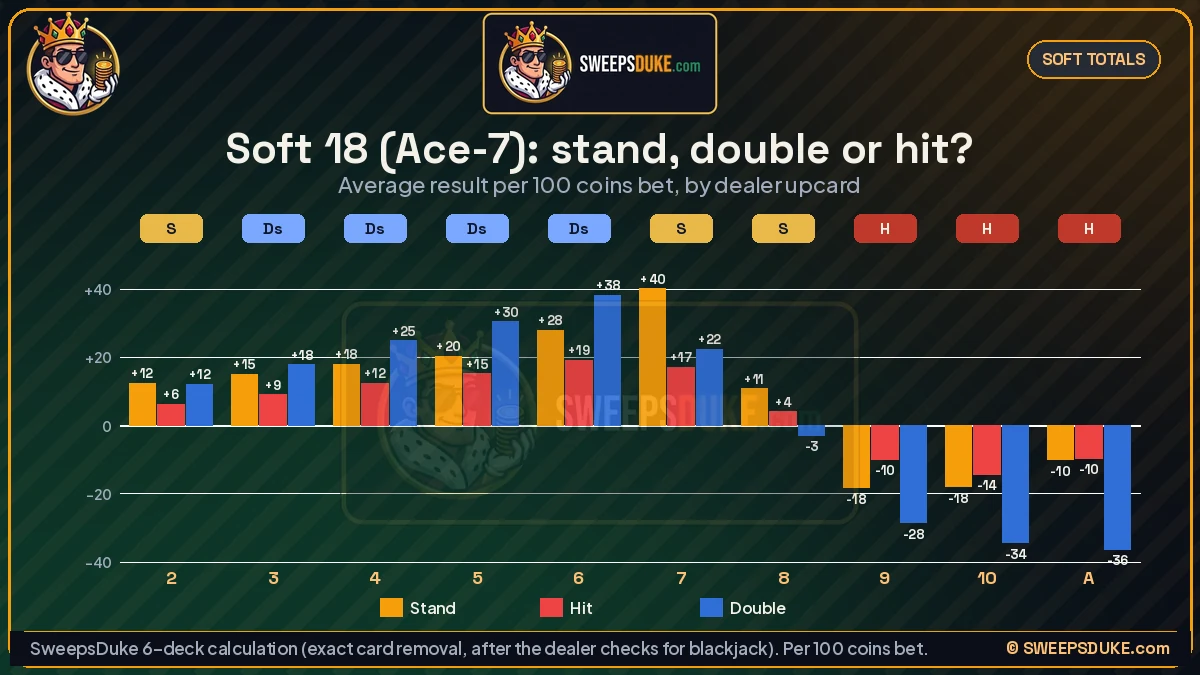
Soft totals of 13 to 17 can never bust with one more card, so they're either a hit or a double. Soft 19 and soft 20 stand, apart from the H17 exception below. That leaves soft 18 (Ace-7), the hand most players get wrong because 18 "feels" good. All three moves are right somewhere:
- Against 2, 7 and 8: stand. Against a 7 your 18 is already ahead of the dealer's most likely 17 (stand +40.2). Against an 8 you're mostly level with the dealer's likely 18 (stand +10.8, hit +4.1). Against a 2, standing (+12.4) narrowly beats doubling (+12.1).
- Against 3 to 6: double. The dealer is likely to bust, so you want more coins out. Against a 6, doubling averages +38.3 vs +28.1 for standing.
- Against 9, 10 and Ace: hit. Against a 9, standing averages −18.3 and hitting −9.9. The dealer 9 usually makes 19, so 18 is a losing total. A hit can't bust you (the Ace becomes a 1), and an Ace, 2 or 3 (3 cards in 13) takes you straight to 19, 20 or 21.
Soft 17 (Ace-6): never stand. Against a 2 it's a hit (+0.1 vs −0.4 for doubling, −15.0 for standing). Against 3 to 6 it's a double.
Soft 19 (Ace-8) against a 6: stand when the dealer stands on soft 17 (+49.4 vs +48.0 for doubling). When the dealer hits soft 17, double it.
Worked example: you hold Ace-7 against a dealer 10 and hit. You draw a 5: Ace-7-5 is now a hard 13 (the Ace counts as 1). Read the hard 13 row: against a 10, hit again.
Splitting pairs: what to split and what to keep
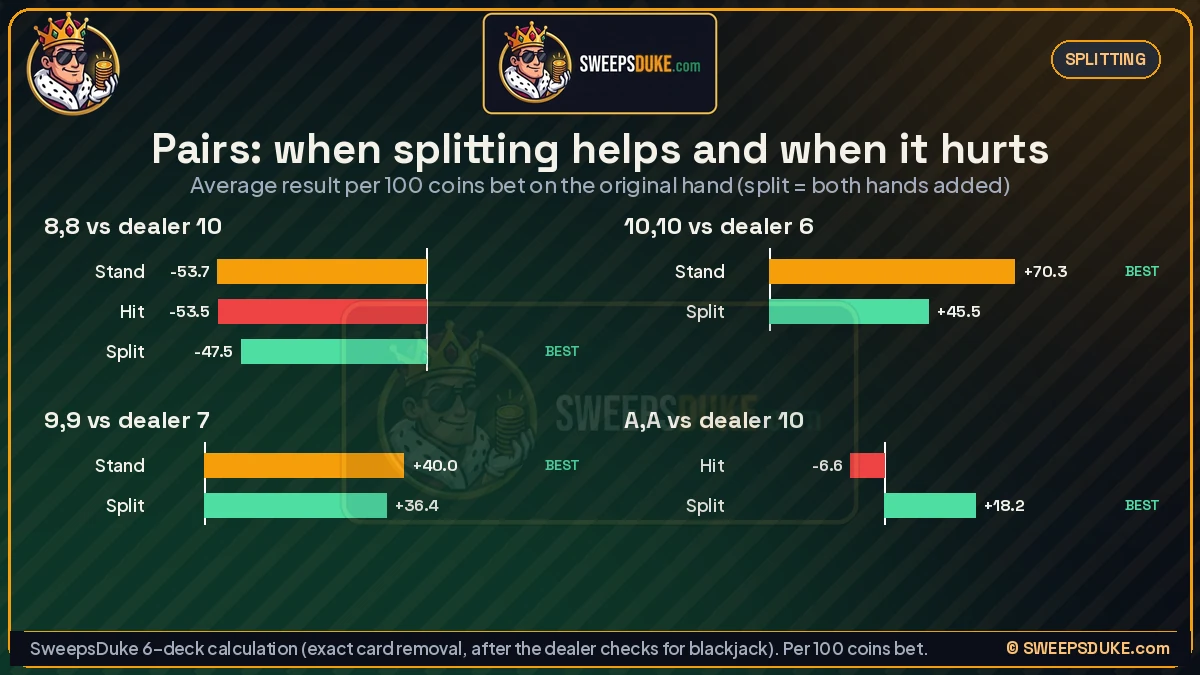
Splitting turns one hand into two, each with its own bet. Split figures here include both hands, measured per 100 coins of your original bet.
Always split Aces. Two hands that each start with an Ace are far stronger than one soft 12. Against a 10, splitting averages +18.2; hitting A,A would average −6.6. Split Aces get only one card each, and an Ace plus a 10 after splitting counts as 21, not blackjack, so it pays 1:1.
Always split 8s (in this rule set). 16 is the worst total in the game. Against a 10, standing averages −53.7 and hitting −53.5; splitting averages −47.5. Splitting still loses on average, but it loses about 6 coins per 100 less. Against an Ace it's −36.5 for splitting vs −51.3 for hitting.
Never split 10s. A hard 20 wins most of the time. Against a 6, standing averages +70.3; splitting averages +45.5. Breaking up 20 costs about 25 coins per 100.
Never split 5s. 5,5 is a hard 10: double it against 2 to 9. Against a 9 doubling averages +14.9, splitting −63.7.
9s: split against 2 to 6, 8 and 9; stand against 7, 10 and Ace. Against a 9, splitting (−8.1) beats standing (−18.5): each 9 can still become 19. Against a 7, standing on 18 (+40.0) beats splitting (+36.4) because the dealer 7 most often makes 17. Against a 10 or Ace, two 9s are likely to make two losing hands, so keep 18.
7s: split against 2 to 7. Against a 7 splitting averages −4.9 vs −33.2 for hitting 14. Against an 8 just hit (−37.8 vs −39.1).
6s: split against 3 to 6, and against a 2 only if you can double after splitting (−19.8 vs −25.3 for hitting; without DAS splitting drops to −27.5, so you hit).
2s and 3s: split against 4 to 7, and against 2 and 3 only with DAS. 2,2 against a 7 is a split (+0.8 vs −8.9 for hitting). Against an 8 hit (−15.7 vs −17.7).
4s: split only against 5 and 6 with DAS. 4,4 against a 5 is +11.0 for splitting with DAS but −2.1 without DAS; hitting the 8 gives +8.4. Without DAS, 4,4 is always a hit.
Resplits: if you split and get the same card again, the chart still applies. Split again up to the table limit (4 hands here). Aces are the exception: one card each, no resplit.
Insurance and even money: always say no
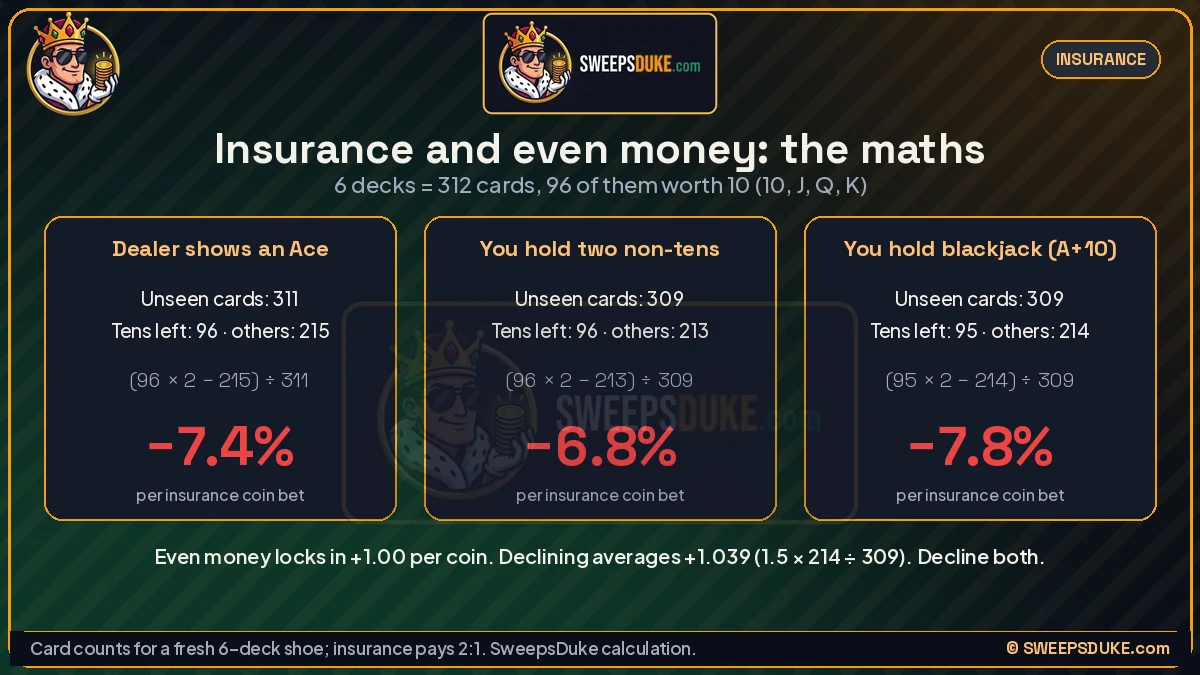
When the dealer shows an Ace you'll be offered insurance: a side bet of up to half your bet that pays 2:1 if the dealer has blackjack. It's a separate bet on one question, "is the hole card a 10?", and the answer is no too often.
A 6-deck shoe has 312 cards, 96 of them 10-value. With only the dealer's Ace seen, 96 of the 311 unseen cards are tens (30.9%). Per coin of insurance: 96 times you win 2, 215 times you lose 1, so the average is (192 − 215) ÷ 311 = −7.4%. If your own two cards are not tens, it's slightly better but still bad (−6.8%).
Even money is insurance in disguise. With blackjack against an Ace, taking even money locks in 1 coin per coin bet. Declining wins 1.5 whenever the dealer doesn't have blackjack: 214 of the 309 unseen cards, so 1.5 × 214 ÷ 309 = 1.039 on average. Declining is worth about 3.9% more. It feels safe because it can't lose, but you pay for that feeling every time.
The only exception is for card counters who know the remaining shoe is rich in tens. Basic strategy assumes you don't, so the answer is always no.
Edge cases the chart doesn't show
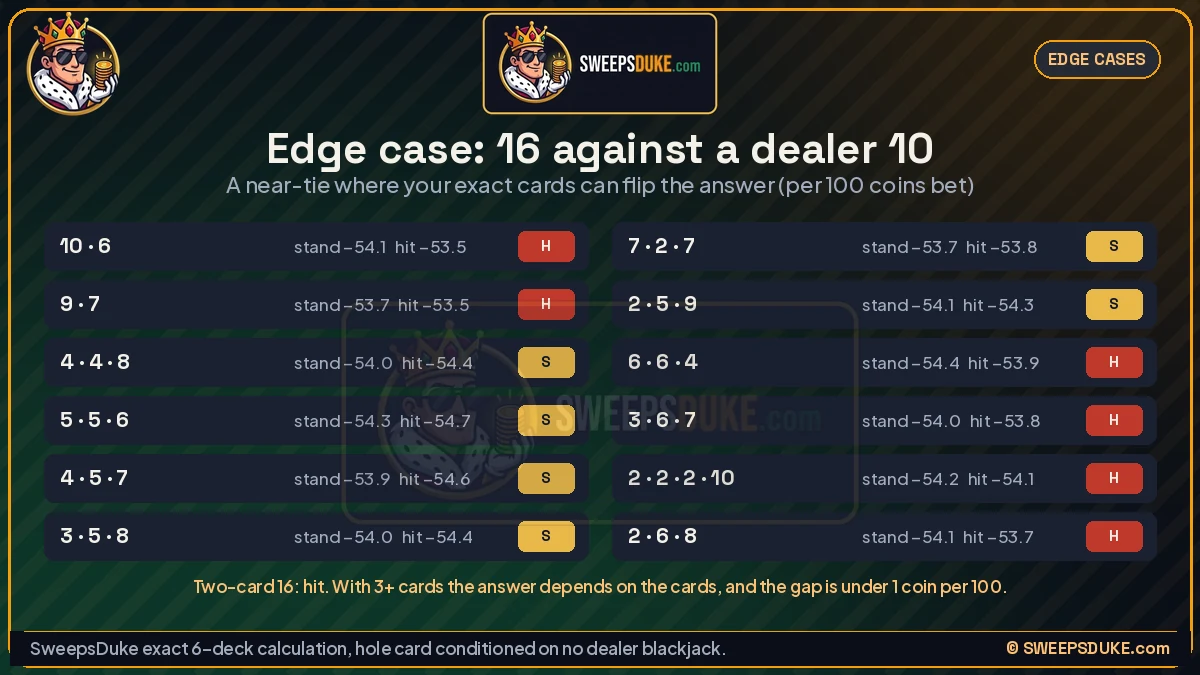
The chart is "total-dependent": it gives one answer per total. The true best play sometimes depends on which exact cards make the total, because the cards in your hand are no longer in the shoe. In a 6-deck game these differences are tiny, but they're real:
- 16 against a 10 with three or more cards. Hitting is right for a two-card 16 (10-6: hit −53.5 vs stand −54.1). With three or more cards the best play depends on the cards: standing is slightly better on 4-4-8, 5-5-6, 4-5-7, 3-5-8 or 7-2-7, while hitting stays better on 6-6-4, 3-6-7, 2-6-8 or 2-2-2-10. The gap is never more than 0.7 coins per 100 bet. If you don't want card-by-card exceptions, follow the chart and hit; it costs almost nothing.
- 12 against a 4. The chart says stand, and that's right for 9-3, 8-4 and 7-5. With 10-2, hitting is a hair better (−21.04 vs −21.11 per 100 coins). Not worth memorising unless you want every last fraction.
- A three-card soft hand: Dh and Ds turn into hit and stand. Ace-2-4 (soft 17) against a 5 is a hit, not a double.
- Split Aces that catch a 10 make 21 but not a blackjack. It pays 1:1, and it can push against a dealer 21.
- Only first-two-card pairs can be split. If you hold 5-3 and draw a 3, you have a hard 11, not a pair. The exception is a split hand that catches a matching card, which you can resplit up to the table limit (not Aces).
If the dealer hits soft 17 (H17)
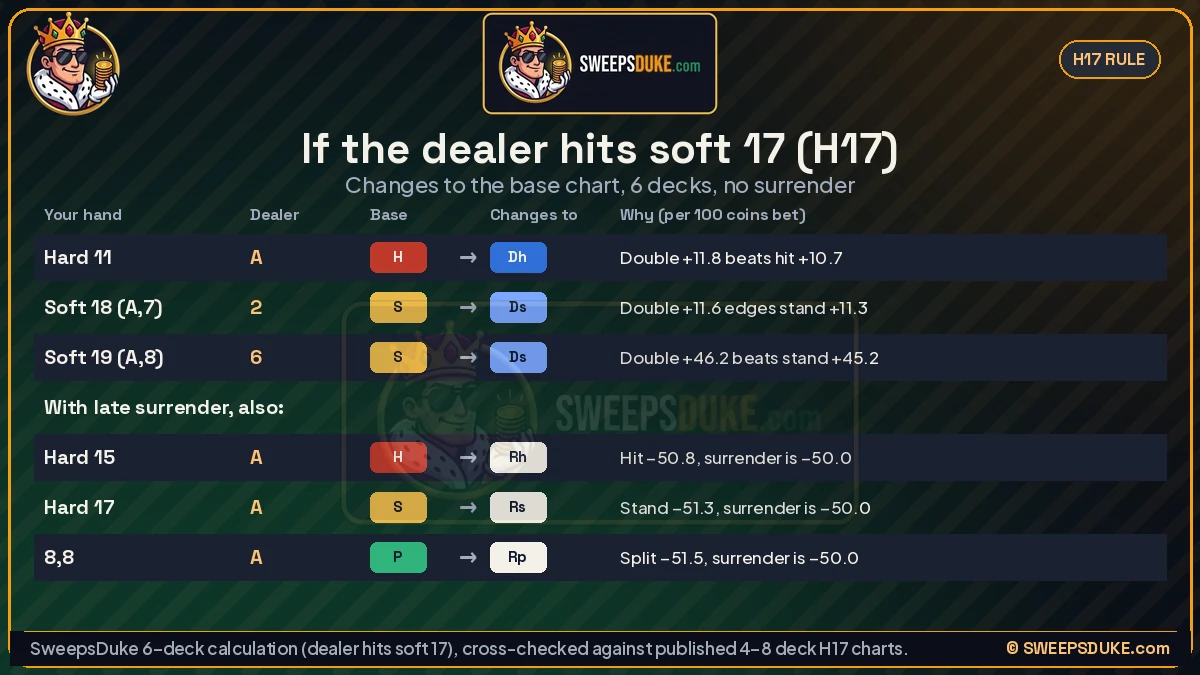
Many tables have the dealer hit soft 17 (look for "Dealer hits soft 17" on the felt or rules screen). Hitting soft 17 helps the dealer: it adds about 0.22% to the house edge. With an Ace up, the dealer busts more often (20.1% vs 16.7%) but also finishes on 17 far less often (8.3% vs 18.8%), and with a 6 up the bust chance rises to 43.9%.
Three cells change when there's no surrender:
- Double 11 against an Ace (double +11.8, hit +10.7).
- Double soft 18 against a 2 (double +11.6, stand +11.3).
- Double soft 19 against a 6 (double +46.2, stand +45.2).
If late surrender is also offered, three more cells become surrenders: 15 against an Ace, 17 against an Ace, and 8,8 against an Ace. Each one averages slightly worse than −50 if you play it, so giving up half your bet is the better deal.
If you play both S17 and H17 tables, learn the S17 chart first. Published analysis finds that using the S17 chart at an H17 table costs much less than the reverse.
If late surrender is offered
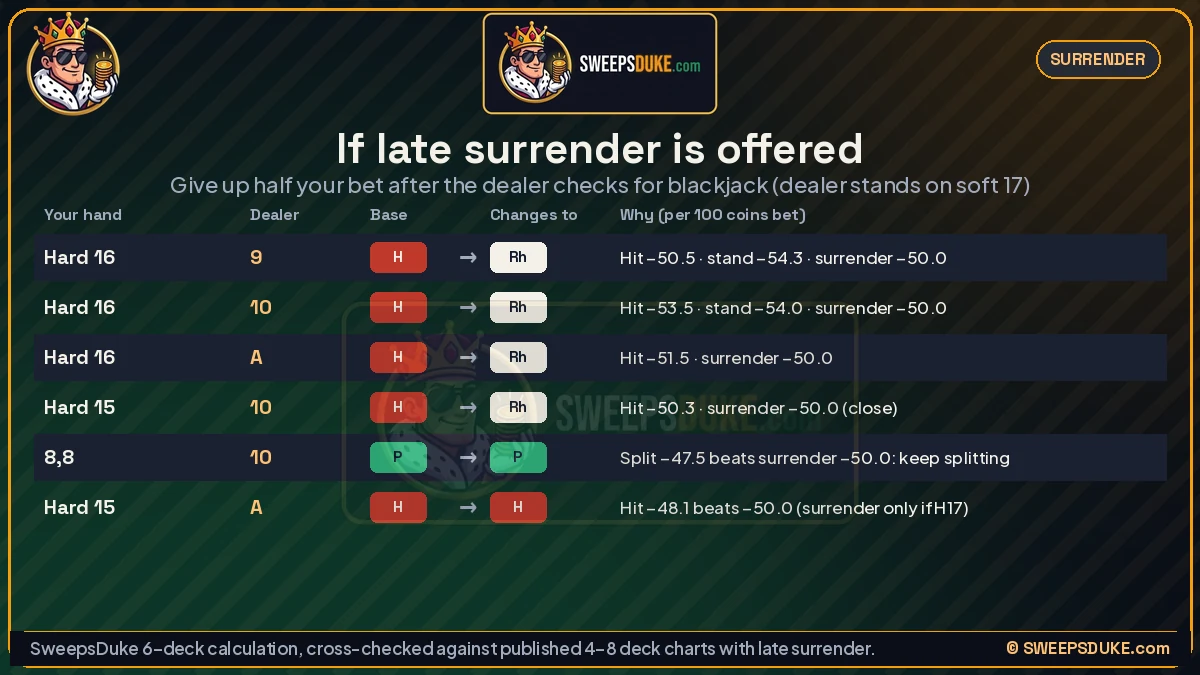
Late surrender lets you give up half your bet after the dealer has checked for blackjack. Surrender is right whenever your best play would lose more than 50 coins per 100 on average. With the dealer standing on soft 17, that's four cells:
- 16 against a 9, 10 or Ace. Against a 10: hit −53.5, stand −54.0, surrender −50.0.
- 15 against a 10: hit −50.3 vs surrender −50.0. A very close call, but surrender wins.
Two things to notice:
- Don't surrender 8,8 against a 10 in this rule set. Splitting averages −47.5, better than −50.
- 15 against an Ace is a hit (−48.1) when the dealer stands on soft 17. It only becomes a surrender if the dealer hits soft 17.
Late surrender lowers the house edge by only about 0.07%, so it's a nice extra, not a game changer. If your table doesn't mention surrender, assume it isn't offered and use the main chart.
No double after split, or limited doubling
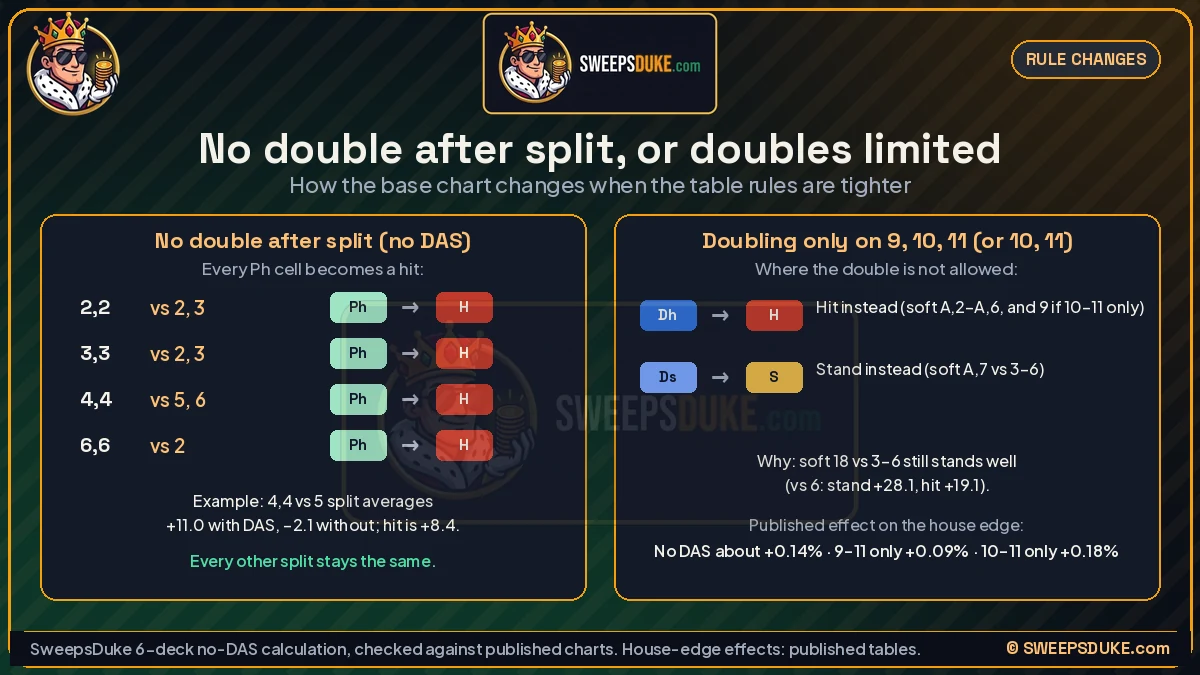
No double after split (no DAS): some of the low-pair splits only pay because you can double a good second card (a split 4 that catches a 7 makes 11, for example). Without DAS, every Ph cell becomes a hit:
- 2,2 and 3,3 against 2 and 3: hit.
- 4,4 against 5 and 6: hit.
- 6,6 against 2: hit.
Every other split stays the same. We ran the full no-DAS chart and it matched the published chart exactly, with Ph read as hit. No DAS adds about 0.14% to the house edge.
Doubling on 9 to 11 only, or 10 and 11 only: where you're not allowed to double, Dh becomes hit and Ds becomes stand. So soft A,2 to A,6 are hits, and soft 18 against 3 to 6 is a stand (against a 6: stand +28.1, hit +19.1). Under "10 and 11 only", hard 9 against 3 to 6 is also a hit. Published effects on the house edge: about +0.09% for 9–11 only and +0.18% for 10–11 only.
Single-deck and double-deck changes
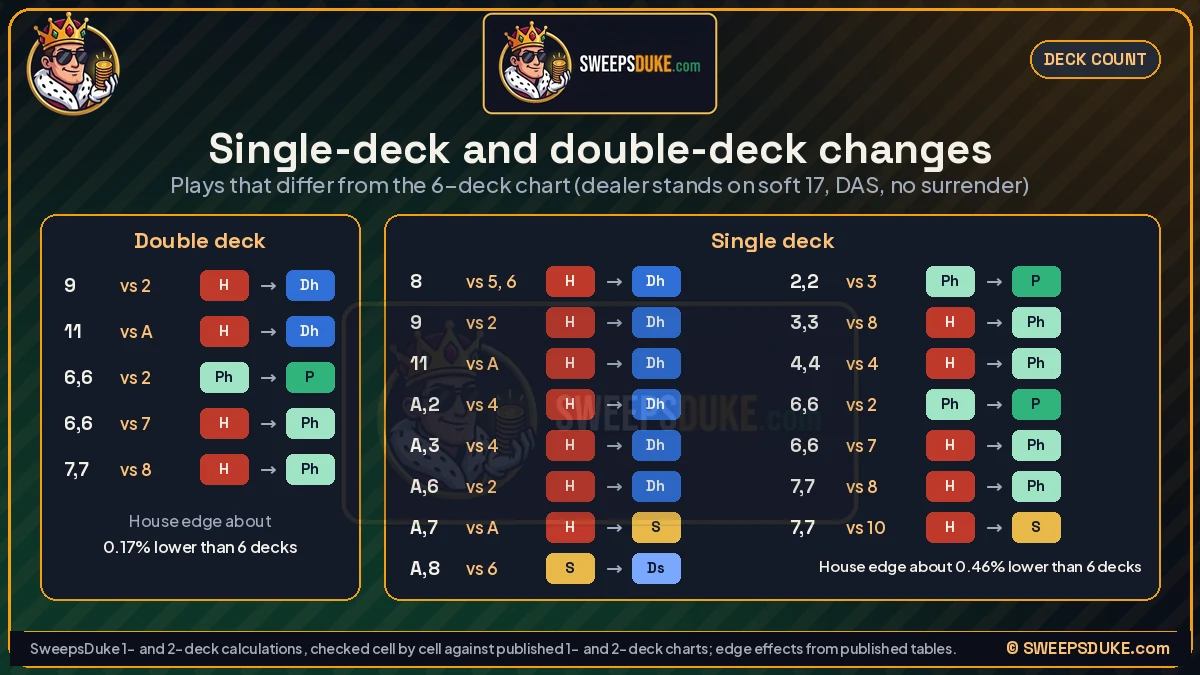
With fewer decks, each card you can see changes the remaining shoe more. That makes doubling and splitting a little more valuable, so the chart gets more aggressive. Changes compared with the 6-deck chart (dealer stands on soft 17, DAS, no surrender):
Double deck:
- Double 9 against a 2.
- Double 11 against an Ace.
- Split 6,6 against a 2 even without DAS.
- 6,6 against a 7 and 7,7 against an 8: split if DAS, otherwise hit.
Single deck:
- Double hard 8 against 5 and 6, hard 9 against a 2, hard 11 against an Ace.
- Double A,2 and A,3 against a 4, and A,6 against a 2.
- Stand on soft 18 against an Ace. Double soft 19 against a 6.
- Split 2,2 against a 3, and 6,6 against a 2, even without DAS.
- 3,3 against an 8, 4,4 against a 4, 6,6 against a 7 and 7,7 against an 8: split if DAS, otherwise hit.
- Stand on 7,7 against a 10.
Fewer decks also lower the house edge: about 0.17% less for double deck and about 0.46% less for single deck, compared with 6 decks at the same rules. Single-deck games often come with worse rules, though (6:5 blackjack is common), which wipes out that advantage several times over.
What common mistakes cost
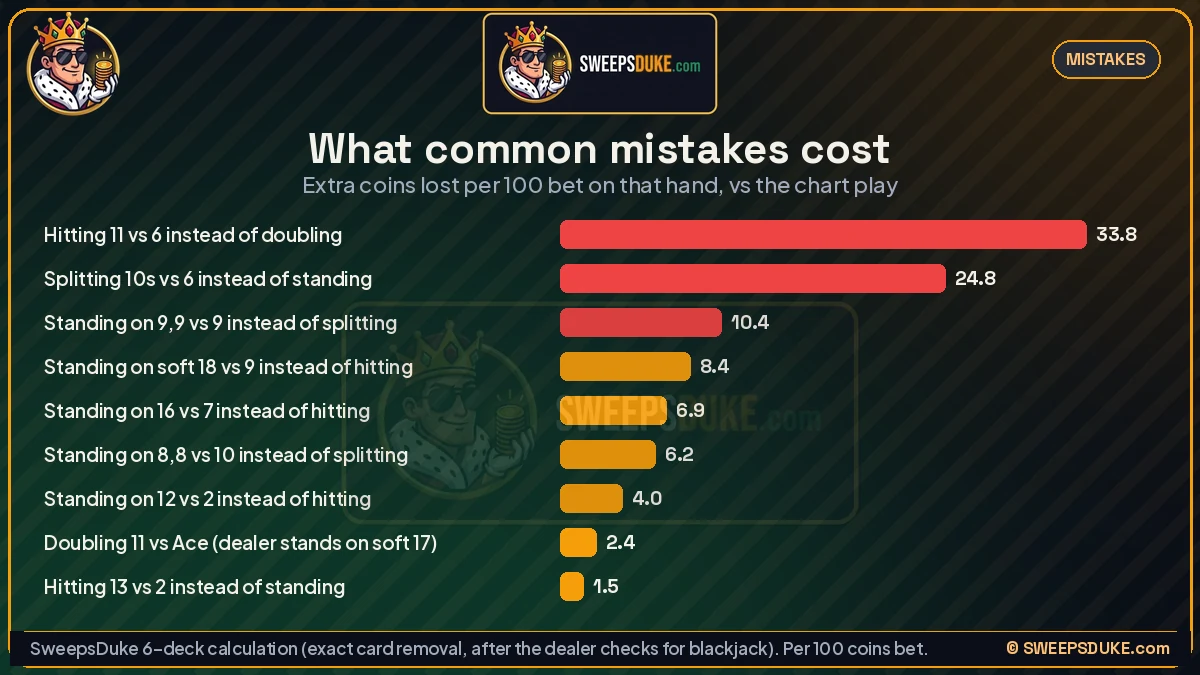
Not every mistake is equal. These are the extra coins lost, on average, per 100 coins bet each time you make the mistake (6 decks, dealer stands on soft 17):
| Mistake | Extra cost per 100 coins |
|---|---|
| Hitting 11 against a 6 instead of doubling | 33.8 |
| Splitting 10s against a 6 | 24.8 |
| Standing on 9,9 against a 9 instead of splitting | 10.4 |
| Standing on soft 18 against a 9 | 8.4 |
| Standing on 16 against a 7 | 6.9 |
| Standing on 8,8 against a 10 instead of splitting | 6.2 |
| Standing on 12 against a 2 | 4.0 |
| Doubling 11 against an Ace | 2.4 |
| Hitting 13 against a 2 | 1.5 |
| Taking insurance | 7.4 per 100 coins put on insurance |
Two lessons: the biggest leaks are missed doubles and bad splits, not the agonising 16-against-10 decisions. And the "scary" plays (splitting 8s, hitting soft 18) are scary because the hand is bad, not because the play is.
Using basic strategy at sweepstakes casinos
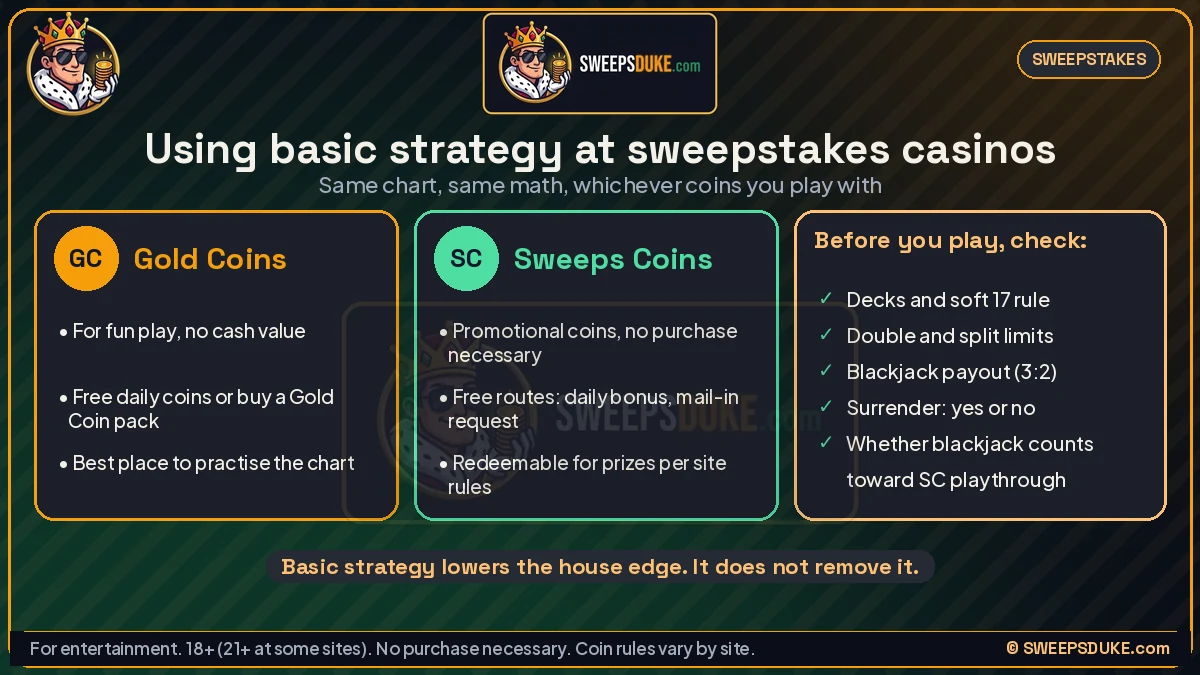
Basic strategy works the same whichever coins you play with, because the cards don't know what they're worth. What changes is the coin:
- Gold Coins (GC) are for fun play only and have no cash value. You get them free or can buy a Gold Coin pack. They're the right coin for learning the chart.
- Sweeps Coins (SC) are promotional coins. You get them free through things like daily bonuses and mail-in requests, or as a bonus with some Gold Coin packs. Under each site's sweepstakes rules, SC you've played through can be redeemed for prizes. No purchase is necessary.
Before you play, check the game's rules screen for the deck count, soft 17 rule, double and split limits, surrender, and the blackjack payout, then use the matching section of this page. Also check the site's terms: many sites require SC playthrough before redemption, and some don't count blackjack in full.
Sweepstakes casinos are 18+ at minimum and many are 21+, and they're not available in every state. Play only where you're allowed to.
How to learn basic strategy
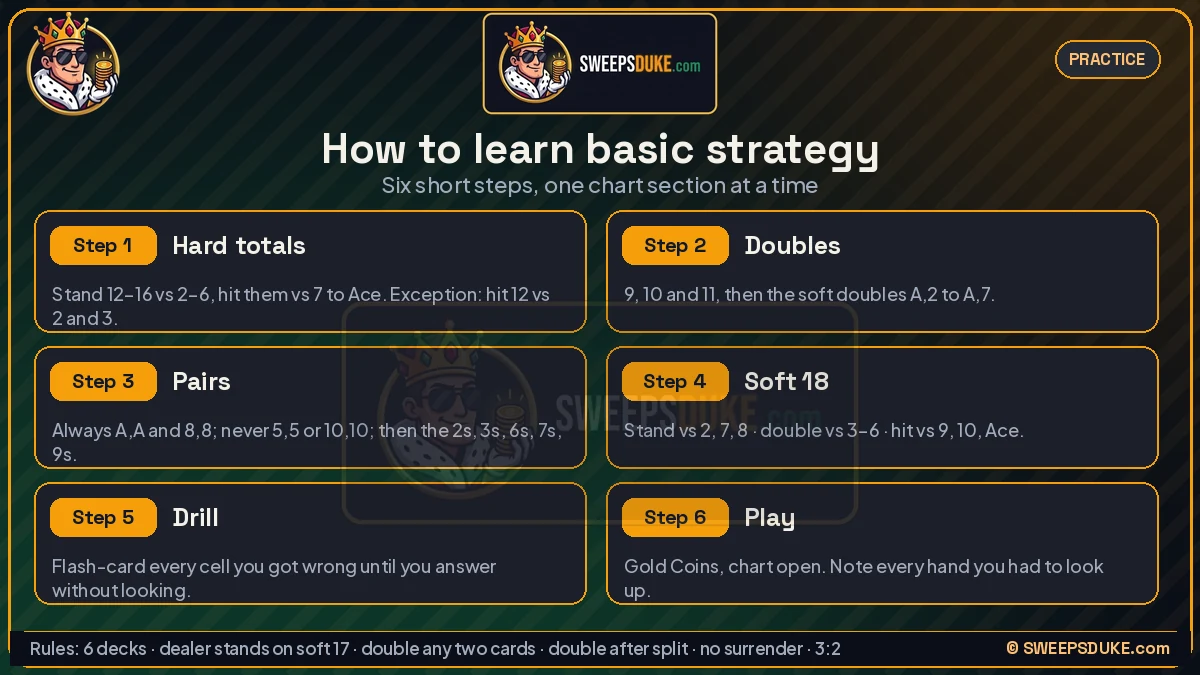
You don't need to memorise 330 cells at once. Most of the chart follows a few patterns, so learn it in chunks:
- Hard totals. Stand on 12 to 16 against 2 to 6, hit them against 7 to Ace, with the exception of 12 against 2 and 3. Always stand on 17+.
- Doubles. 11 against 2 to 10, 10 against 2 to 9, 9 against 3 to 6. Then the soft doubles, which all sit against 3 to 6.
- Pairs. Always Aces and 8s, never 5s or 10s. Then 9s (not against 7, 10 or Ace), then 2s, 3s, 6s and 7s.
- Soft 18. Stand against 2, 7, 8; double 3 to 6; hit 9, 10, Ace.
- Drill. Flash-card the cells you get wrong until you can answer without looking.
- Play. Use Gold Coins with the chart open, and note each hand you had to look up.
Online you play on your own screen, so you can keep the chart open beside the game. Check the site's terms if you're unsure. For a one-page printable version, see our blackjack cheat sheet, and for the strategy ideas beyond the basic chart, see our blackjack strategy guide. New to the game? Start with how to play blackjack.
Basic strategy FAQ
Is basic strategy the same for every blackjack game?
No. It depends on the deck count, whether the dealer hits soft 17, doubling and splitting rules and surrender. The core is the same everywhere, but a handful of cells change. This page covers the common variations.
Does basic strategy guarantee wins?
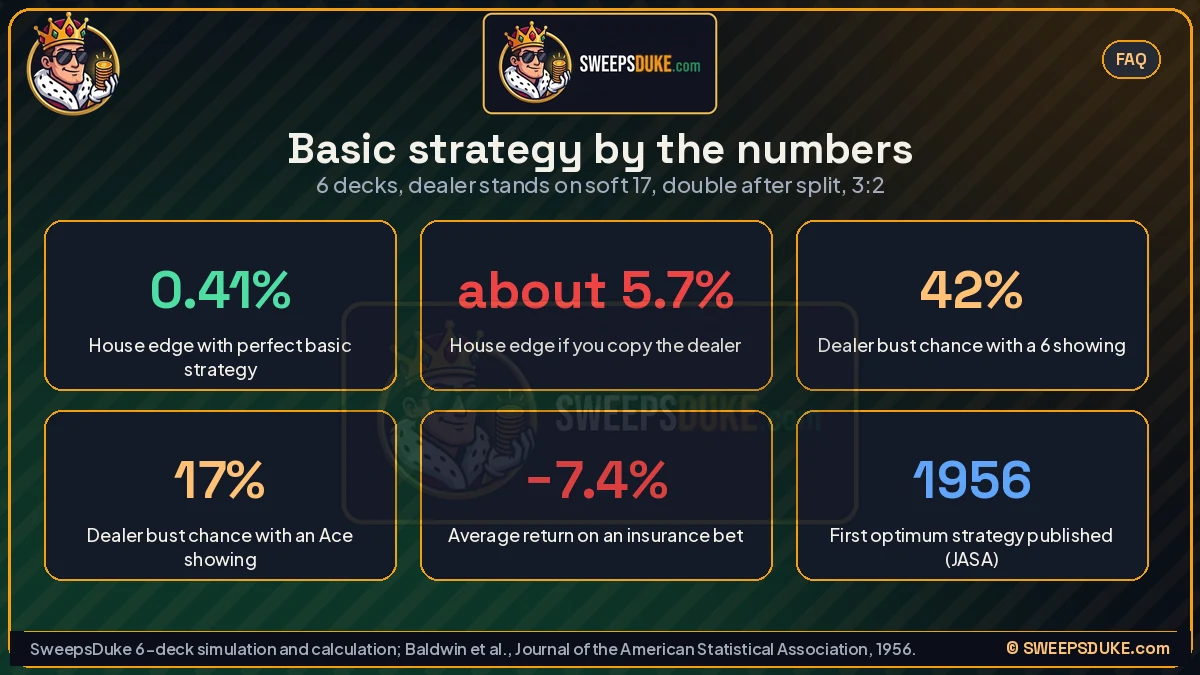
No. With perfect play the house still keeps about 0.41% of what you bet at these rules, and you'll still have losing sessions. Basic strategy minimises that cost; it doesn't remove it.
Why should I hit 16 against a 10 when I'll probably bust?
Because standing is even worse. Standing only wins when the dealer busts (23% of the time against a 10). Hitting busts you about 62% of the time, but the other 38% you have a hand that can win or push. Over many hands, hitting loses about half a coin less per 100 bet. It's the closest call on the chart, so don't stress over it.
Should I ever take insurance?
No, not with basic strategy. It loses about 7.4% of what you put on it in a 6-deck game, and even money costs you about 3.9% of your blackjack's value.
Why stand on 12 against a 4 but hit it against a 3?
Against a 4 the dealer busts about 40% of the time, enough that you let the dealer take the risk. Against a 3 (37%) and a 2 (35%) it isn't, so the 31% chance you bust with one hit is the better trade.
Can I use a strategy chart while I play online?
You play online on your own screen, so you can keep this chart or our cheat sheet open beside the game. If you're unsure, check the site's terms.
Is basic strategy the same as card counting?
No. Basic strategy assumes you don't track the cards. Card counting changes bets and some plays based on the cards already seen. Online games are usually reshuffled often, so counting doesn't help there.
What changes at a 6:5 table?
The chart barely changes, but the cost of the game jumps by about 1.36% of everything you bet. That's more than three times the house edge of the whole 3:2 game. Look for 3:2 tables.
Every chart cell and figure on this page comes from our own finite-shoe calculation for the stated rules: exact card-removal maths for standing, hitting and doubling, with the dealer's hole card conditioned on no blackjack. We compared our 6-deck chart (dealer stands and dealer hits soft 17), our no-DAS chart and our 1- and 2-deck charts cell by cell with the published charts listed in our sources. The 6-deck charts matched in all 330 cells, and so did the no-DAS chart. Our 1- and 2-deck charts differed from the published ones only in near-tie cells (for example double-deck 11 against an Ace, within 0.3 coins per 100), and there we follow the published play. House-edge figures come from our 800-million-round simulation (checked against our own finite-shoe calculation, 0.40%) and published rule-variation tables.
18+ (21+ at many sweepstakes sites). Play for fun, not income. Blackjack has a house edge, and no strategy, system or count turns a sweepstakes or casino game into a way to make money. Set a time and spend limit before you start. Need help? Call or text 1-800-GAMBLER or see our responsible gaming page.