


How to Play Blackjack
How to play blackjack step by step: card values, hit, stand, double and split, dealer rules and payouts, with example hands and a 6-deck strategy chart.
On this page
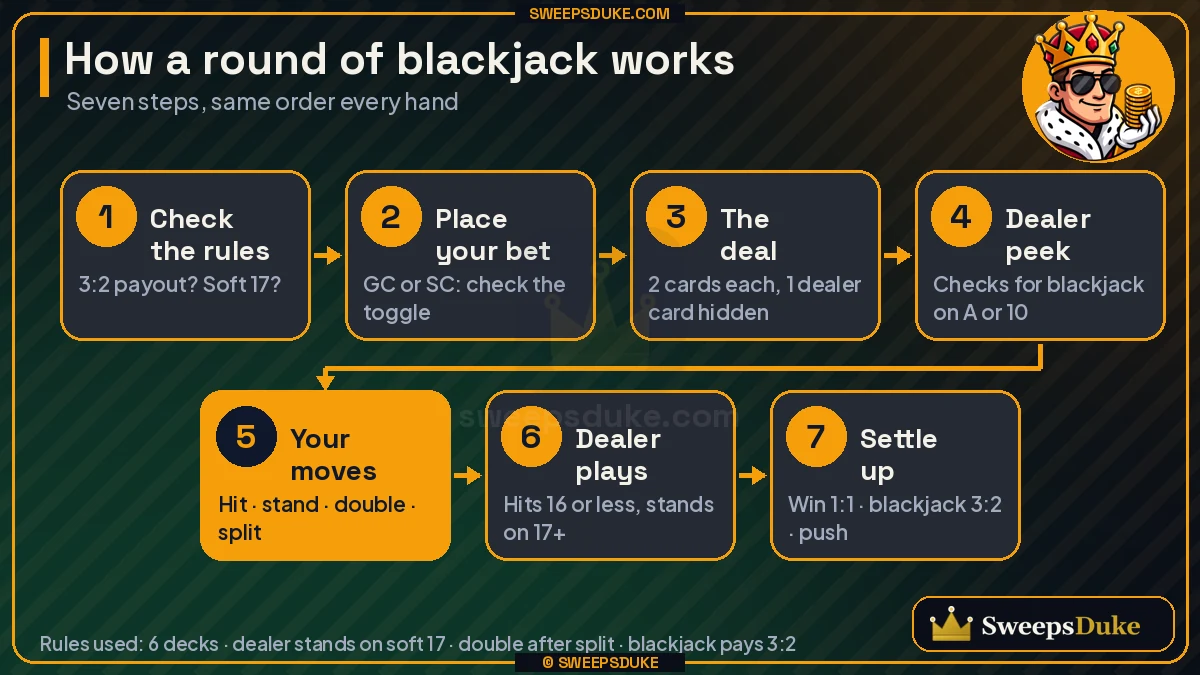
Blackjack is simple at heart: you and the dealer each try to get closer to 21 than the other without going over. You place a bet, get two cards, then choose to hit, stand, double or split until you're happy with your hand or you bust. Then the dealer plays by fixed rules, and the better hand wins.
This guide walks you through a full round, step by step, with real example hands, the payouts, the dealer's rules and a starter strategy chart you can keep open while you play.
Affiliate disclosure: SweepsDuke may earn a commission if you sign up through some links on this site. That never changes our charts, math or verdicts. How we make money.
Key takeaways
- The goal is to beat the dealer, not to hit 21. A 19 that beats a dealer's 18 wins exactly as much as a 21.
- Number cards count their face value, 10s and picture cards count 10, and an Ace counts 1 or 11.
- If you go over 21 you lose straight away, even if the dealer busts later. That one rule is where the house edge comes from.
- The dealer has no choices. They hit 16 or less and stand on 17 or more.
- Look for "Blackjack pays 3 to 2" before you sit down. A 6:5 table costs you about 1.4% of every bet.
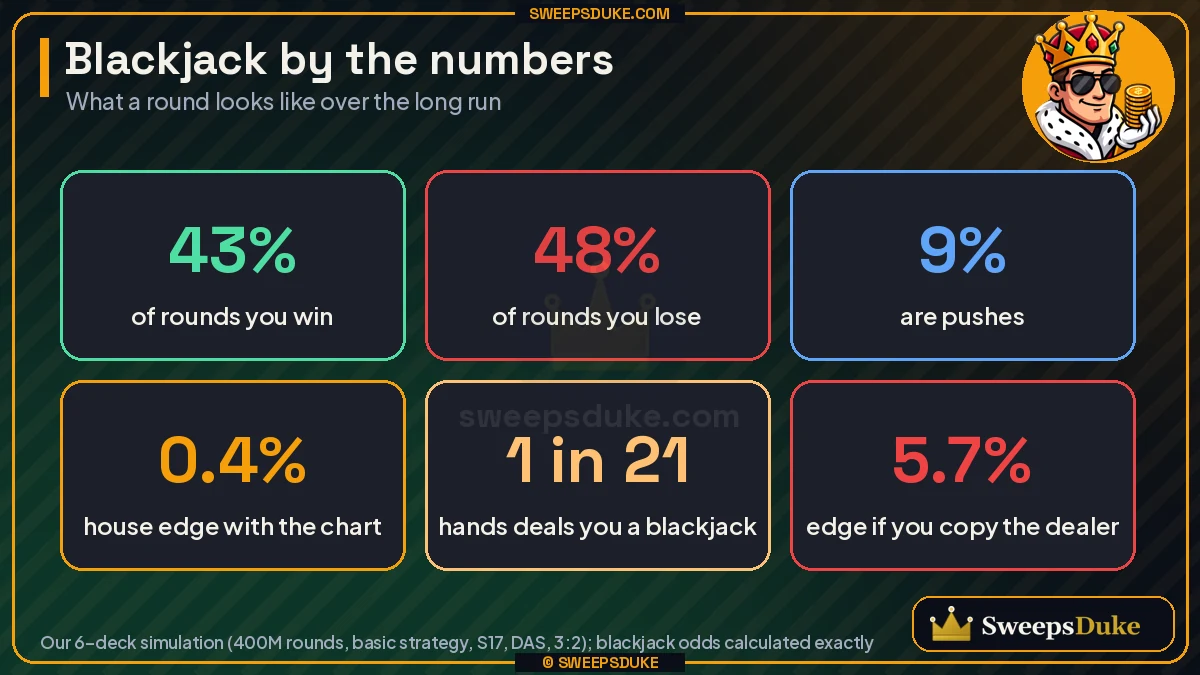
- Use a strategy chart. Played by the chart, a good 6-deck game has a house edge of about 0.4%. Copying the dealer's rules pushes it to about 5.7%.
- Skip insurance. On average it loses about 7.4% of what you put on it.
Card values and the goal of the game
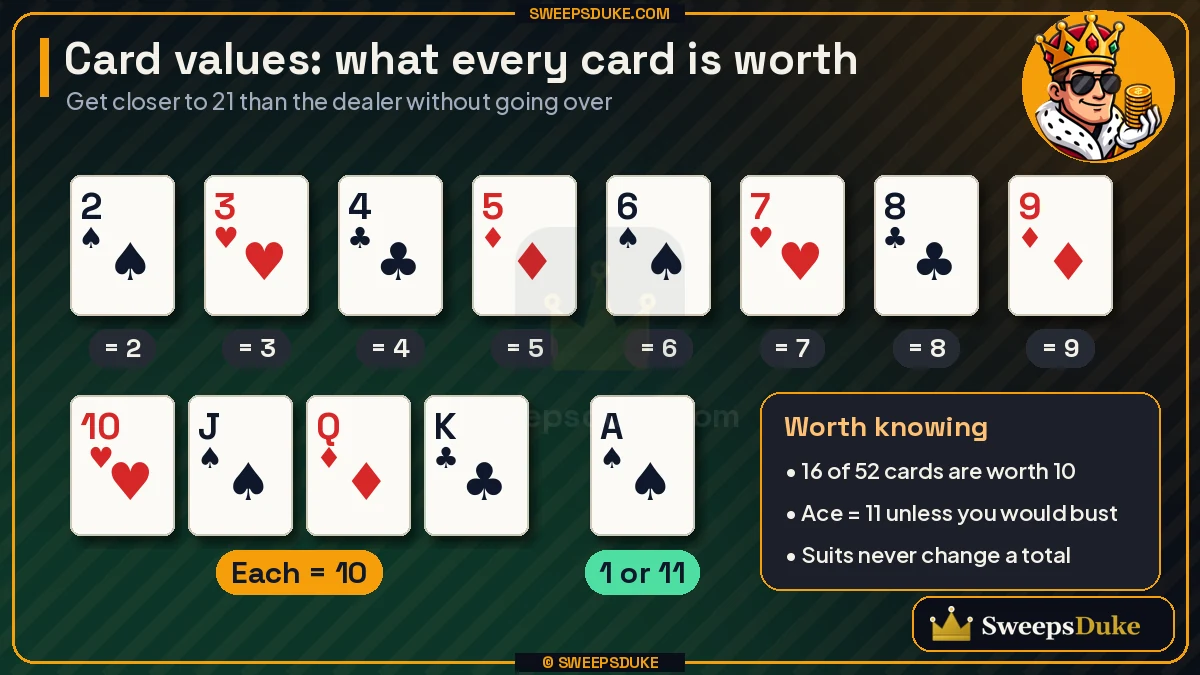
Every card has a points value, and your hand's total is just those values added up:
| Card | Value |
|---|---|
| 2 to 9 | Face value (a 7 is worth 7) |
| 10, Jack, Queen, King | 10 each |
| Ace | 1 or 11, whichever helps you more |
Suits never matter. A K♠ and a K♥ are both just 10.
A few quick totals so it clicks:
- 9♣ 7♦ = 16
- K♥ 5♠ = 15
- A♦ 8♣ = 19 (or 9, but you'd always count it as 19)
- A♠ 4♥ 9♦ = 14. The Ace has to count as 1 here, because 11 + 4 + 9 would be 24.
Ten-value cards are everywhere: 16 of the 52 cards in each deck (about 31%) are worth 10. That's why "assume the hidden card is a 10" is a handy rule of thumb, and why a dealer showing a 6 is in trouble.
You win the round if your final total is higher than the dealer's without going over 21, or if the dealer busts while you're still in. If you tie, it's a push and your bet comes back.
The table and the rules this guide uses
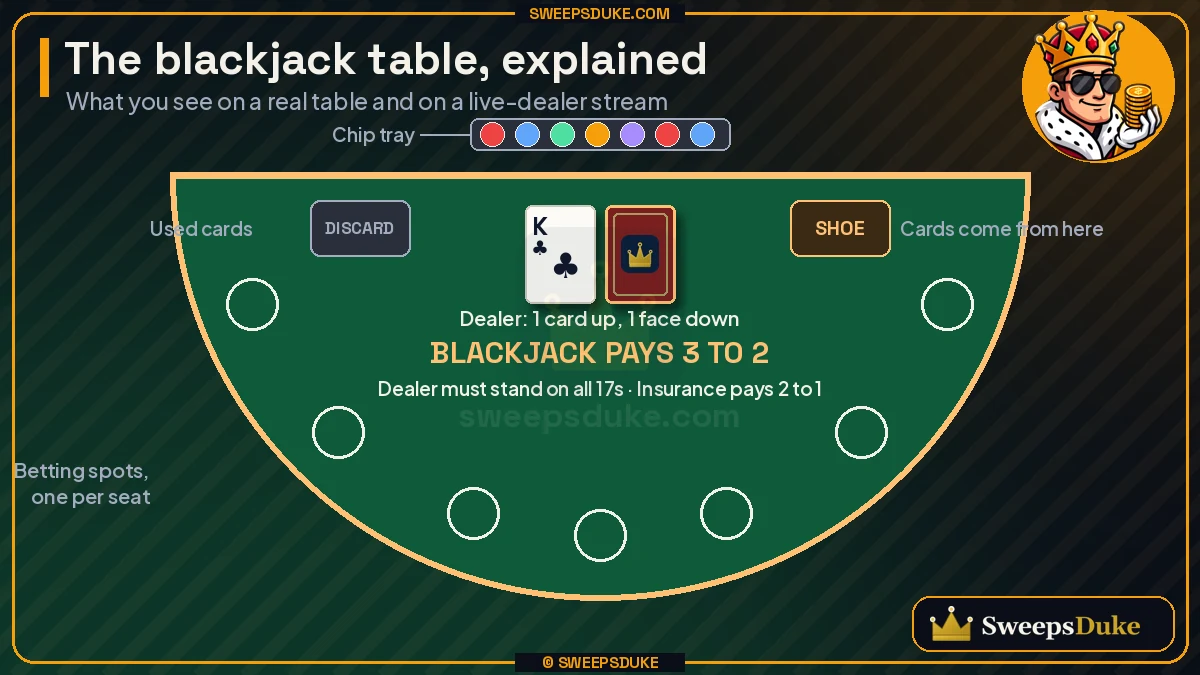
A blackjack table is a half-circle. The dealer stands on the straight side with the chip tray, the shoe the cards come from and a discard tray for used cards. Players sit around the curve, each with a betting spot. Online and live-dealer games show the same layout on screen, with buttons instead of hand signals.
The most important thing on the table is the small print on the felt or in the game's info panel. Blackjack rules vary a little from game to game, and those small differences change the right play and the house edge. Everything on this page, including the chart and every number, assumes these rules:
| Rule | This guide assumes |
|---|---|
| Decks | 6 |
| Soft 17 | Dealer stands on all 17s (S17) |
| Blackjack payout | 3 to 2 |
| Doubling | Any first two cards, including after a split (DAS) |
| Splitting | Up to 4 hands; split Aces get one card each |
| Dealer peek | Yes, the dealer checks for blackjack with an Ace or 10 showing |
| Surrender | Not offered |
| Insurance | Offered, pays 2 to 1 |
That's a very common setup for online RNG and live-dealer blackjack. If your game is different, most of this guide still applies, and the next step shows which differences matter.
Step 1: Pick a table and check the rules
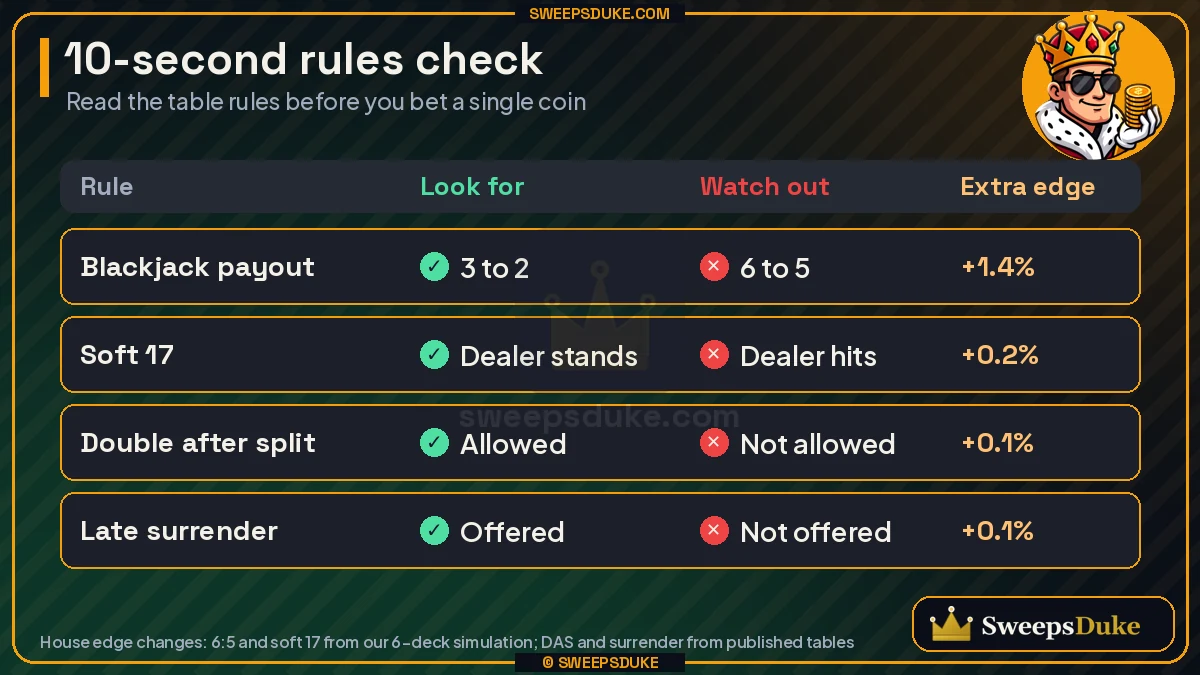
Before you place a single coin, take ten seconds to read the rules. Four lines tell you almost everything:
| Look at | You want | Watch out for | What the bad version adds to the house edge |
|---|---|---|---|
| Blackjack payout | 3 to 2 | 6 to 5 | About 1.4% |
| Soft 17 | Dealer stands | Dealer hits (H17) | About 0.2% |
| Double after split | Allowed | Not allowed | About 0.1% |
| Late surrender | Offered | Not offered | About 0.1% |
The payout is the big one. On a 10-coin bet, a blackjack pays 15 at a 3:2 table and only 12 at a 6:5 table. You'll get a blackjack about once every 21 hands, so that missing 3 coins adds up fast. If the table says 6:5, just pick another one. None of the other rules make up for it.
The number of decks matters less than people think. Fewer decks help you a little, but the payout and soft-17 rules matter more.
Step 2: Choose your coins and place a bet
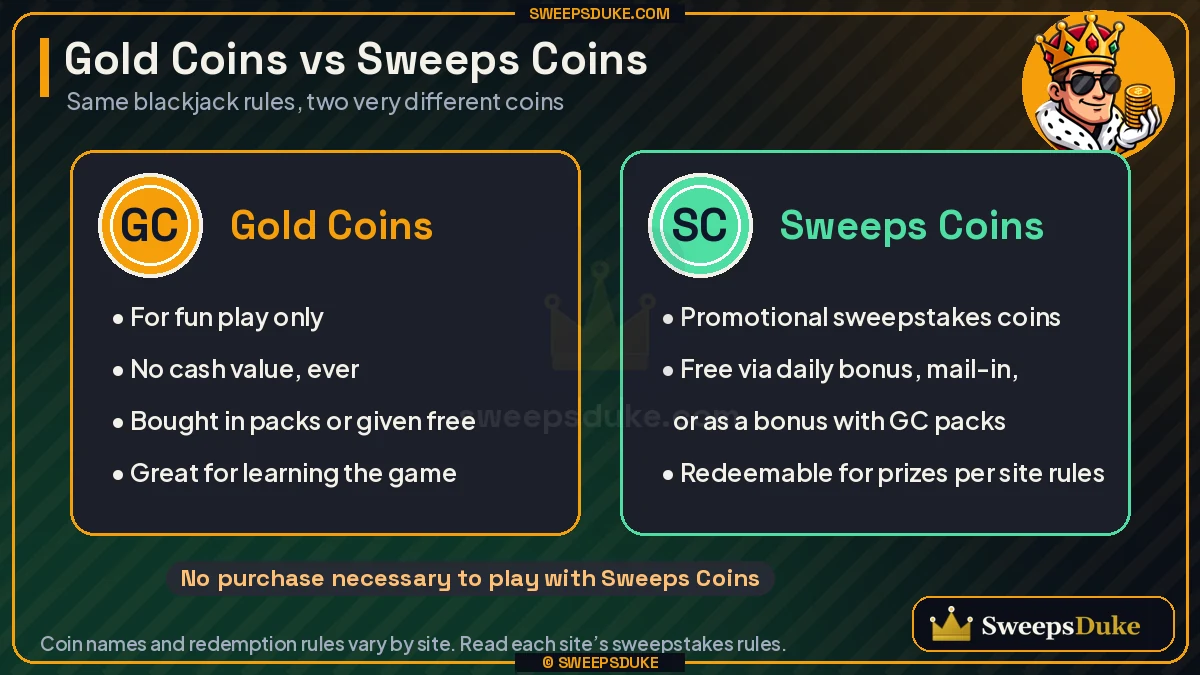
At an online casino you tap a chip value, then tap the betting spot. At a sweepstakes casino there's one extra check: which coin are you playing?
- Gold Coins (GC) are for fun play only. They have no cash value. You get them free or buy them in packs, and they're the right coin for learning.
- Sweeps Coins (SC) are promotional coins. You get them free through things like daily bonuses and mail-in requests, or as a bonus with some Gold Coin packs. Under each site's sweepstakes rules, SC you've played through can be redeemed for prizes.
No purchase is ever necessary to play with Sweeps Coins. The blackjack rules are the same whichever coin you use, but the toggle is easy to miss, so check it every time you sit down.
Two more things to look at before you rely on Sweeps Coin blackjack:
- Playthrough. Many sites ask you to play SC through at least once before you can redeem it, and some don't count table games like blackjack in full. Read the site's terms.
- Table limits. Know the minimum and maximum bet before you start, so you can size your bets for a whole session, not just a few hands.
Sweepstakes casinos are 18+ at minimum, and many are 21+. They're also not available in every state, so check our state-by-state restrictions guide and play only where you're allowed to.
Step 3: The deal, and what counts as blackjack
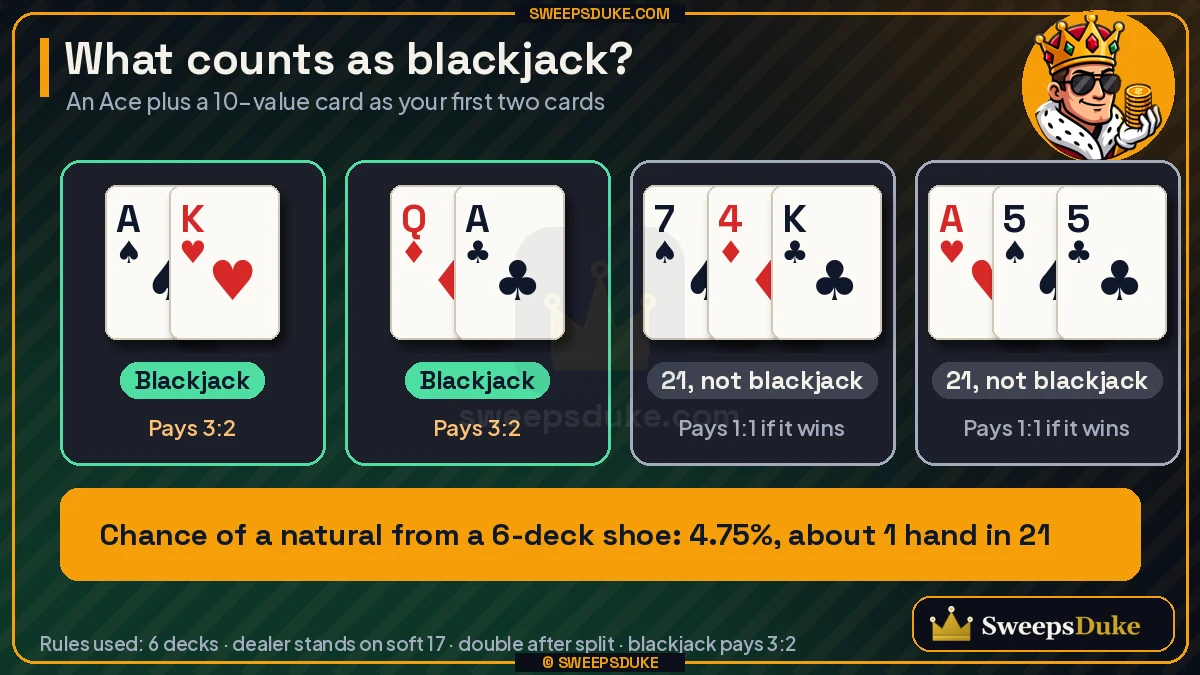
Once bets are in, everyone gets two cards. Yours are face up. The dealer gets one face up (the upcard) and one face down (the hole card). In most European-style games the dealer takes the second card later, but the play works the same way.
A blackjack, or natural, is an Ace plus any 10-value card as your first two cards: A♠ K♥, Q♦ A♣, A♥ 10♠ and so on. It's the best hand in the game and pays 3 to 2 unless the dealer also has one, in which case it's a push.
A 21 made with three or more cards (7♠ 4♦ K♣, or A♥ 5♠ 5♣) is a great hand, but it isn't blackjack. It wins at 1 to 1 if the dealer doesn't also make 21. An Ace and a 10 after a split also counts as a plain 21, not blackjack.
From a 6-deck shoe, the chance of being dealt a natural is 4.75%, about one hand in 21.
Step 4: The dealer peek and the insurance offer
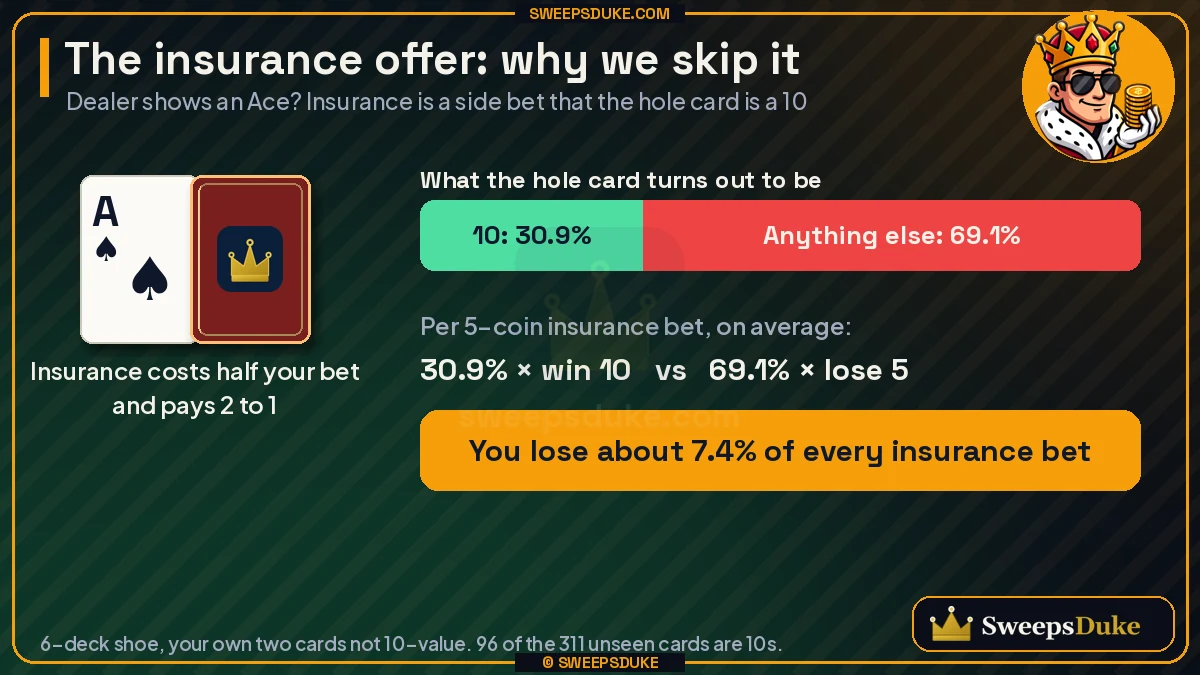
If the dealer's upcard is an Ace or a 10-value card, they check the hole card for blackjack before anyone plays. If they have it, the round ends at once: you lose your bet unless you also have blackjack, which pushes. The good news is that you never lose a double or split bet to a dealer blackjack in a peek game.
When the upcard is an Ace, you'll first be offered insurance. It's a side bet of up to half your main bet that pays 2 to 1 if the hole card is a 10.
Here's why it's a bad deal. With six decks and no 10s in your own hand, 96 of the 311 cards you can't see are 10-value. That's 30.9%. So on a 5-coin insurance bet:
- 30.9% of the time you win 10.
- 69.1% of the time you lose 5.
On average that comes to a loss of about 7.4% of every insurance bet. "Even money" on your own blackjack is the same bet in disguise, so turn that down as well. Just tap "No".
Step 5: Your turn: hit, stand, double, split or surrender
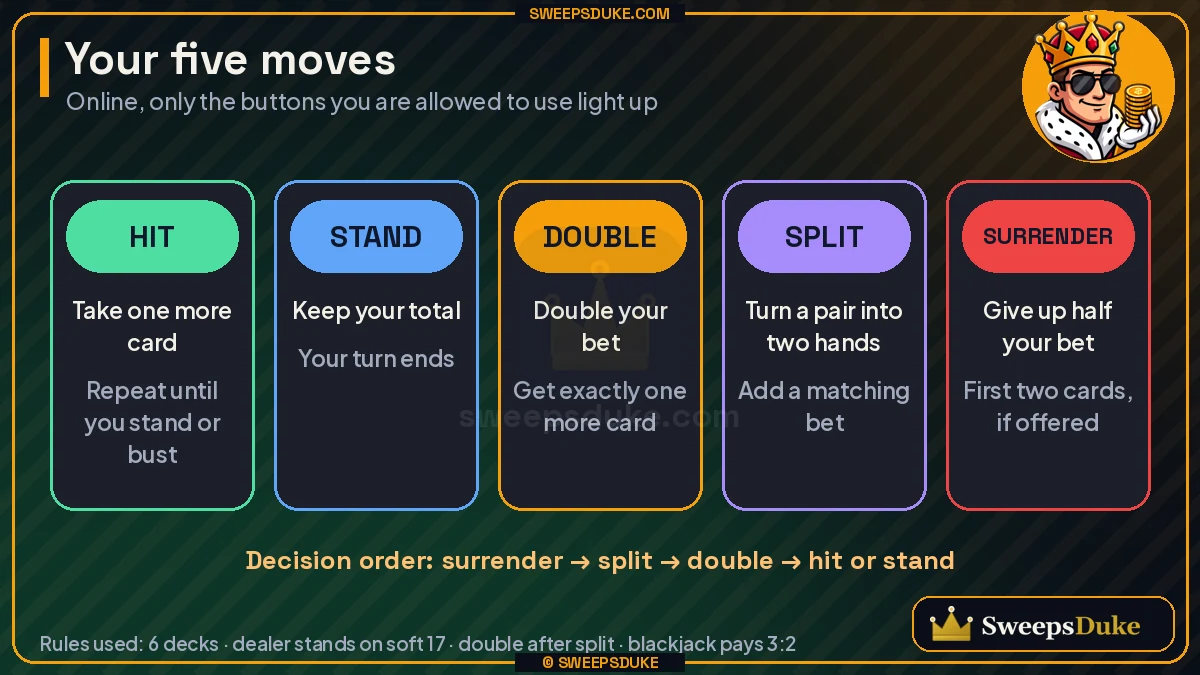
Now the decisions are yours. Online, only the buttons you're allowed to use light up.
| Move | What happens | When you can use it |
|---|---|---|
| Hit | Take one more card | Any time, until you stand or bust |
| Stand | Keep your total; your turn ends | Any time |
| Double down | Add a bet equal to your first one and get exactly one more card | Usually your first two cards only |
| Split | Turn a pair into two hands, each with its own bet | First two cards of the same rank |
| Surrender | Give up half your bet and end the hand | First two cards only, where offered |
Think about them in this order: surrender (if the table offers it), then split, then double, then hit or stand. Once you've hit, doubling and splitting are off the table.
Hit and stand
Hit when your total is low enough that a card can't hurt, or when standing would probably lose anyway. With 11 or less you can't bust, so you always take a card (or double). On hard 17 or more you always stand.
The tricky zone is 12 to 16, where one card can bust you. Here's how often a single hit busts each total:
| Your hard total | Chance one card busts you |
|---|---|
| 12 | 30.8% |
| 13 | 38.5% |
| 14 | 46.2% |
| 15 | 53.8% |
| 16 | 61.5% |
That looks scary, but against a dealer 7 or higher, standing on 12 to 16 loses even more often. That's why the chart tells you to hit.
Double down
Doubling lets you put more on a hand when you're in a strong spot. The price is that you get exactly one card, whatever it is. Double 9♠ 2♦ (11) and draw a 3, and you're stuck on 14.
The best doubles are 10 and 11 against a weak dealer card, and soft hands (more on those below) against a dealer 3 to 6.
Split
With two cards of the same rank you can split them into two hands. You add a second bet the same size as the first, and each hand gets a new second card. Each hand then plays and pays on its own, so one can win while the other loses.
Two rules to remember forever: always split Aces and 8s, and never split 10s or 5s. Split Aces get one card each and that's it. With double after split allowed, you can double a split hand that turns into 10 or 11.
Surrender
Some tables let you give up half your bet on your first two cards. Ours doesn't, but if yours does, the standard plays are to surrender hard 16 against a 9, 10 or Ace, and hard 15 against a 10.
Hard hands vs soft hands
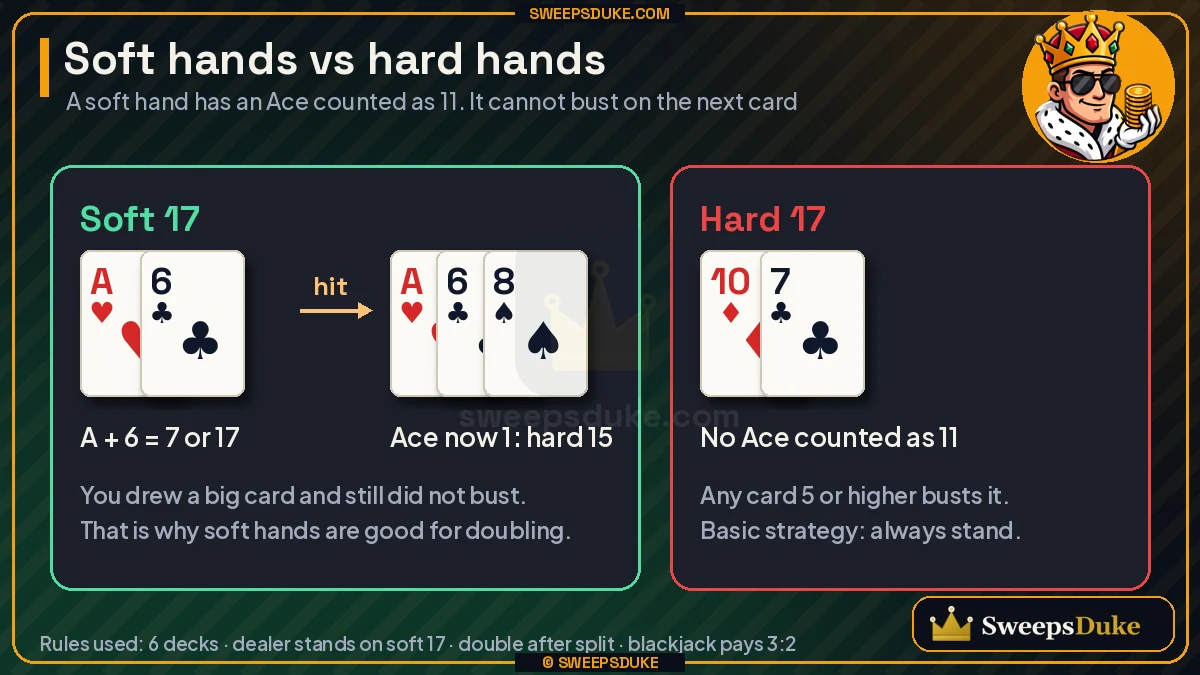
This is the idea that trips up most new players, and it's simple once you see it.
- A soft hand has an Ace being counted as 11. A♥ 6♣ is soft 17: it's 17, or 7 if you need it to be.
- A hard hand has no Ace, or has one that must count as 1. 10♦ 7♣ is hard 17.
A soft hand can't bust on the next card. If you hit A♥ 6♣ and draw an 8♠, the Ace simply drops to 1 and you have hard 15. Hit hard 17 instead, and any card from 5 up busts you.
That's why soft hands get played more aggressively. Strategy says to hit soft 17 and double it against a dealer 3 to 6. It also says to hit soft 18 (A,7) against a 9, 10 or Ace, where standing on 18 loses more often than you'd expect.
Once a soft hand turns hard, play it as a hard hand from then on.
Step 6: How the dealer plays
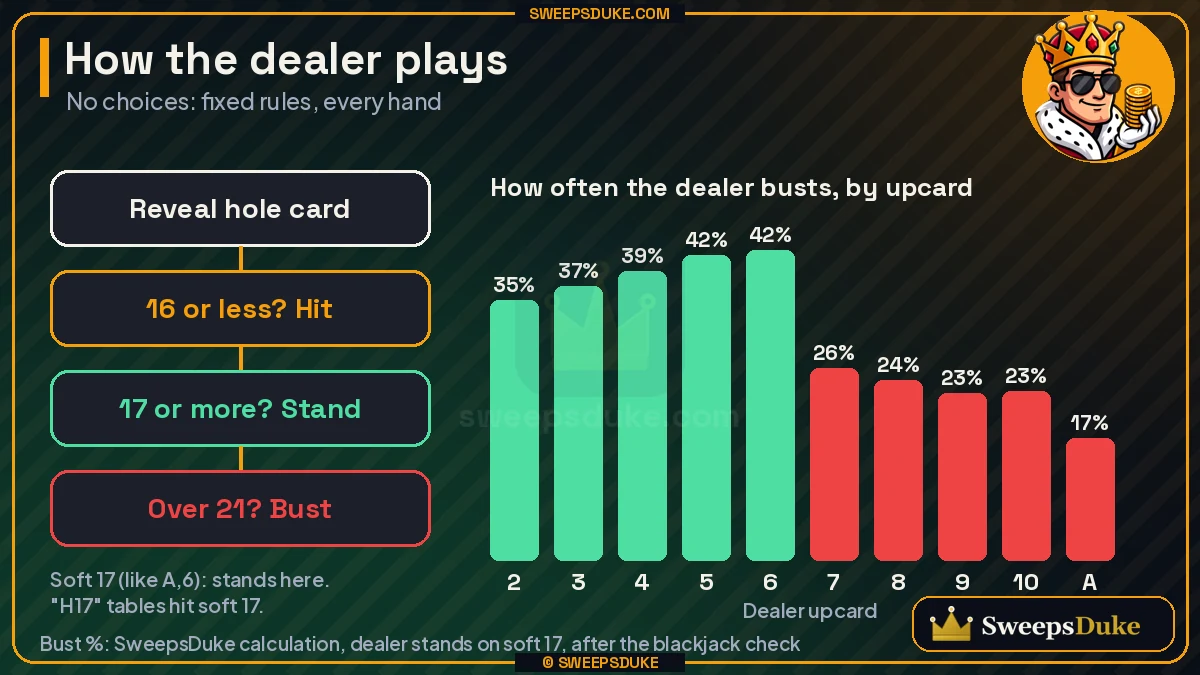
When every player has finished, the dealer turns over the hole card and plays by fixed rules. They don't get to choose:
- 16 or less: hit.
- 17 or more: stand. At our tables that includes soft 17 (like A♦ 6♠). At "H17" tables, the dealer hits soft 17.
- Over 21: bust, and every player still in the hand wins.
If every player has already busted, the dealer doesn't need to draw at all.
Because the dealer must keep hitting stiff hands, a weak upcard is your friend. Here's how often the dealer ends up busting with each upcard, under our rules and after the blackjack check:
| Dealer upcard | 2 | 3 | 4 | 5 | 6 | 7 | 8 | 9 | 10 | A |
|---|---|---|---|---|---|---|---|---|---|---|
| Dealer busts | 35.4% | 37.4% | 39.4% | 41.6% | 42.3% | 26.2% | 24.5% | 22.8% | 23.0% | 16.7% |
That table explains most of basic strategy. Against a 4, 5 or 6 the dealer busts around 40% of the time, so you stand on your stiff hands and double more. Against a 7 or higher they usually make a hand, so you keep drawing.
Step 7: How bets are paid
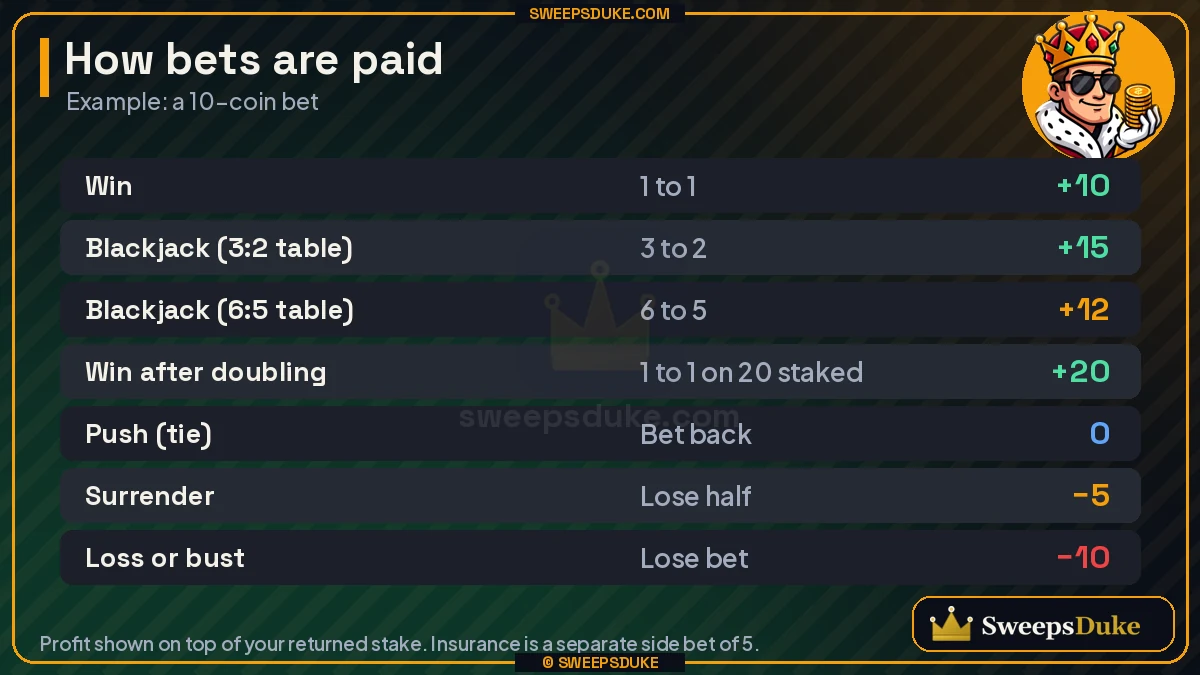
Finally, every hand is compared with the dealer's. Here's what happens on a 10-coin bet. Winnings are on top of getting your original bet back.
| Result | Pays | You get back |
|---|---|---|
| Win | 1 to 1 | Your 10 + 10 |
| Blackjack (3:2 table) | 3 to 2 | Your 10 + 15 |
| Blackjack (6:5 table) | 6 to 5 | Your 10 + 12 |
| Win after doubling (20 staked) | 1 to 1 | Your 20 + 20 |
| Push | Tie | Your 10 |
| Surrender | Half lost | 5 |
| Loss or bust | Lost | 0 |
Online, all of this is automatic: the game settles each hand and updates your balance before the next deal.
Three hands, played out
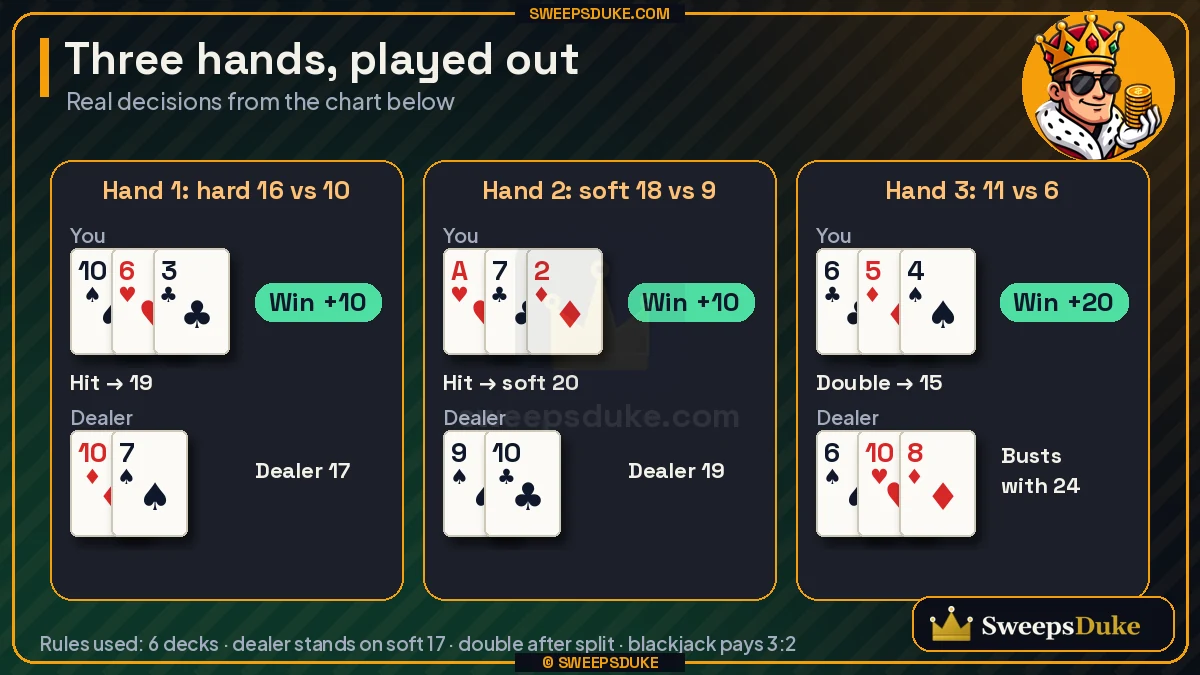
Here's how the steps fit together, using 10-coin bets and the chart in the next section. We picked hands that went well so they're easy to follow. Plenty of the same plays lose, and they're still the right plays.
Hand 1: hard 16 against a dealer 10
You have 10♠ 6♥ (hard 16). The dealer shows 10♦ and peeks: no blackjack.
- Hard 16 against a 10 is the worst spot in the game. The dealer will often finish on 17 or more, so standing usually loses. With no surrender on this table, the chart says hit.
- You draw 3♣ for 19 and stand.
- The dealer turns over 7♠ for 17 and must stand. Your 19 wins: +10.
Hand 2: soft 18 against a dealer 9
You have A♥ 7♣ (soft 18). The dealer shows 9♠.
- Most people stand on 18 without thinking. Against a 9 that's a mistake. The dealer finishes on 19 or better often enough that soft 18 loses on average, and you can't bust with one card. The chart says hit.
- You draw 2♦ for soft 20 and stand.
- The dealer turns over 10♣ for 19. Your 20 wins: +10.
Hand 3: 11 against a dealer 6
You have 6♣ 5♦ (11). The dealer shows 6♠, their weakest upcard.
- This is the classic double. You add another 10 coins and take exactly one card.
- You draw 4♠ and are stuck on 15. Not great, but the dealer is the one in trouble.
- The dealer turns over 10♥ for 16, must hit, and draws 8♦ for 24. Bust. Your doubled bet wins: +20.
Bonus: splitting 8s against a 10
You have 8♠ 8♦ against a dealer 10♣. Playing it as hard 16 is miserable, so you split into two hands with 10 coins each.
- Hand A gets 3♥ for 11. Double after split is allowed and 11 against a 10 is a double, so you add 10 more and draw 9♣ for 20.
- Hand B gets 10♠ for 18. You stand.
- The dealer has 10♣ 7♥ for 17. Hand A (20 coins staked) wins 20, and Hand B wins 10: +30 in total.
Splitting 8s against a 10 doesn't usually win. It just loses less than playing 16 does, about 5% of your bet less each time on average.
A starter strategy chart
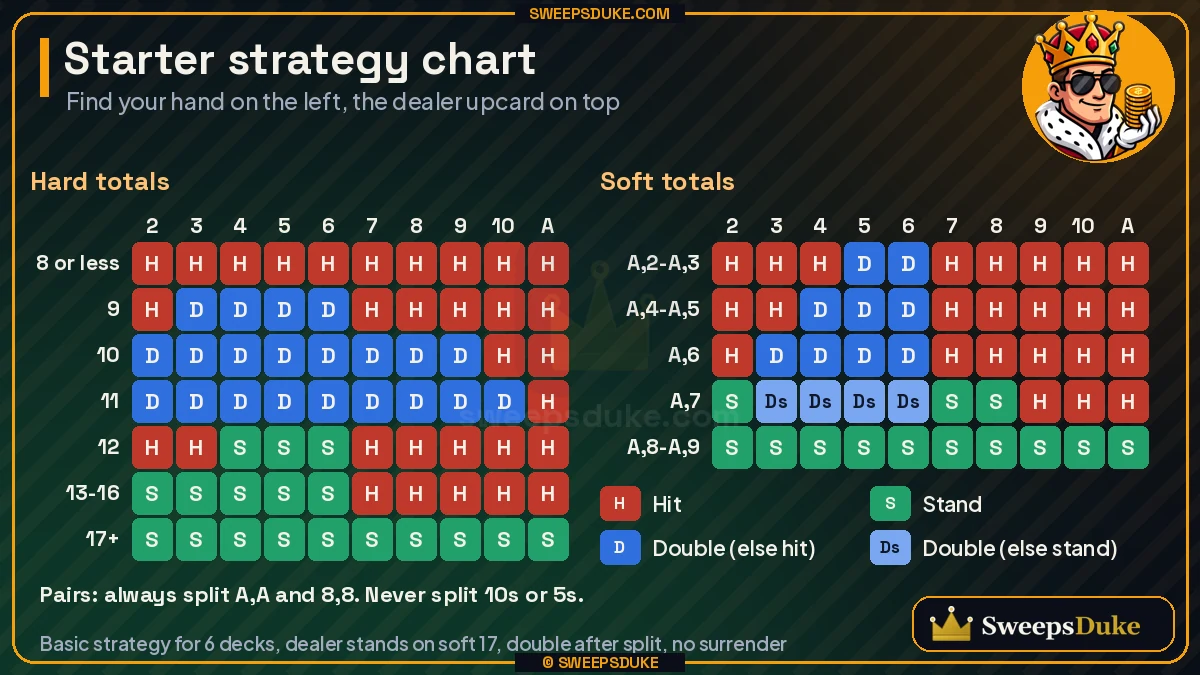
Basic strategy is the mathematically best play for every hand against every dealer upcard. You don't have to memorise it on day one. Online, keep it open next to the game.
To read it, find your hand on the left and the dealer's upcard along the top. "D" means double if you're allowed, otherwise hit. "Ds" means double if you're allowed, otherwise stand.
Hard totals
| Your hand | 2 | 3 | 4 | 5 | 6 | 7 | 8 | 9 | 10 | A |
|---|---|---|---|---|---|---|---|---|---|---|
| 8 or less | H | H | H | H | H | H | H | H | H | H |
| 9 | H | D | D | D | D | H | H | H | H | H |
| 10 | D | D | D | D | D | D | D | D | H | H |
| 11 | D | D | D | D | D | D | D | D | D | H |
| 12 | H | H | S | S | S | H | H | H | H | H |
| 13 to 16 | S | S | S | S | S | H | H | H | H | H |
| 17+ | S | S | S | S | S | S | S | S | S | S |
Soft totals
| Your hand | 2 | 3 | 4 | 5 | 6 | 7 | 8 | 9 | 10 | A |
|---|---|---|---|---|---|---|---|---|---|---|
| A,2 or A,3 | H | H | H | D | D | H | H | H | H | H |
| A,4 or A,5 | H | H | D | D | D | H | H | H | H | H |
| A,6 | H | D | D | D | D | H | H | H | H | H |
| A,7 | S | Ds | Ds | Ds | Ds | S | S | H | H | H |
| A,8 or A,9 | S | S | S | S | S | S | S | S | S | S |
Pairs (with double after split)
| Your pair | Split against | Otherwise |
|---|---|---|
| A,A | Everything | — |
| 8,8 | Everything | — |
| 9,9 | 2 to 6, 8, 9 | Stand against 7, 10, A |
| 7,7 | 2 to 7 | Hit |
| 6,6 | 2 to 6 | Hit |
| 4,4 | 5 and 6 | Hit |
| 2,2 and 3,3 | 2 to 7 | Hit |
| 5,5 | Never | Play as hard 10 |
| 10,10 | Never | Stand on 20 |
If your table has different rules, the chart changes a little. If the dealer hits soft 17, for example, you also double 11 against an Ace and double A,7 against a 2. Our basic strategy chart has versions for the common rule sets.
Beginner mistakes that cost the most
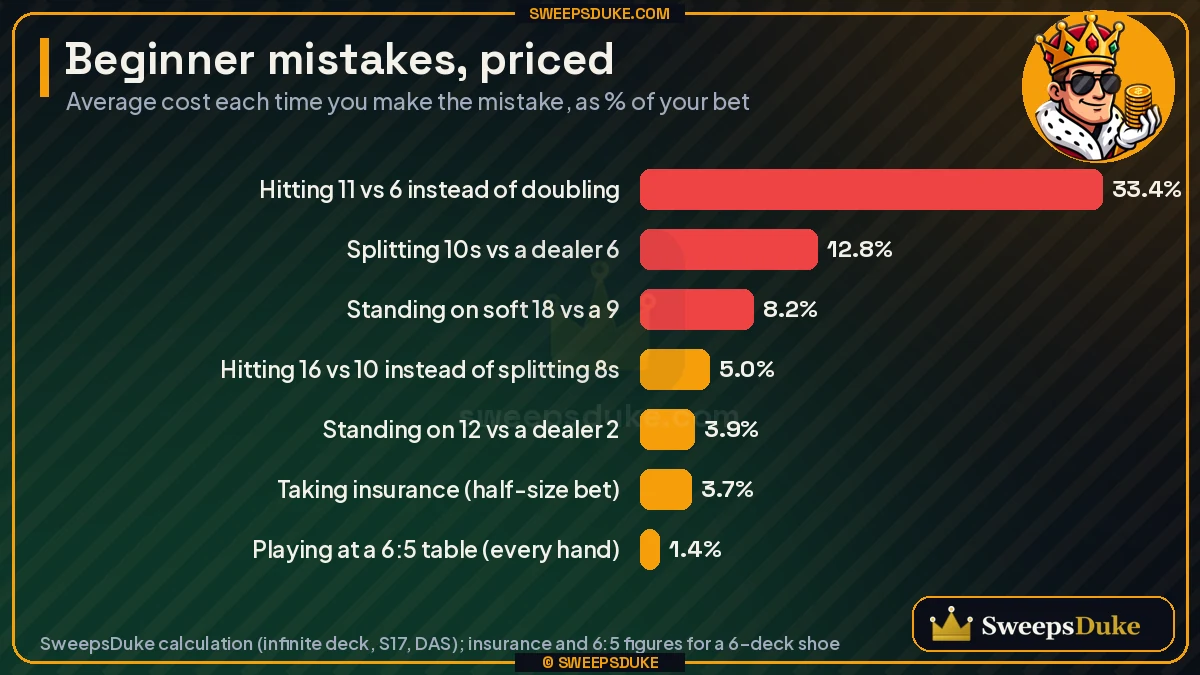
Every mistake has a price. Here's roughly what the common ones cost, on average, each time you make them, as a share of your original bet:
| Mistake | What it costs each time | The right play |
|---|---|---|
| Just hitting 11 against a 6 | About 33% of your bet | Double |
| Splitting 10s against a 6 | About 13% | Stand on 20 |
| Standing on soft 18 against a 9 | About 8% | Hit |
| Playing 8,8 as 16 against a 10 | About 5% | Split |
| Standing on 12 against a 2 | About 4% | Hit |
| Taking insurance (half-size) | About 3.7% of your main bet | Decline |
| Playing at a 6:5 table | About 1.4% of every bet, every hand | Find a 3:2 table |
The biggest one is the one most people never notice: not doubling when you should. Doubling 11 against a 6 is one of the best spots in blackjack, and just hitting throws away a third of a bet's worth of value each time.
A few other habits worth dropping:
- "Never bust" play. Standing on every 12 or more feels safe, but it turns most of your stiff hands against a 7 to Ace into losers.
- Copying the dealer. Hitting to 17 like the dealer does gives you no doubles and no splits, and you still bust first. In our simulation it raised the house edge from about 0.4% to about 5.7%.
- Chasing losses. No streak makes the next card more likely to be a 10. Each hand is its own event.
Your first-session game plan
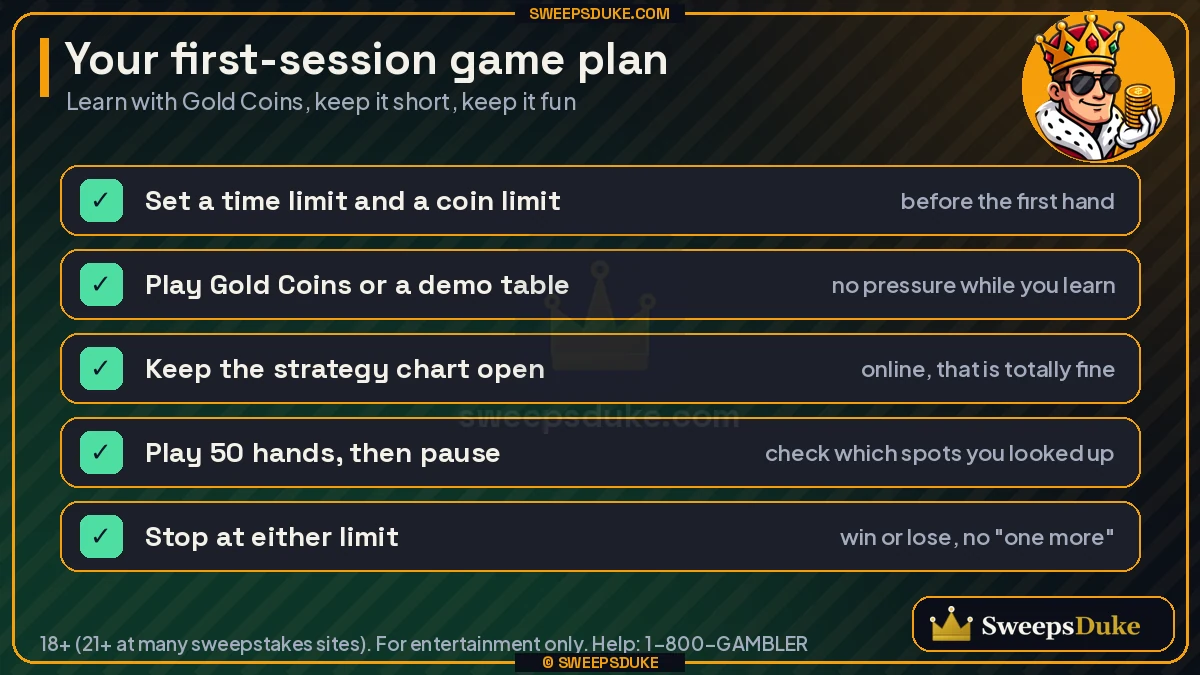
The quickest way to get comfortable is a short, relaxed session at a low stake:
- Set a time limit and a coin limit before your first hand, and stick to whichever comes first.
- Play Gold Coins or a demo table. There's no pressure while you learn, and the cards behave the same way.
- Keep the chart open. Online, nobody minds. Say each decision out loud if it helps.
- Play 50 hands, then pause. Notice which spots you had to look up. For most people it's soft hands and pairs.
- Practise those spots with our strategy trainer for 10 minutes.
- Stop at either limit, win or lose. "One more hand" is how short sessions turn into long ones.
Once the chart feels natural, have a look at hand signals for live-dealer tables and our guide to sweepstakes blackjack.
Blackjack FAQ
How often do you win at blackjack?
Playing by the chart under the rules on this page, you win about 43% of rounds, lose about 48% and push about 9%. You lose more rounds than you win, but blackjacks paying 3:2 and well-timed doubles and splits win you extra. That brings the house edge down to about 0.4% of what you bet over the long run. That's an average over a huge number of hands, not a forecast for any one session.
Is blackjack the same at sweepstakes casinos?
The rules and the strategy are the same. What's different is the currency: you play with Gold Coins for fun or with Sweeps Coins, which can be redeemed for prizes under each site's rules. Check the coin toggle, the table rules and whether blackjack counts toward Sweeps Coin playthrough before you rely on it.
Does the dealer hit or stand on soft 17?
It depends on the table, and it's printed in the rules. This guide uses tables where the dealer stands on all 17s, which is slightly better for you than tables where the dealer hits soft 17 (about 0.2% difference).
Can I use a strategy chart while I play?
Online, yes. Nobody can see your screen, and the game doesn't care. At a land-based table a small card is usually tolerated, but ask if you're not sure.
What happens if the dealer and I both have blackjack?
It's a push. You get your bet back and nobody wins.
Should I take even money when I have blackjack and the dealer shows an Ace?
No. Even money is insurance under a different name, and insurance loses about 7.4% of what you put on it in a 6-deck game.
Is it better to play one hand or several?
For learning, one. Playing more hands at once doesn't change the odds on each hand. It just means more coins on the table per round.
Can strategy or card counting guarantee wins?
No. Basic strategy lowers the house edge but doesn't remove it, and online games usually reshuffle so often that counting cards doesn't help. Blackjack is entertainment. Play with coins you're comfortable losing.
The numbers on this page come from our own blackjack calculations for the rules listed above: an exact infinite-deck calculation for dealer outcomes and decision costs, and a 6-deck simulation for the house edge and win, loss and push rates. They line up with the published references in the sources.
18+ (21+ at many sweepstakes sites). Play for fun, not income. Blackjack has a house edge, and no strategy, system or count turns a sweepstakes or casino game into a way to make money. Set a time and spend limit before you start. Need help? Call or text 1-800-GAMBLER or see our responsible gaming page.