



Blackjack Strategy Guide
Blackjack strategy beyond the chart: table rules, bankroll and bet sizing, why betting systems fail, side bets, card counting online, live dealer, all simulated.
On this page
Blackjack strategy is more than the chart. Basic strategy tells you how to play each hand, and it's the biggest single thing you control: it takes the house edge from about 5.7% (copying the dealer) down to about 0.41% on a good 6-deck table. Everything else that people call "strategy" is about the choices around the hands: which table you sit at, how much you bet, which extra bets you skip, and what you can and can't expect over a session.
This guide covers all of those, with numbers. We ran 800 million simulated rounds per playing style and rule set, 2 million simulated sessions per betting system, and exact calculations for the common side bets. You'll see what table rules are worth, how big swings get, how often a session ends ahead, why no betting system changes the house edge, what card counting does in a dealt shoe and why it does nothing online, and how all of it fits sweepstakes play with Gold Coins and Sweeps Coins.
Affiliate disclosure: SweepsDuke may earn a commission if you sign up through some links on this site. That never changes our charts, math or verdicts. How we make money.
What blackjack strategy can and can't do
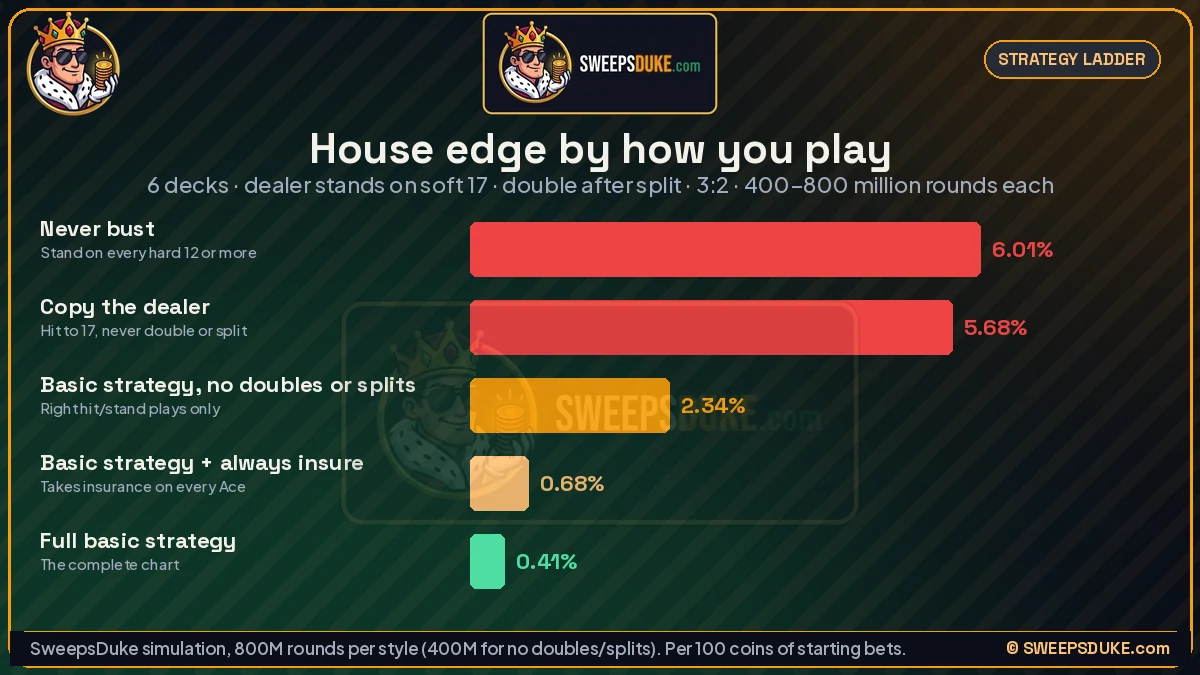
Strategy decides how much the game costs you on average. It doesn't decide whether you win tonight. Here is the same 6-deck table (dealer stands on soft 17, double after split allowed, blackjack pays 3:2) played five ways, 800 million rounds each (400 million for the no-doubles style):
| How you play | House edge (per 100 coins of starting bets) |
|---|---|
| Never bust: stand on every hard 12 or more, hit soft hands up to soft 17 | 6.01 |
| Copy the dealer: hit to 17, never double or split | 5.68 |
| Basic strategy hit/stand plays only, no doubles or splits | 2.34 |
| Full basic strategy, but take insurance every time the dealer shows an Ace | 0.68 |
| Full basic strategy | 0.41 |
Two popular "simple" styles are the most expensive. Copying the dealer sounds safe, because the dealer has the edge and you're playing the dealer's way. The catch is order: you act first, so when you both bust, you've already lost. If you play like the dealer you bust about as often as the dealer does, roughly 29% of hands, so the two of you both bust in something like 8 rounds in 100 (0.29 × 0.29), and you lose every one of them. The 3:2 blackjack bonus hands back only about 2.3 coins per 100 (a 4.5% blackjack rate × the extra half bet). That back-of-envelope sum lands near the simulated 5.68%.
Never busting is even worse, at 6.01%. You can't lose by busting, but you give up on every 12 to 16 against a strong dealer upcard, where standing only wins if the dealer busts. Behind a 10 the dealer busts about 23% of the time; behind an Ace about 17% (6 decks, S17, after the dealer has checked for blackjack).
What strategy can't do is make the number negative. At 0.41%, the house still keeps about 41 coins of every 10,000 you bet, on average. Variance (the short-term swings) is far bigger than that edge, so you'll have winning and losing sessions either way. The rest of this guide is about keeping the cost as low as the rules allow and understanding the swings.
Step 1: get basic strategy right
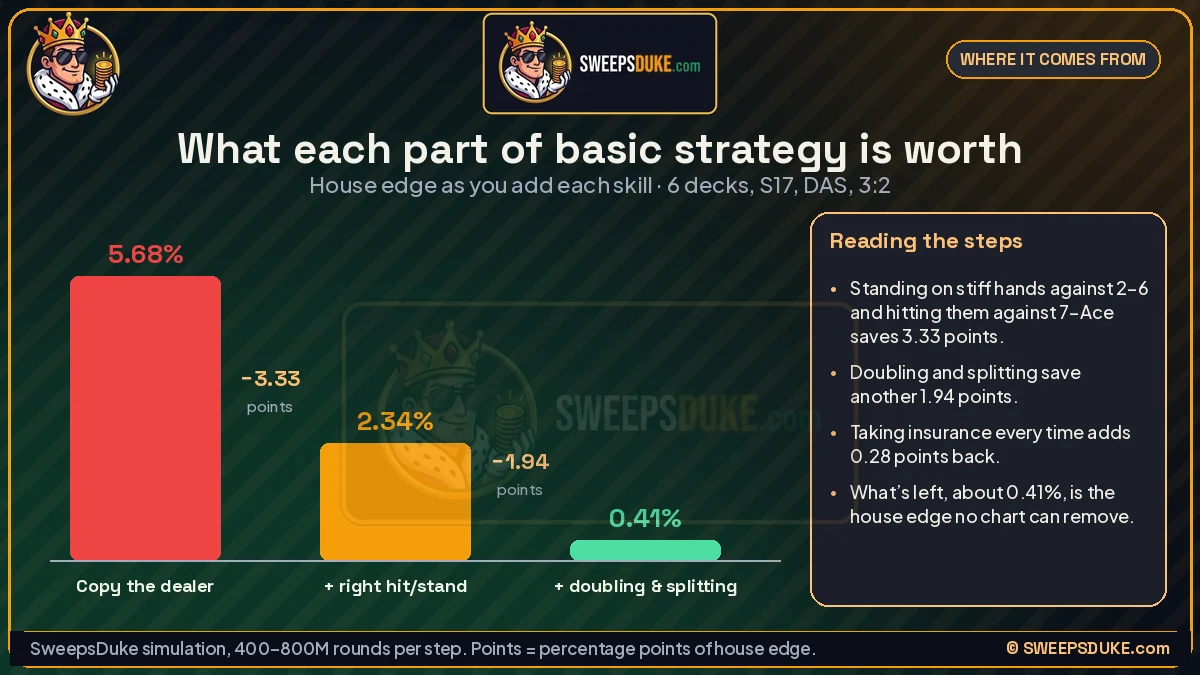
The playing chart is the one part of blackjack strategy with a large, dependable effect on what the game costs you over time. It comes in layers, and the image above shows what each layer is worth in our simulation:
- Correct hitting and standing saves about 3.33 points (5.68% down to 2.34%). This is mostly knowing when to stand on 12 to 16 (dealer shows 2 to 6) and when to hit them (dealer shows 7 to Ace), plus hitting soft hands the dealer would stand on.
- Doubling and splitting saves another 1.94 points (2.34% down to 0.41%). These are the hands where you get more money on the table when you're the favourite: 11 against most cards, 10 against 2 to 9, splitting Aces and 8s, and the soft doubles against 3 to 6.
- Skipping insurance is worth 0.28 points on its own (0.68% with "always insure" versus 0.41%).
The exact chart, the reasoning behind every cell and worked hands are on our basic strategy guide. If you want the charts for a specific rule set (6 decks, double deck, single deck, with or without surrender, dealer hits or stands on soft 17) on one printable page, use the blackjack cheat sheet. This page doesn't repeat them. It assumes you play by the chart and asks what else matters.
Is anything beyond the chart worth learning for the cards themselves? Only a little. Basic strategy uses your total and the dealer's upcard. A "composition-dependent" strategy also looks at which cards make your total. In our 6-deck calculation, 16 against a 10 made of 10-6 is a hit (expected loss 53.47 coins per 100 bet versus 54.10 standing), while 16 made of 4-4-8 is a stand (53.99 versus 54.44 hitting). The difference is under one coin per 100 coins bet on a hand you see a few times an hour. Overall, that kind of refinement is worth a small fraction of a point, so get the standard chart perfect first.
Pick the table: rules matter more than any trick
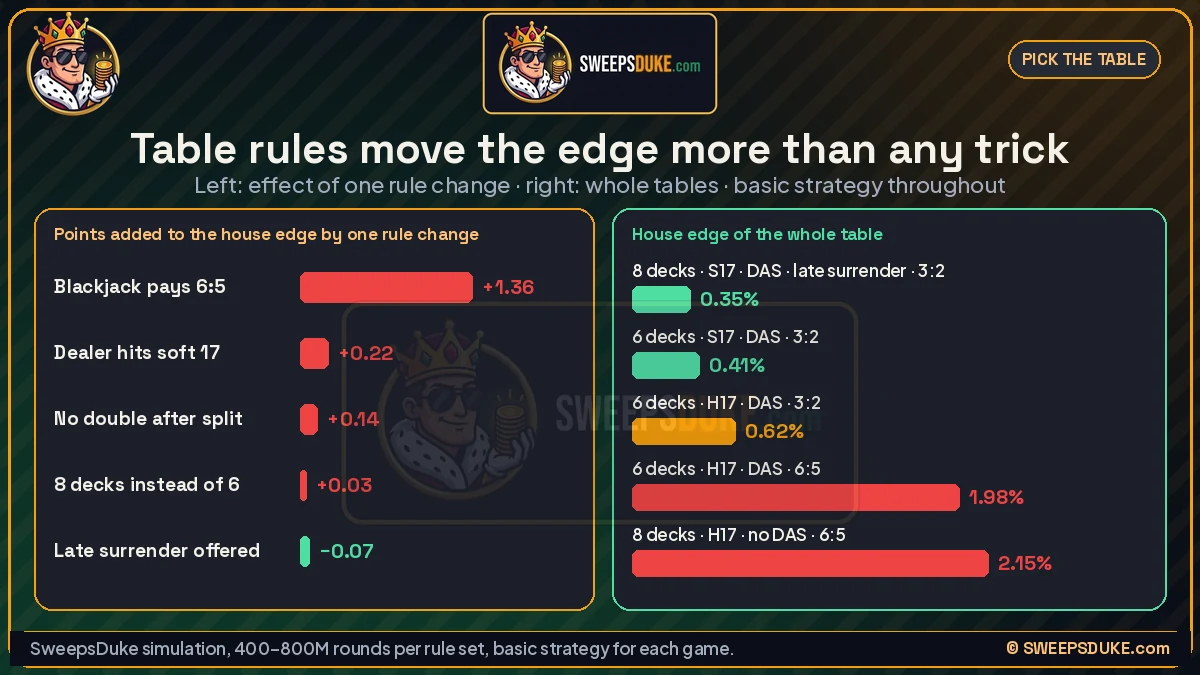
Before you play a hand, the rules have already set your cost. Changing one rule from our standard table (each measured with 800 million rounds of correct basic strategy for that game):
| Rule change | Effect on house edge (points) | Why |
|---|---|---|
| Blackjack pays 6:5 instead of 3:2 | +1.36 | You get a blackjack about 4.53% of rounds (dealer doesn't also have one). Each pays 0.3 bets less: 4.53 × 0.3 = 1.36. Our exact calculation agrees. |
| Dealer hits soft 17 (H17) | +0.22 | The dealer improves a soft 17 more often than busting it, so fewer dealer 17s you can beat. |
| No double after split | +0.14 | Fewer chances to double on 10 or 11 after splitting 2s, 3s, 6s, 7s, 8s or 9s. |
| 8 decks instead of 6 | +0.03 | Each card removed changes the odds slightly less in a bigger shoe; a small effect. |
| Late surrender offered | −0.07 | You can give up half your bet on hands like 16 against 10, losing less than playing them out. |
Our simulated rule effects match the published rule-variation tables to within a few hundredths of a point (see sources). Put the rules together and whole tables range a long way:
| Table | House edge |
|---|---|
| 8 decks, S17, DAS, late surrender, 3:2 | 0.35% |
| 6 decks, S17, DAS, 3:2 | 0.41% |
| 6 decks, H17, DAS, 3:2 | 0.62% |
| 6 decks, H17, DAS, late surrender, 3:2 | 0.54% |
| 6 decks, H17, DAS, 6:5 | 1.98% |
| 8 decks, H17, no DAS, 6:5 | 2.15% |
The gap between the best and worst tables in this list, 1.8 points, is almost as big as the whole value of doubling and splitting. That's why table selection comes second only to the chart. What to check, in order of size:
- Blackjack payout. 3:2 (a 10-coin bet gets 15 for a blackjack) versus 6:5 (12 coins). This is the one rule worth walking away for.
- Soft 17. The table felt or rules screen says "dealer stands on soft 17" or "dealer hits soft 17". Use the matching chart.
- Double after split, surrender, number of decks. Smaller effects, but they decide which chart you use.
Rules are explained one by one on our blackjack rules page, and the house edge guide covers how the percentage is measured.
A worked example: at 10 coins a hand and 100 hands, the expected cost at the 0.41% table is about 4.1 coins of the roughly 1,130 coins you'll bet (doubles and splits add about 13% to your starting bets). At the 8-deck, H17, no-DAS, 6:5 table it's about 21.5 coins per 1,000 coins of starting bets, more than five times as much, for the same cards and the same skill.
Variance: what one round can do
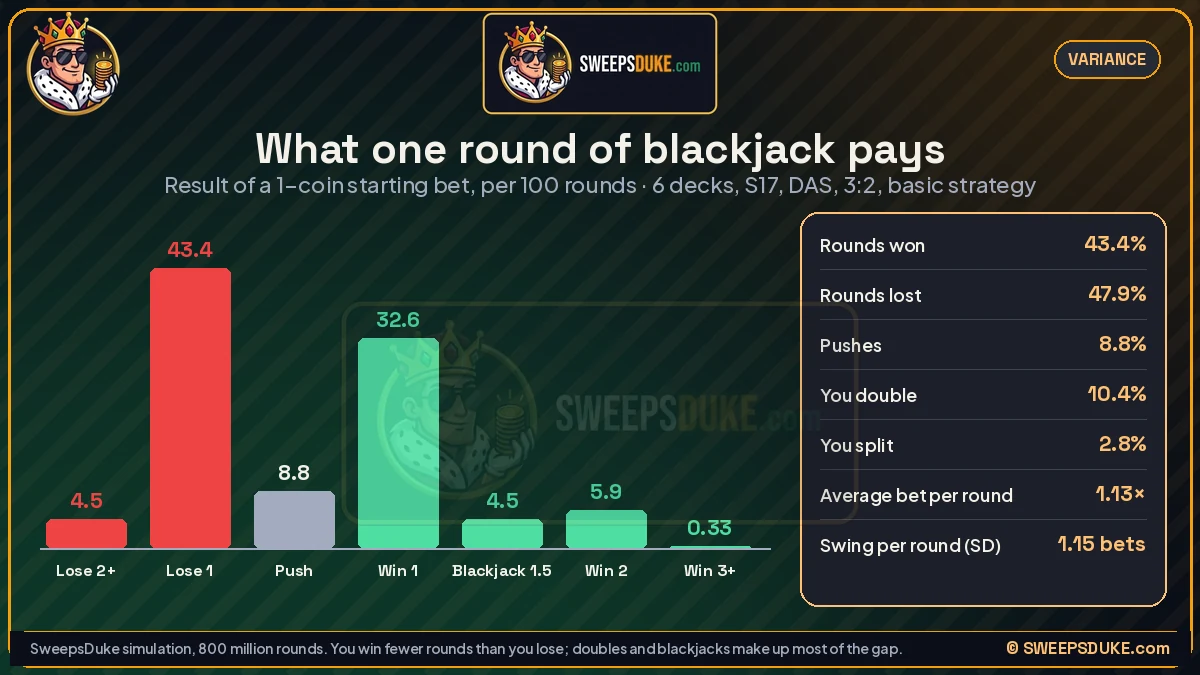
Here's a surprise for many players: with perfect basic strategy you lose more rounds than you win. In our 800-million-round simulation you won 43.4% of rounds, lost 47.9% and pushed 8.8%. The game is still close to even because the wins are bigger on average:
- Blackjacks (4.5% of rounds) pay 1.5 bets, not 1.
- Doubles (you double in 10.4% of rounds) and splits (2.8% of rounds) put more money out when you're the favourite. Wins of 2 bets happen in 5.9 rounds per 100; losses of 2 bets in 4.2.
Per 100 rounds with a 1-coin starting bet, the results looked like this:
| Result of the round | Times per 100 rounds |
|---|---|
| Lose 3 or more bets (splits and doubles going wrong) | 0.26 |
| Lose 2 bets | 4.20 |
| Lose 1 bet | 43.41 |
| Push | 8.78 |
| Win 1 bet | 32.63 |
| Blackjack, win 1.5 bets | 4.53 |
| Win 2 bets | 5.86 |
| Win 3 or more bets | 0.33 |
Two numbers describe the swings. Your average stake per round is 1.13 starting bets, because doubles and splits add money. The standard deviation of one round is about 1.15 starting bets. That's nearly three hundred times the 0.41% edge, which is why short sessions are mostly luck. Over 100 rounds the typical swing is about 11.5 bets (1.15 × √100) either way, against an expected cost of about 0.4 bets.
What this means in practice: a losing streak isn't evidence the game is broken or that you played wrong, and a winning streak isn't a sign you've found something. Judge your play by the chart, not by the last hour's result.
How often a session finishes ahead
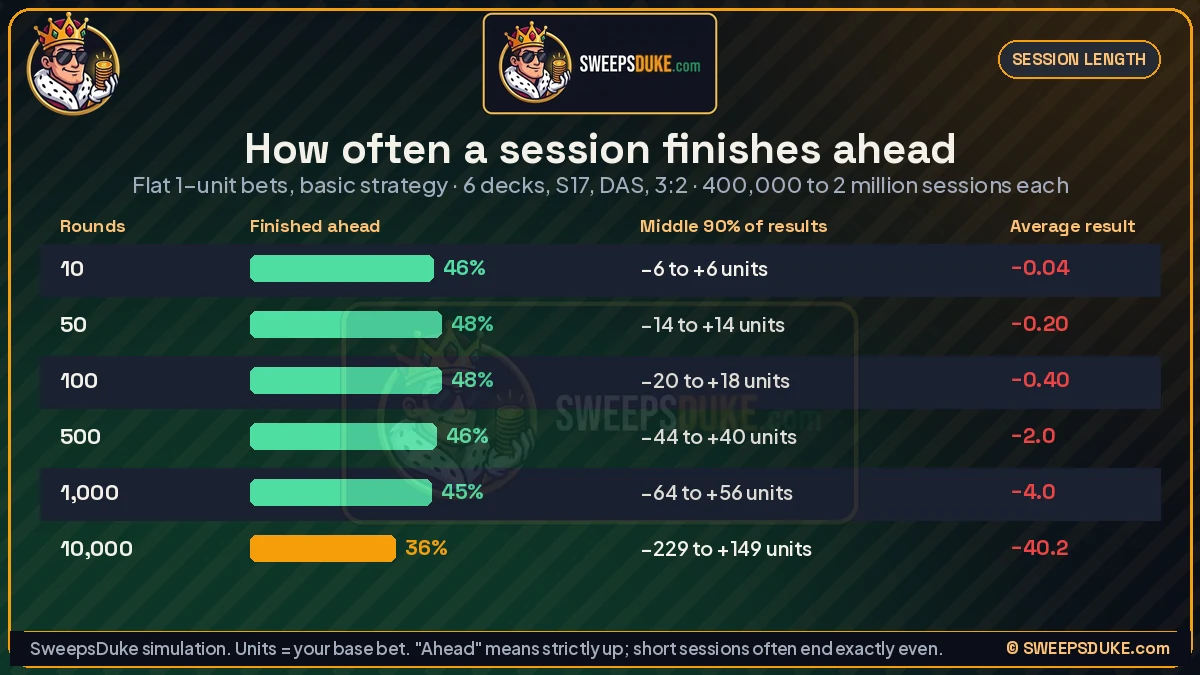
We simulated flat-betting sessions (the same 1-unit starting bet every round, perfect basic strategy) of different lengths, 2 million sessions each (400,000 for the 10,000-round case):
| Rounds | Finished ahead | Middle 90% of results (units) | Average result (units) |
|---|---|---|---|
| 10 | 45.6% | −6 to +6 | −0.04 |
| 50 | 47.7% | −13.5 to +13.5 | −0.20 |
| 100 | 47.7% | −19.5 to +18.5 | −0.40 |
| 500 | 46.4% | −44.5 to +40.5 | −2.05 |
| 1,000 | 45.3% | −64 to +56 | −4.01 |
| 10,000 | 36.2% | −229 to +149 | −40.2 |
"Ahead" means strictly up. Short sessions often end exactly even, which is why 10 rounds shows only 45.6% ahead even though the average result is almost zero.
The pattern is the important part. Over a session of up to a few hundred rounds, you'll finish ahead a bit less than half the time. As rounds pile up, the small edge slowly wins over the swings: by 10,000 rounds only about a third of sessions are ahead, and the average result is about 40 units down, which is the 0.41% edge × 10,000 rounds × 1 unit, give or take the doubles and splits.
This is the honest answer to "what's the best strategy to win at blackjack": over a short session, nothing gets your chance of finishing ahead much above 47%, and over a long enough time, the house edge shows up. Basic strategy keeps the cost of that time as low as possible.
Bankroll and bet sizing
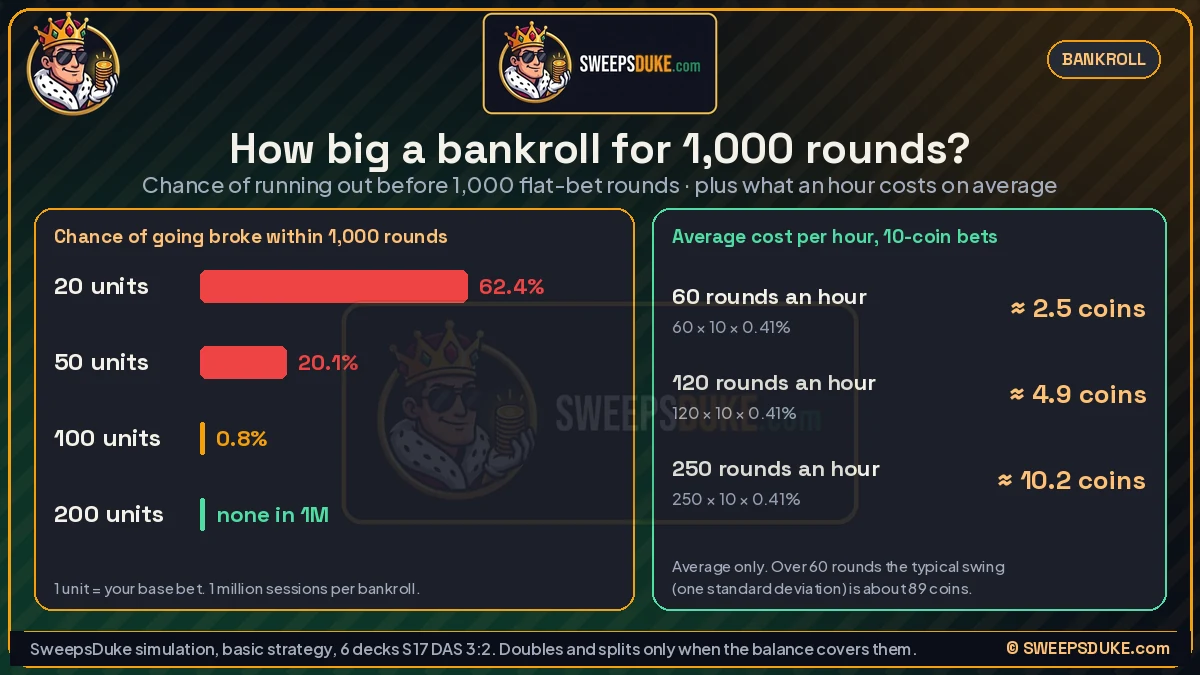
Your bankroll is the coins you've set aside for a session, and a unit is your base bet. Their ratio decides how likely you are to run out before you're done. We ran 1 million flat-betting sessions of up to 1,000 rounds for each bankroll, stopping a session if the coins ran out (doubles and splits were only allowed if the balance covered them):
| Bankroll | Ran out within 1,000 rounds |
|---|---|
| 20 units | 62.4% |
| 50 units | 20.1% |
| 100 units | 0.83% |
| 200 units | 0 in 1 million sessions |
So with a 1,000-coin limit and 1,000 rounds in mind, a 50-coin base bet (20 units) runs out in most sessions, a 20-coin bet (50 units) in about one in five, and a 10-coin bet (100 units) rarely. That's the reasoning behind a simple rule of thumb: make your base bet 1/50 to 1/100 of what you're prepared to spend in the session. It doesn't change the house edge. It changes how long your coins last and how much of a session is played rather than spent waiting to be over.
Your average cost depends on how much you bet in total, not on the size of your bankroll. At 10 coins a hand and a 0.41% edge:
| Pace | Average cost per hour |
|---|---|
| 60 rounds an hour | about 2.5 coins |
| 120 rounds an hour | about 4.9 coins |
| 250 rounds an hour | about 10.2 coins |
Those are averages, and a single hour moves much more than that: over 60 rounds at 10 coins, one standard deviation is about 89 coins (10 × 1.15 × √60). Pace varies a lot by game. Software blackjack can deal as fast as you click; live-dealer tables are much slower. Faster play doesn't change the edge per hand, but it multiplies the hourly cost.
Three bet-sizing points the numbers support:
- Raising your bet to "win it back" doesn't change the edge. It only makes the next loss bigger. The next section shows this with systems built on exactly that idea.
- Bet size doesn't affect the right play. The chart is the same for 1 coin or 1,000. If a hand feels too big to double, the bet was too big for the bankroll.
- Set the limit before you start, in coins and in time, and stop when you hit either. The responsible gaming page has more tools for that.
Why betting systems don't change the house edge
A betting system changes how much you bet based on recent results. Each one rests on the idea that past rounds change future ones, and in blackjack software that reshuffles every round they don't. Even in a dealt shoe, whether you won the last hand says almost nothing about the next one. The cards don't know what you bet.
Every round has the same expected cost per coin bet, so any mix of bet sizes has the same expected cost per coin bet. A system can only change where the results land: many small wins and an occasional disaster, or the other way around.
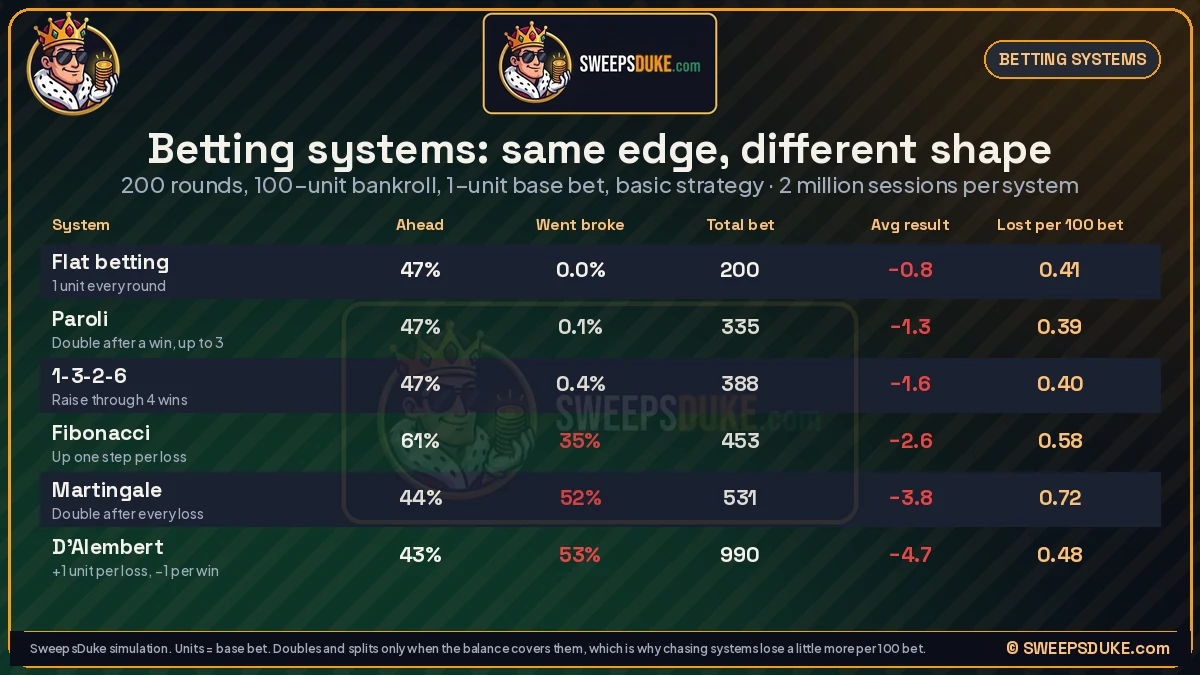
We tested six systems on real simulated blackjack rounds: 200 rounds, a 100-unit bankroll, a 1-unit base bet, basic strategy, 2 million sessions each. A session stopped early if the bankroll fell below 1 unit, and the bet was capped at what was left.
| System | How it bets | Finished ahead | Went broke | Average total bet | Average result | Lost per 100 bet |
|---|---|---|---|---|---|---|
| Flat betting | 1 unit every round | 47.3% | 0% | 200 | −0.82 | 0.41 |
| Paroli | Double after a win, back to 1 after 3 wins or a loss | 47.0% | 0.05% | 335 | −1.31 | 0.39 |
| 1-3-2-6 | 1, 3, 2, 6 units through a 4-win run, back to 1 on a loss | 46.8% | 0.43% | 388 | −1.56 | 0.40 |
| Fibonacci | Next number in 1, 1, 2, 3, 5, 8… after a loss, back two steps after a win | 61.2% | 35.1% | 453 | −2.63 | 0.58 |
| Martingale | Double after every loss, back to 1 after a win | 44.4% | 52.4% | 531 | −3.82 | 0.72 |
| D'Alembert | +1 unit after a loss, −1 after a win | 42.8% | 53.3% | 990 | −4.75 | 0.48 |
What the table shows:
- No system turned the average result positive. Every row is negative. The more a system bets in total, the more it loses in total.
- "Up after wins" systems (Paroli, 1-3-2-6) cost about the same per coin bet as flat betting, 0.39 to 0.41 per 100, the same within simulation noise. They don't help or hurt the edge; they just make the session swingier.
- "Up after losses" systems (Martingale, D'Alembert, Fibonacci) lost more per 100 coins bet: 0.48 to 0.72. That's not because the cards changed. It's because, near the bottom of a bankroll, they can't afford to double or split when the chart says to, so they play some hands worse than the chart. Flat bettors almost never hit that wall.
- Fibonacci finished ahead most often (61%) and still lost on average, because its losing sessions (35% went broke) are far bigger than its winning ones. The median Fibonacci session was +35.5 units; the average was −2.6.
The house edge is per bet. No system turns a series of bets that each lose on average into a total that wins on average. The systems only rearrange the risk.
Martingale up close: many small wins, one big loss
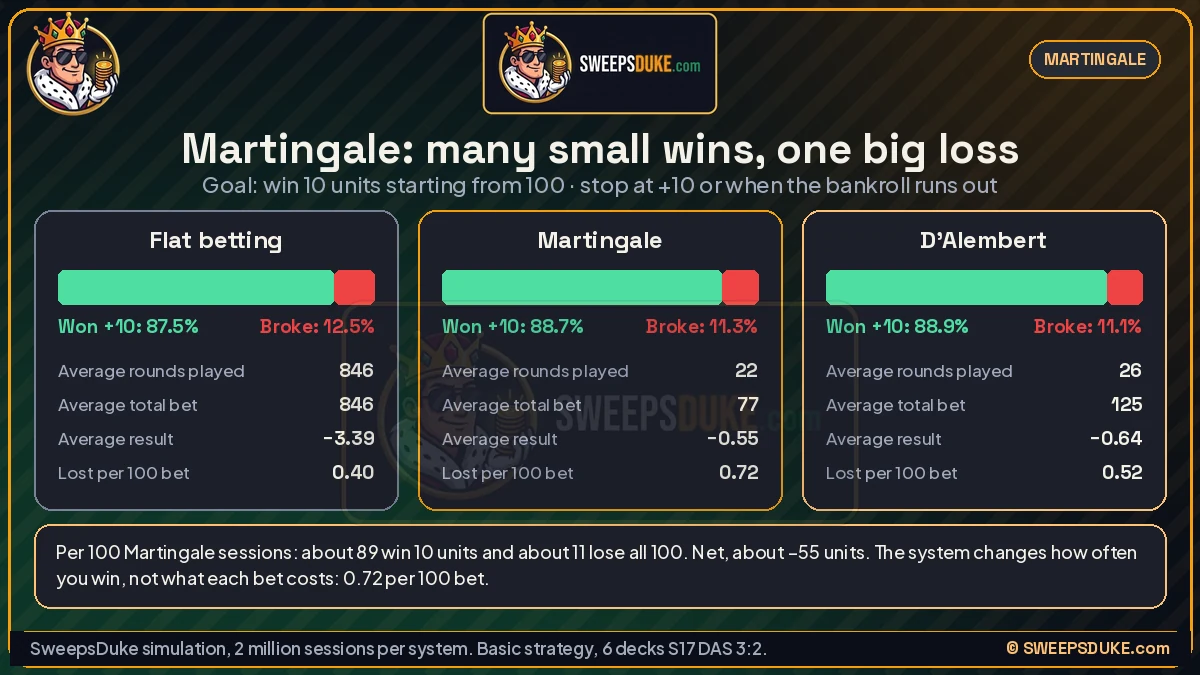
Martingale is the system people ask about most, because it feels unbeatable: double after every loss, and the first win recovers everything plus one unit. Here's what really happens. We gave flat betting, Martingale and D'Alembert the same goal, start with 100 units and stop at +10 or when the bankroll runs out, and ran 2 million sessions of each:
| Flat betting | Martingale | D'Alembert | |
|---|---|---|---|
| Reached +10 | 87.5% | 88.7% | 88.9% |
| Went broke | 12.5% | 11.3% | 11.1% |
| Average rounds played | 846 | 21.5 | 25.7 |
| Average total bet | 846 | 76.8 | 124.7 |
| Average result | −3.39 | −0.55 | −0.64 |
| Lost per 100 bet | 0.40 | 0.72 | 0.52 |
Martingale reaches the goal in about 89 sessions out of 100. The other 11 or so lose essentially the whole 100 units. Per 100 sessions, the 11 or so losers give up about 1,120 units between them, and the 89 or so winners bring back a little less, about 1,065 (wins often overshoot +10 slightly, because a doubled bet or a blackjack can land above the goal). The net is a loss of about 55 units, or −0.55 a session.
Why it looks good on a small goal: it gets there in about 22 rounds, so the total amount bet (and therefore the total house edge paid) is small. Flat betting takes about 846 rounds to reach the same +10, bets about 11 times as much in total, and pays more edge in total. Per coin bet, though, Martingale is worse: 0.72 per 100 versus 0.40, because of the same affordability problem described above.
Why it can't be fixed with a bigger bankroll: the doubling grows fast. After 6 losses in a row you've lost 1 + 2 + 4 + 8 + 16 + 32 = 63 units and the next bet is 64. A 100-unit bankroll can't cover it. Ignoring pushes, the chance of losing any given decided round is about 52.5% (47.9 losses for every 91.2 decided rounds), so 7 losses in a row is about a 1.1% event (0.525⁷), which comes up about once every 90 tries. In our 200-round Martingale sessions, the bet reached 32 units or more in 97.7% of them, and 52.4% ended broke. Table maximums add another wall: once the doubled bet is above the limit, the system can't recover at all.
There's also a blackjack-specific problem. Martingale's "one win recovers everything" assumes even-money bets. In blackjack, a big doubled bet sometimes needs another double or a split to play correctly, which a near-empty bankroll can't fund. And a win doesn't always arrive cleanly: pushes freeze the sequence, and a 3:2 blackjack or a won double pays more than the system expects, while a lost double costs more.
Side bets and insurance
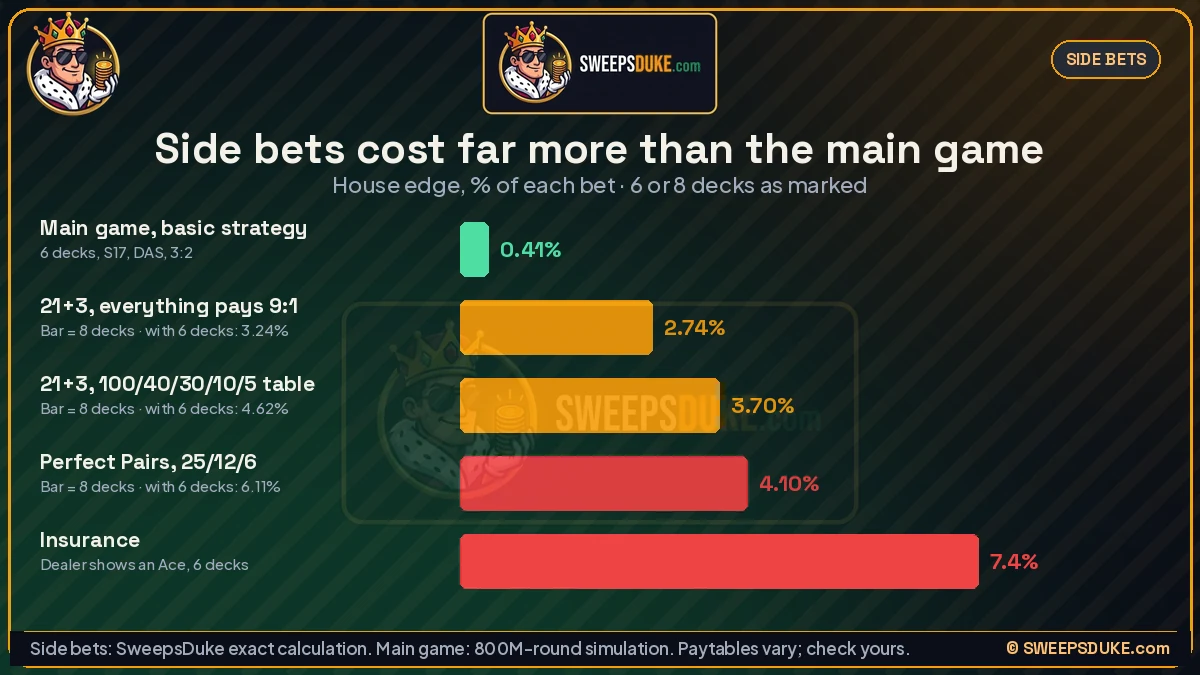
Side bets are optional extra wagers on your first cards, and they're where strategy gives the most away for the least thought. We calculated the common ones exactly, by counting every possible combination of cards:
| Bet | Paytable | 6 decks | 8 decks |
|---|---|---|---|
| Main game, basic strategy | — | 0.41% | 0.43% |
| 21+3 (your two cards + dealer upcard as a 3-card poker hand) | Every winning hand pays 9:1 | 3.24% | 2.74% |
| 21+3 | Suited trips 100, straight flush 40, trips 30, straight 10, flush 5 | 4.62% | 3.70% |
| Perfect Pairs (your first two cards are a pair) | Perfect 25, coloured 12, mixed 6 | 6.11% | 4.10% |
| Perfect Pairs | Perfect 30, coloured 10, mixed 5 | 5.79% | 3.37% |
| Insurance (dealer shows an Ace) | 2:1 | 7.4% | — |
Paytables vary between games, and the edge moves with them. Unlike the main game, there's no decision to make after you place a side bet, so there's no strategy that lowers its edge. The only strategy is whether to make it. Even the cheapest version here costs more than six times the main game per coin bet.
Insurance is a side bet too, offered when the dealer shows an Ace. It pays 2:1 if the dealer has a 10-value card underneath. In 6 decks, with only the Ace seen, 96 of the 311 unseen cards are 10s, 30.9%. Insurance needs 33.3% to break even, so it loses 7.4 coins per 100 bet (3 × 96/311 − 1). If your own hand has no 10s, the chance is slightly better for insurance, and it still loses about 6.8 per 100. "Even money" on a blackjack is the same bet in another form. In our simulation, insuring every time raised the overall house edge from 0.41% to 0.68%.
What about using side bets "to cover" a hand? A side bet doesn't change your main hand's odds. It's a separate wager with its own, higher edge, so adding it raises the cost of every round you add it to. The odds and maths page has more on why each bet is priced on its own.
Card counting: how it works and what it's worth
Card counting is the one method that can, in theory, shift the edge, and it only works in a game dealt from a shoe that isn't reshuffled after every round. Edward Thorp published the first practical counting methods in Beat the Dealer (1962). The idea: cards that have been dealt aren't coming back until the shuffle. A shoe with more 10s and Aces left favours the player (more blackjacks, better doubles, more dealer busts); a shoe rich in small cards favours the dealer.
The most common method, Hi-Lo, gives each card a value as it's dealt: 2 to 6 count +1, 7 to 9 count 0, and 10s and Aces count −1. The running total is the running count. Dividing it by the number of decks still to be dealt gives the true count, which measures how rich the remaining shoe is.
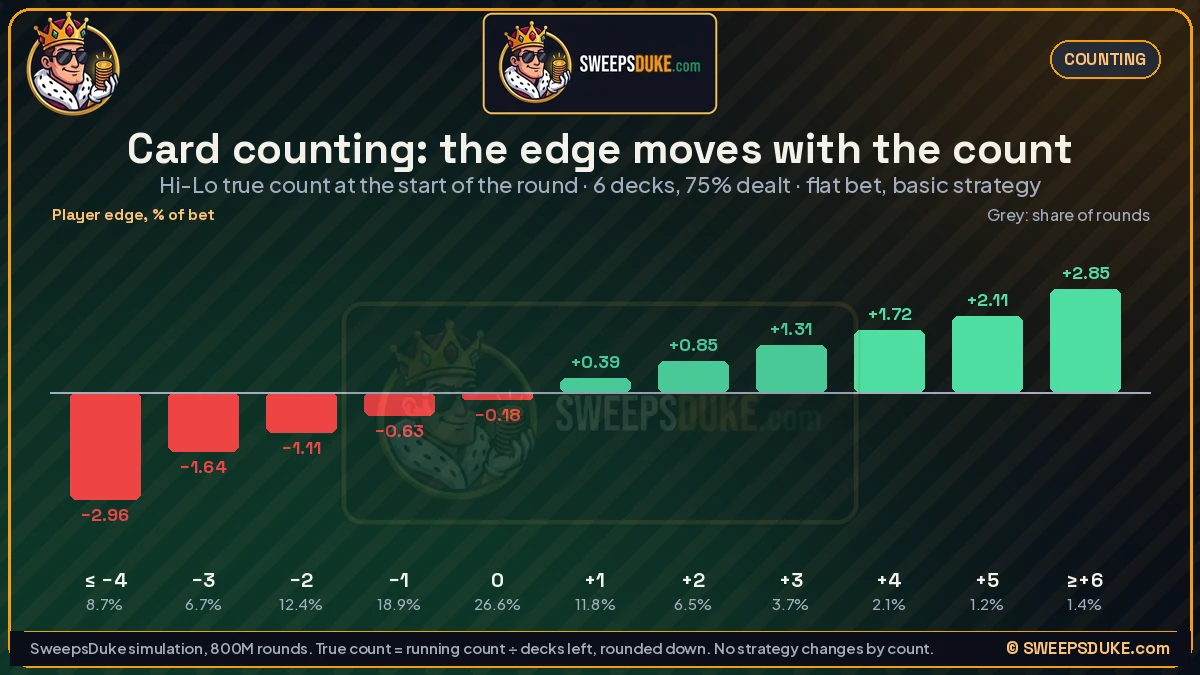
We simulated 800 million rounds from a 6-deck shoe dealt to 75% before the shuffle, playing flat bets and basic strategy (no changes to the chart by count), and recorded the result for each true count at the start of the round (rounded down):
| True count | Share of rounds | Player result per 100 coins bet |
|---|---|---|
| −4 or lower | 8.7% | −2.96 |
| −3 | 6.7% | −1.64 |
| −2 | 12.4% | −1.11 |
| −1 | 18.9% | −0.63 |
| 0 | 26.6% | −0.18 |
| +1 | 11.8% | +0.39 |
| +2 | 6.5% | +0.85 |
| +3 | 3.7% | +1.31 |
| +4 | 2.1% | +1.72 |
| +5 | 1.2% | +2.11 |
| +6 or higher | 1.4% | +2.85 |
Each point of true count moved the result by about 0.4 to 0.46 points, close to the rule of thumb of about half a point per true count that's commonly quoted in the counting literature. But look at the share column: the count was +1 or more in only 26.6% of rounds, and +2 or more in 14.8%. Most of the time the shoe is neutral or bad.
A counter makes use of this by betting more when the count is high. With a 1-to-8 spread (1 unit at true count 0 or lower, 2 at +1, 4 at +2, 6 at +3, 8 at +4 or more), our simulated result was +0.40 coins per 100 coins of starting bets at 75% penetration. That's a small edge, with the swings of a game where your bets jump eightfold, and it assumes perfect counting, no mistakes, and a casino that tolerates the spread. At 50% penetration (the shoe shuffled halfway through), the same spread came out at +0.02, effectively nothing, because high counts are rarer when half the cards are never reached. Counting in your head uses only cards everyone can see, but casinos can restrict bets, shuffle early or refuse play to suspected counters. We describe it here for understanding, not as a plan.
Why card counting doesn't work online
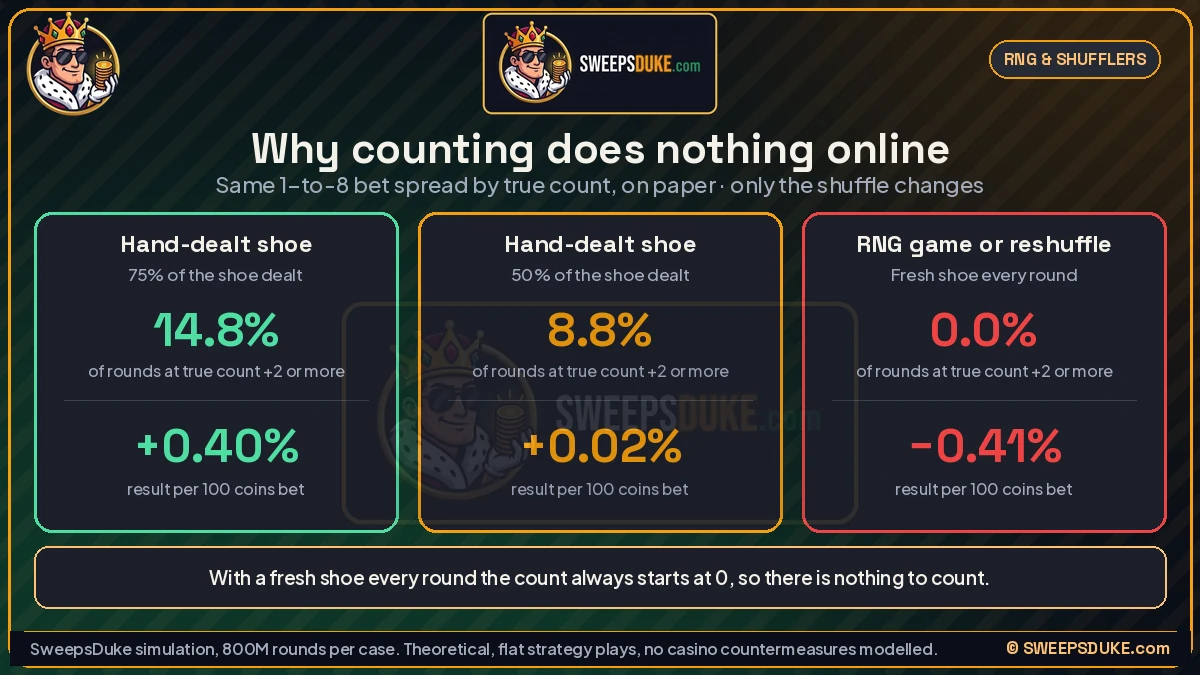
Most online blackjack, including the software tables at sweepstakes casinos, uses a random number generator (RNG) that in effect deals each round from a freshly shuffled set of decks. A continuous shuffling machine at a physical table does much the same, because used cards go back in before the shoe runs low. Either way, every round starts from a full set of cards, so the count is always 0 and there's nothing to track.
We ran the same 1-to-8 spread in a game reshuffled every round. The result: −0.41 per 100, exactly the normal house edge, because the spread never had a high count to bet into. The three cases side by side:
| Shuffle | Rounds at true count +2 or more | 1-to-8 spread result per 100 |
|---|---|---|
| Hand-dealt shoe, 75% dealt | 14.8% | +0.40 |
| Hand-dealt shoe, 50% dealt | 8.8% | +0.02 |
| RNG game or reshuffle every round | 0% | −0.41 |
Two related myths:
- "The RNG is due." A fresh shuffle every round has no memory. Ten losses in a row don't make a win more likely next hand.
- "Counting the hand on screen helps." Using the cards you can see in the current round is what basic strategy already does through your total and the upcard. The composition tweaks it adds are worth a small fraction of a point.
Live-dealer games are the exception that's worth understanding, which is the next section.
Live-dealer blackjack: what changes and what doesn't
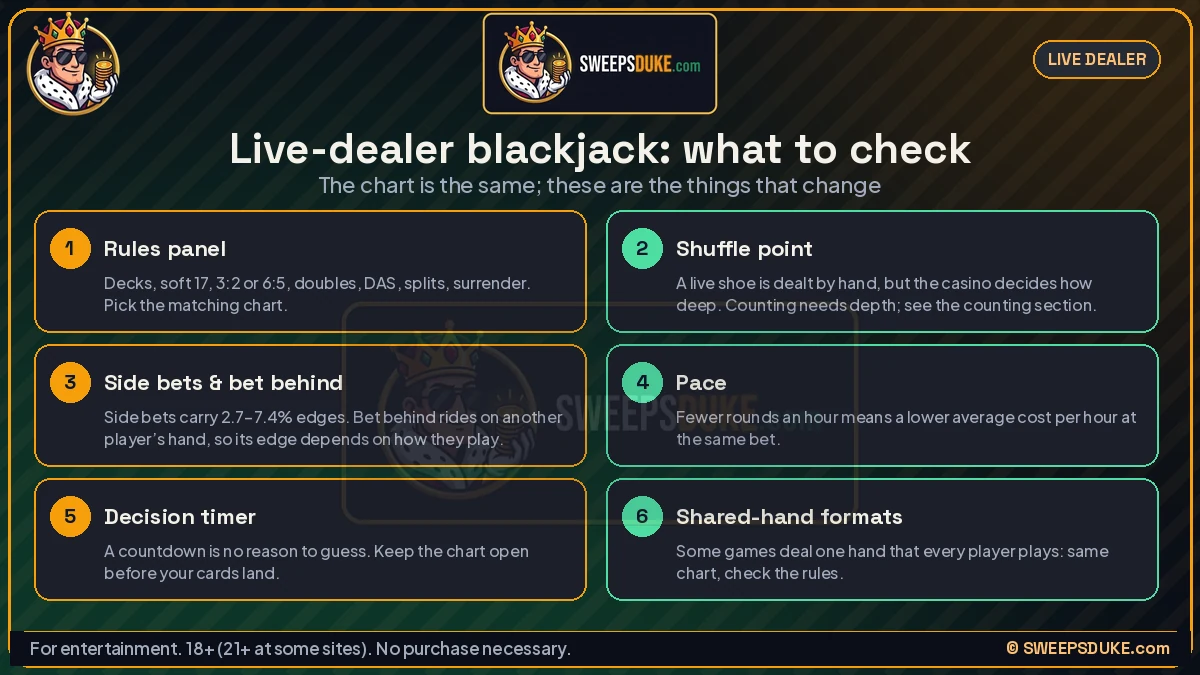
In live-dealer blackjack a real dealer deals real cards on camera. The chart is the same as for any game with the same rules. The differences are practical:
- Read the rules panel. Live tables publish the number of decks, whether the dealer hits or stands on soft 17, the blackjack payout, doubling and splitting rules, and whether surrender is offered. Many live tables use 8 decks; our calculations show 8 decks plays from the same chart as 6. Rules such as "double on 9 to 11 only" or "one split" change a few cells, so check the cheat sheet for the matching rule set.
- Check the shuffle point. A live shoe is dealt by hand, but the casino decides where the cut card goes and can shuffle whenever it likes. As the previous sections show, counting needs deep penetration, and at 50% a spread was worth essentially nothing in our simulation. Treat a live game as a normal house-edge game.
- Price side bets and "bet behind". Live tables often push side bets, which carry the 2.7% to 7.4% edges shown above. "Bet behind" lets you place a bet on another seated player's hand. You don't make the decisions, so your edge is whatever that player's play gives: about 0.41% if they follow the chart on our standard rules, more if they don't.
- Mind the pace. Live tables deal far fewer rounds an hour than software games. That lowers the average cost per hour at the same bet. It doesn't change the cost per hand.
- Don't let the decision timer rush you. Live tables give a fixed window to act. Have the chart open before your cards land, so the timer never makes the decision for you.
- Shared-hand formats. Some live games deal one hand that every player at the table plays, each making their own decisions. The cards are the same for everyone, but the rules (and side-bet menus) often differ from a standard table, so read them before you assume the standard chart applies.
Blackjack strategy at sweepstakes casinos
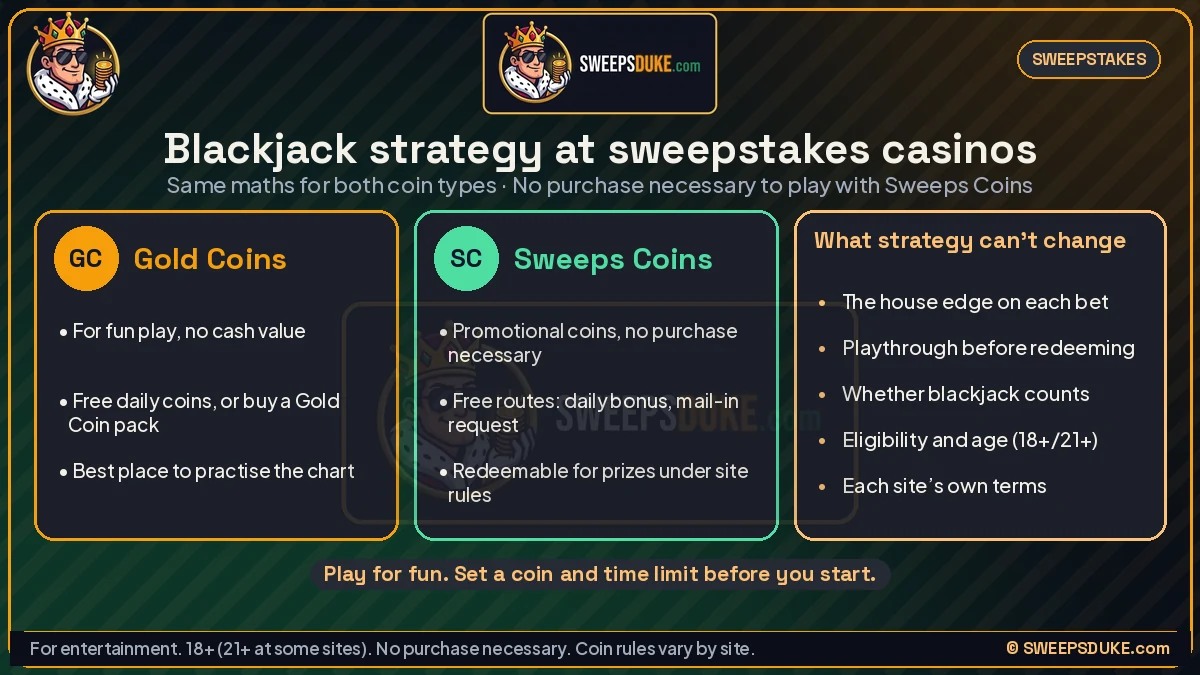
At a sweepstakes casino you play with two kinds of coin. The blackjack maths is the same for both; what differs is what the coins are for.
- Gold Coins are for fun play and have no cash value. You get them free (sign-up and daily bonuses), or you can buy a Gold Coin pack. They're the best place to practise the chart and try a betting idea without anything at stake.
- Sweeps Coins are promotional coins, and no purchase is necessary to get them. Sites give them free through daily bonuses, social promotions and a mail-in request (often called AMOE, alternative method of entry); some also include them as a free bonus with a Gold Coin pack. Under each site's rules, Sweeps Coins won in play can be redeemed for prizes. Our guides explain how to get free Sweeps Coins, what Sweeps Coins are, how mail-in requests work and the usual redemption methods.
How strategy fits around the coins:
- The house edge applies per coin bet, in both currencies. A 0.41% game costs about 0.41 Sweeps Coins per 100 bet on average, and a 6:5 game about 1.8. Table selection and skipping side bets matter as much here as anywhere.
- Playthrough rules. Sites usually require Sweeps Coins to be played through before they can be redeemed, and they set which games count. Strategy can't change those rules. It only changes how much the playthrough costs on average. At 0.41%, playing 1,000 Sweeps Coins through blackjack costs about 4 Sweeps Coins on average, with swings far larger than that.
- Check that blackjack counts and which variant you're playing. Each site sets its own game list, rules and terms. Read the game's info screen for the rules and the site's terms for playthrough and eligibility.
- Age and location. Sweepstakes casinos set their own eligibility rules, typically 18+ or 21+, and aren't available everywhere. Only play where the site's terms say you're eligible.
None of this makes blackjack a way to earn money. Treat Sweeps Coins the same way as anything else you play with: set a limit you're happy to spend, in coins and time, before you start.
A blackjack session plan
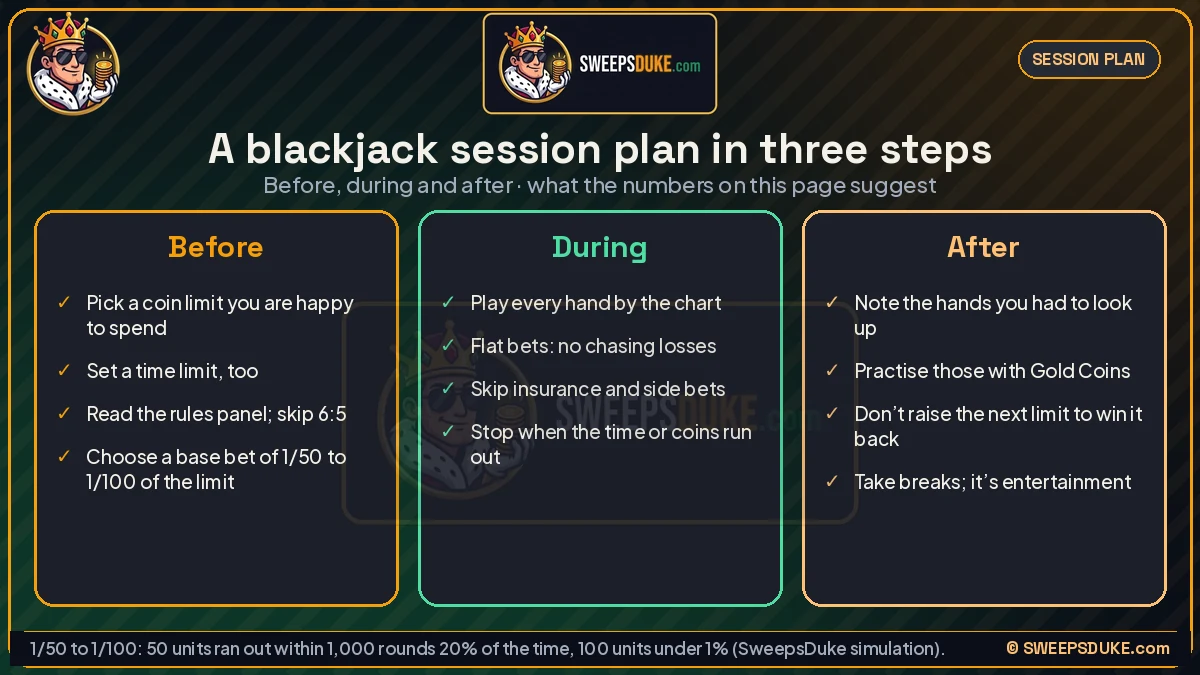
Everything above comes down to a short routine.
Before you play
- Pick a coin limit you're happy to spend, and a time limit too.
- Open the rules screen. Skip 6:5 tables. Note soft 17, double after split and surrender, and open the matching chart from the cheat sheet.
- Choose a base bet of 1/50 to 1/100 of your limit. In our simulation, 50 units ran out within 1,000 rounds about 20% of the time; 100 units under 1%.
While you play
- Play every hand by the chart, including the uncomfortable ones (hitting 12 against a 2, splitting 8s against a 10).
- Flat bets. Raising after losses doesn't change the edge; it makes the losses bigger.
- Skip insurance, even money and side bets.
- Stop when the time or the coins run out, whichever comes first.
After you play
- Note any hands you had to look up, and practise them with Gold Coins.
- Don't raise the next session's limit to win back the last one.
- Take breaks. It's entertainment, and the results are a mix of a small edge and a lot of luck.
New to the game? Start with how to play blackjack and what blackjack is before this page.
Blackjack strategy FAQ
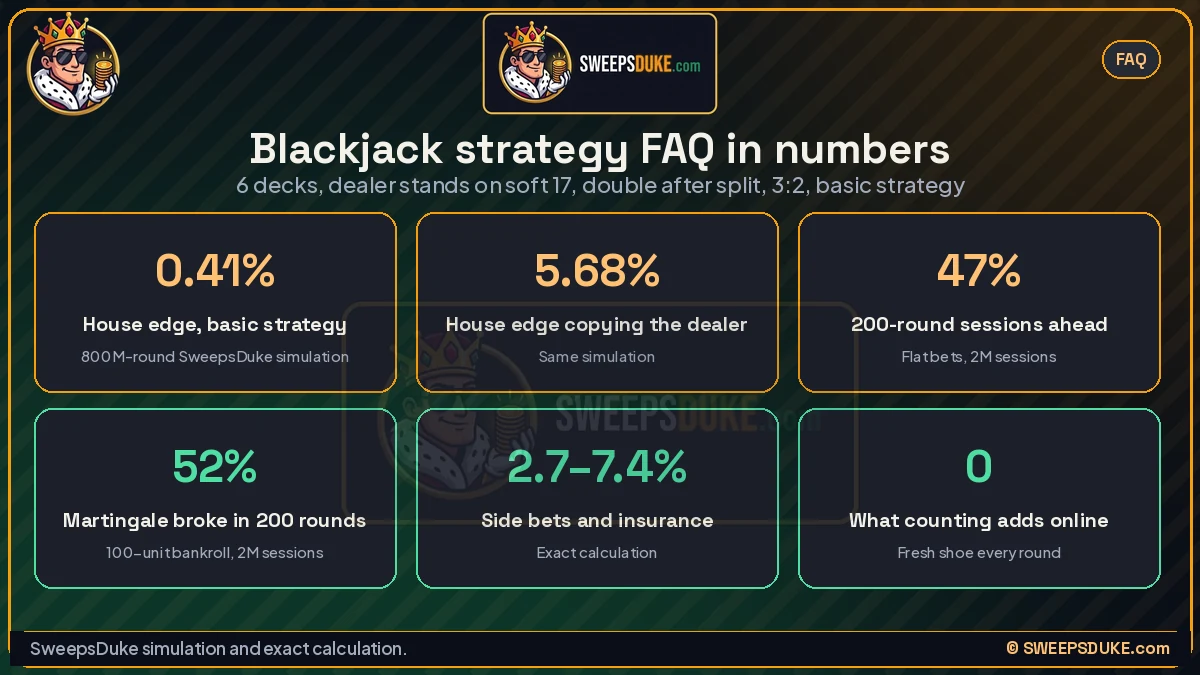
What is the best blackjack strategy?
Basic strategy for the exact rules on your table, played on every hand, with no insurance or side bets, at a 3:2 table with the best rules you can find. On 6 decks with the dealer standing on soft 17 and double after split, that costs about 0.41% of what you bet. Copying the dealer costs about 5.7%.
Can any strategy guarantee a win at blackjack?
No. With perfect basic strategy the house keeps a small edge, and short sessions are dominated by luck: about 47% of 200-round flat-bet sessions finished ahead in our simulation, and fewer the longer you play.
Do betting systems like Martingale work?
They don't change the house edge. In our simulation, every system lost on average. Martingale went broke in 52% of 200-round sessions with a 100-unit bankroll, and lost 0.72 per 100 coins bet compared with 0.41 for flat betting.
What bankroll do I need for blackjack?
It depends on how long you want to play. For 1,000 flat-bet rounds, 50 base bets ran out about 20% of the time in our simulation and 100 base bets under 1%. A base bet of 1/50 to 1/100 of your session limit is a sensible range.
Should I take insurance or even money?
No, if you play basic strategy and don't count cards. Insurance loses about 7.4 coins per 100 bet on 6 decks (6.8 when your hand has no 10s), and even money is the same bet. Insuring every time raised the overall house edge from 0.41% to 0.68% in our simulation.
Are blackjack side bets worth it?
Not on price. The common paytables we calculated cost 2.7% to 6.1% per coin bet, compared with 0.41% for the main game. Play them only if the extra cost is worth it to you as entertainment.
Does card counting work in online blackjack?
Not in RNG blackjack. The cards are reshuffled every round, so the count never moves. Our 1-to-8 count spread lost the normal 0.41% there. In a hand-dealt shoe the same spread was worth +0.40 per 100 at 75% penetration and essentially nothing at 50%.
Does blackjack strategy work with Sweeps Coins?
Yes. The cards and the maths are the same for Gold Coins and Sweeps Coins. Strategy lowers the average cost of play, including playthrough, but it doesn't change a site's rules for redeeming Sweeps Coins or guarantee any result.
Should I play faster or slower?
The edge per hand is the same either way, but faster play multiplies the cost per hour. At 10 coins a hand, 60 rounds an hour costs about 2.5 coins on average and 250 rounds about 10.2.
Where do I find the charts?
On the basic strategy guide (with the reasoning) and the blackjack cheat sheet (one printable chart per rule set). More topics are on the blackjack guides hub.
How we got these numbers: playing styles, rule sets and the card-counting results come from our own blackjack simulator, 800 million rounds per case (400 million for basic strategy without doubles or splits), using the computed basic-strategy charts for each rule set. Our 6-deck S17 result of 0.41% agrees with our separate finite-shoe calculation (0.40%) and with published rule-variation figures. Betting-system and bankroll figures come from 400,000 to 2 million simulated sessions per case on real blackjack rounds, allowing doubles and splits only when the balance covers them. Side-bet edges are exact combinatorial calculations for the paytables shown. Insurance is exact card counting from the shoe. Card counting uses Hi-Lo with true count rounded down, flat basic strategy, no index plays and no casino countermeasures. See our methodology.
18+ (21+ at many sweepstakes sites). Play for fun, not income. Blackjack has a house edge, and no strategy, system or count turns a sweepstakes or casino game into a way to make money. Set a time and spend limit before you start. Need help? Call or text 1-800-GAMBLER or see our responsible gaming page.