



Blackjack Rules
Complete blackjack rules: card values, order of play, payouts, dealer soft 17, doubling, splitting, surrender, insurance, decks and what each rule costs.
On this page
Blackjack has one goal: finish closer to 21 than the dealer without going over. Number cards count their number, Jacks, Queens and Kings count 10, and an Ace counts 1 or 11. You play your hand first, the dealer then draws to 17 by a fixed rule, wins pay 1 to 1, a blackjack pays 3 to 2 and ties push.
That much is the same at every table. What changes from game to game are the table rules: how many decks, whether the dealer hits soft 17, what a blackjack pays, when you can double, split or surrender, and whether the dealer peeks for blackjack. Those lines decide how much the game costs you. This page explains every standard rule with worked examples, settles the edge cases players argue about, and puts a number on each rule variation. We measured each one ourselves in an 800-million-round simulation.
Affiliate disclosure: SweepsDuke may earn a commission if you sign up through some links on this site. That never changes our charts, math or verdicts. How we make money.
Blackjack rules at a glance
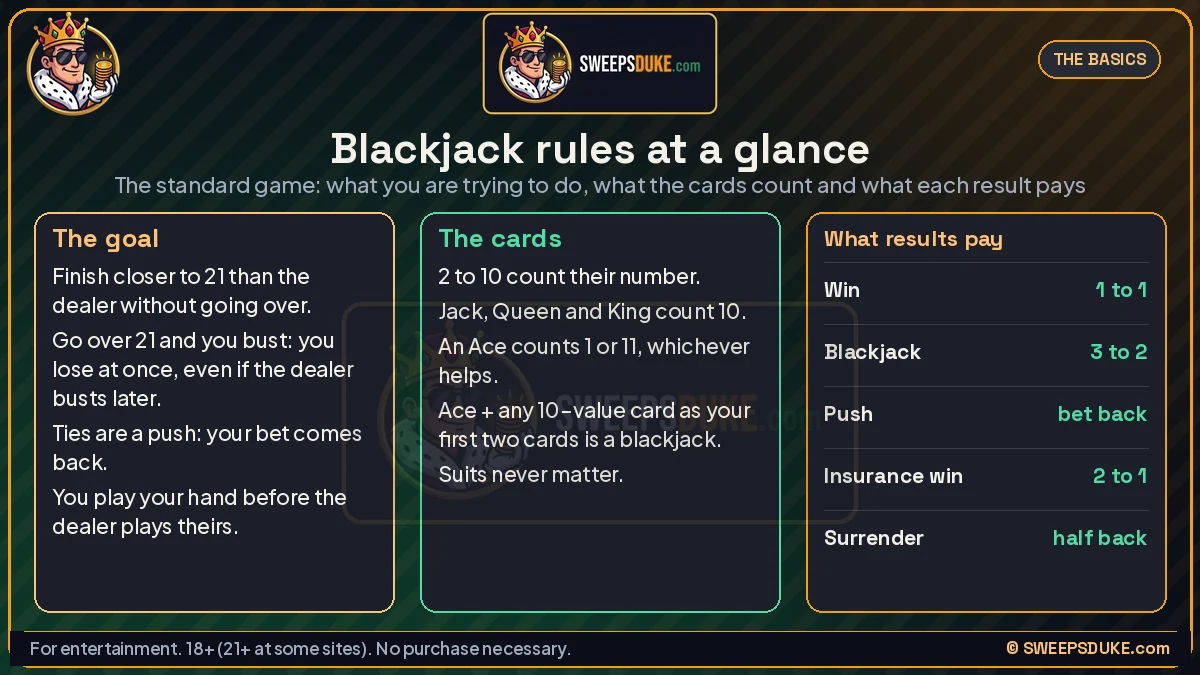
Here is the whole game in eight lines. Everything else on this page is detail, variations and edge cases built on them. If you've never played, what is blackjack explains the game's background and how to play blackjack walks you through your first hands.
- You play against the dealer, not the other players. Each seat is its own contest with the dealer's hand. Other players' choices change which cards come out, but not your odds on average.
- The target is 21. A hand closer to 21 than the dealer's wins. A hand over 21 is a bust and loses straight away.
- Card values. 2 to 10 count their number, Jack, Queen and King count 10, and an Ace counts 1 or 11, whichever is better for the hand. Suits never matter.
- Blackjack. An Ace plus any 10-value card as your first two cards is a blackjack (also called a natural). It beats every other hand, including a dealer 21 made with three or more cards, and pays 3 to 2 at a standard table.
- You act first. You hit (take a card), stand, double, split or surrender before the dealer plays. If you bust, you lose even if the dealer busts later. This is the house's built-in advantage.
- The dealer has no choices. The dealer draws until reaching 17 or more, then stops. The only variation is whether the dealer also hits a soft 17 (a 17 that counts an Ace as 11).
- Payouts. A win pays 1 to 1, a blackjack 3 to 2, an insurance win 2 to 1, and a surrender returns half your bet.
- Ties push. If you and the dealer finish on the same total, your bet comes back. The dealer does not win ties in standard blackjack.
With these rules and the best play for every hand (basic strategy), a standard 6-deck game has a house edge of about 0.41%. That means about 0.41 coins lost per 100 coins bet over the long run. The rest of this page shows how each rule moves that number.
Card values and how to count a hand
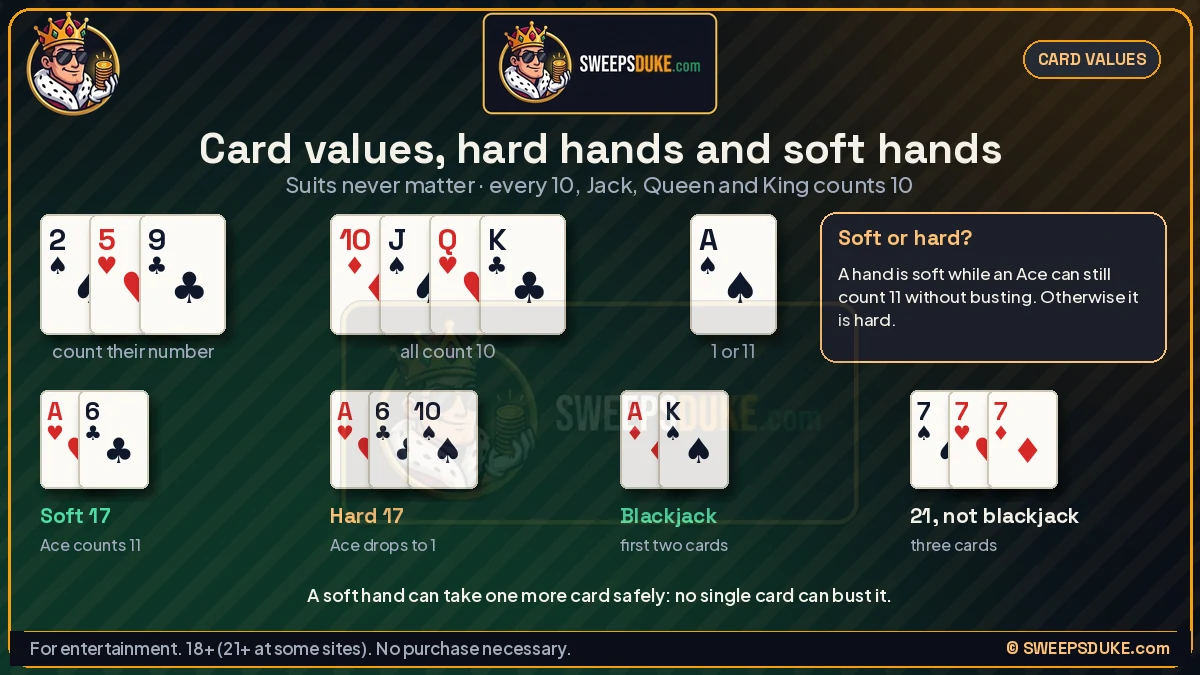
Counting a hand is just adding, with one twist: the Ace.
| Card | Value |
|---|---|
| 2, 3, 4, 5, 6, 7, 8, 9 | Their number |
| 10, Jack, Queen, King | 10 |
| Ace | 1 or 11 |
Because there are four 10-value ranks, almost a third of the deck counts 10: 16 of every 52 cards, or 30.8%. That's why "assume the hole card is a 10" is a common shortcut, though it's wrong more often than right.
Soft and hard hands. A hand is soft when it holds an Ace that is currently counted as 11. It's hard when it has no Ace or every Ace has to count 1 to avoid busting.
- A + 6 is soft 17. The Ace counts 11. If you draw a 10, the Ace drops to 1 and you have hard 17, not a bust.
- A + 6 + 10 is hard 17. There's no way to count the Ace as 11 without going over 21.
- A + A is soft 12. Only one Ace can ever count 11; two would make 22.
- A + 5 + 5 is soft 21, not blackjack, because it took three cards.
The practical point is that no single card can bust a soft hand. If you hit soft 17 and draw a 10, you're on hard 17, not out of the hand. That's why basic strategy hits and doubles soft hands that look high, like soft 17 and soft 18 against some dealer cards. A hard 17 is a different hand altogether: any card from 5 up busts it.
Blackjack versus 21. Only an Ace and a 10-value card as your first two cards make a blackjack. Three or more cards totalling 21 are just 21. So are an Ace and a 10 dealt to a split hand (see the edge cases below). In a 6-deck shoe you're dealt a blackjack on 4.75% of hands, about one in 21. With one deck it's 4.83%.
How a round of blackjack works, step by step
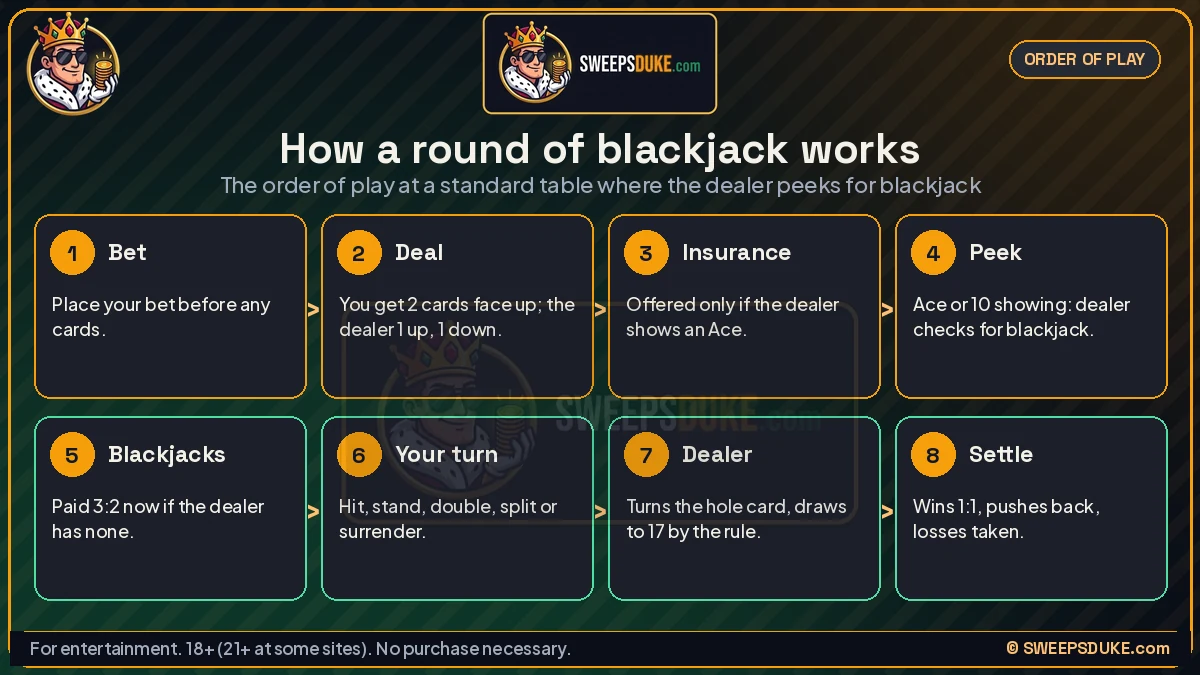
This is the order of play at a standard table where the dealer has a hole card and peeks for blackjack. Online RNG games and live-dealer games follow the same order, with buttons instead of hand signals.
- Bet. Place your bet within the table minimum and maximum before any cards are dealt. Side bets, if offered, go in their own spots at the same time.
- Deal. Each player gets two cards, normally face up in shoe games. The dealer gets one card face up (the upcard) and one face down (the hole card).
- Insurance (only if the upcard is an Ace). The dealer offers insurance, a side bet of up to half your bet that pays 2 to 1 if the dealer has blackjack. If you hold a blackjack yourself, the offer is called even money. Both are covered in their own section below.
- Peek. With an Ace or a 10-value card showing, the dealer checks the hole card. If it makes blackjack, the hand ends there. Everyone loses their original bet except players who also have blackjack, who push. Insurance bets are paid 2 to 1.
- Player blackjacks are paid. If the dealer doesn't have blackjack, every player blackjack is paid 3 to 2 at once and that hand is over.
- Your decisions. Going round the table, each player plays their hand until they stand, bust, double, or surrender.
- Dealer plays. The dealer turns over the hole card and draws by the house rule: hit on 16 or less, stand on 17 or more, with the soft-17 rule deciding that one total. If every player has busted or surrendered, the dealer doesn't draw.
- Settle. Hands closer to 21 than the dealer's win 1 to 1. If the dealer busts, every hand still standing wins. Ties push. Hands that lost or busted are collected.
The options you have at step 6, and when each one is allowed:
| Option | What it means | When you can use it | Standard rule |
|---|---|---|---|
| Hit | Take another card | Any time before you stand or bust | Unlimited |
| Stand | Take no more cards | Any time | — |
| Double down | Double your bet, take exactly one card | First two cards of a hand | Any two cards; also after splitting at most tables |
| Split | Turn a pair into two hands, adding a second equal bet | First two cards are a pair | Resplit up to 3 or 4 hands; split Aces get one card each |
| Surrender | Give up half your bet and end the hand | First decision only, before any other action | Late surrender, where offered |
| Insurance | Side bet of up to half your bet that the dealer has blackjack | Dealer shows an Ace, before the peek | Pays 2 to 1 |
A simple example. You bet 10 coins and get 9 and 2 (11). The dealer shows a 6. You double: your bet becomes 20 and you get one card, a 10, for 21. The dealer turns over a 10 (16), must hit, draws a 7 and busts with 23. You win 20 coins. Had you only hit, you'd have won 10 coins with the same cards.
Blackjack payouts: 3:2, 6:5 and 1:1
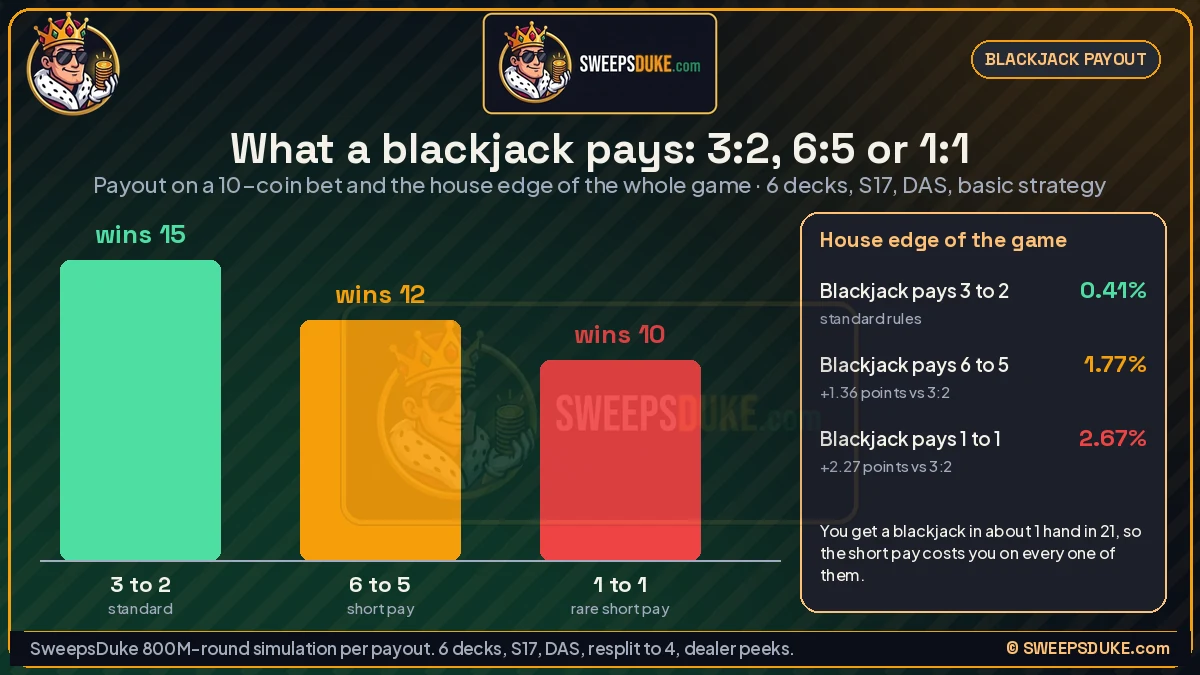
The blackjack payout is the most important rule at the table, and the easiest to check. Look for it printed on the felt, in the game's info panel, or in the game's name.
| Blackjack pays | Win on a 10-coin bet | House edge (our simulation) | Change vs 3:2 |
|---|---|---|---|
| 3 to 2 (standard) | 15 coins | 0.41% | — |
| 6 to 5 | 12 coins | 1.77% | +1.36 points |
| 1 to 1 (even) | 10 coins | 2.67% | +2.27 points |
Our 800-million-round simulation, 6 decks, S17, DAS, resplit to 4, dealer peeks, basic strategy.
Why so much from one rule? You get a blackjack on 4.75% of hands. At 3:2 each one pays 1.5 bets; at 6:5 it pays 1.2, so you lose 0.3 bets each time. 4.75% × 0.3 is about 1.4 points. The exact figure is a little lower, 1.36, because a few of your blackjacks (about 1 in 22) meet a dealer blackjack and push, so only 4.53% of hands are paid as blackjacks: 4.53% × 0.3 = 1.36. That makes a 6:5 game more than four times as expensive as the standard game. On its own it costs more than all the other bad rules on this page put together, apart from the even rarer 1:1 payout.
Two practical checks:
- "Blackjack pays 6 to 5" sometimes shows up on single-deck games to offset the deck advantage (see the decks section). A single-deck 6:5 game is still far worse than a 6-deck 3:2 game.
- Payouts on odd bets. At 3:2 a 5-coin bet wins 7.5 coins. If a game can't pay fractions, check how it rounds; betting in even amounts avoids the question.
The dealer's rules: standing or hitting soft 17
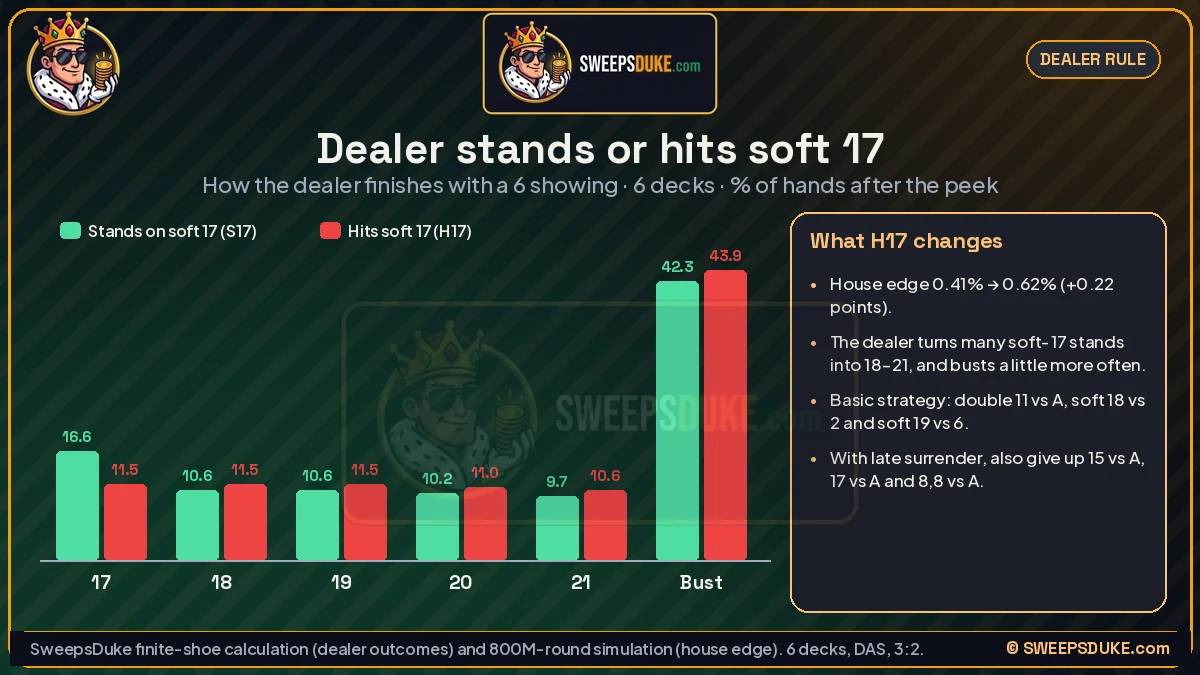
The dealer follows a fixed rule with no choices: hit on 16 or less, stand on 17 or more. Tables differ on one total only, soft 17, such as A + 6 or A + 3 + 3.
- S17 ("dealer stands on all 17s"): the dealer stands on soft 17.
- H17 ("dealer hits soft 17"): the dealer hits it.
Hitting soft 17 is good for the dealer because, as with your own soft hands, no single card can bust it. A soft 17 is a weak total (it only beats your 16 or less). Drawing turns it into 18 to 21 fairly often, and when it doesn't, the dealer often ends up on another 17 or busts. With a 6 showing, H17 cuts the dealer's chance of finishing on exactly 17 from 16.6% to 11.5%. It raises busts from 42.3% to 43.9%, but it also puts more 18s, 19s and 20s in front of you. Net effect, per our simulation:
| Rule | House edge | Change |
|---|---|---|
| Dealer stands on soft 17 (S17) | 0.41% | — |
| Dealer hits soft 17 (H17) | 0.62% | +0.22 points |
Effects are measured from unrounded results, so they can differ by 0.01 from the gap between the rounded edges.
How often the dealer busts depends on the upcard. These are the chances for a 6-deck game after the dealer has peeked and doesn't have blackjack:
| Dealer upcard | 2 | 3 | 4 | 5 | 6 | 7 | 8 | 9 | 10 | A |
|---|---|---|---|---|---|---|---|---|---|---|
| Bust %, S17 | 35.4 | 37.4 | 39.6 | 41.8 | 42.3 | 26.2 | 24.4 | 22.9 | 23.0 | 16.7 |
| Bust %, H17 | 35.7 | 37.7 | 39.9 | 42.0 | 43.9 | 26.2 | 24.4 | 22.9 | 23.0 | 20.1 |
Our finite-shoe calculation, 6 decks.
The rule only matters when the dealer can reach soft 17, so it changes nothing for a 7 to 10 upcard. It matters most for a 6 (6 + Ace is soft 17 at once) and an Ace. Across all hands, a dealer who plays every hand out busts 28.2% of the time under S17 and 28.6% under H17.
H17 also changes six cells of basic strategy for 6 decks. You double 11 against an Ace, double soft 18 (A,7) against a 2, and double soft 19 (A,8) against a 6. If late surrender is offered, you also surrender 15, 17 and 8,8 against an Ace. Our cheat sheet has separate charts for both rules.
Doubling down rules
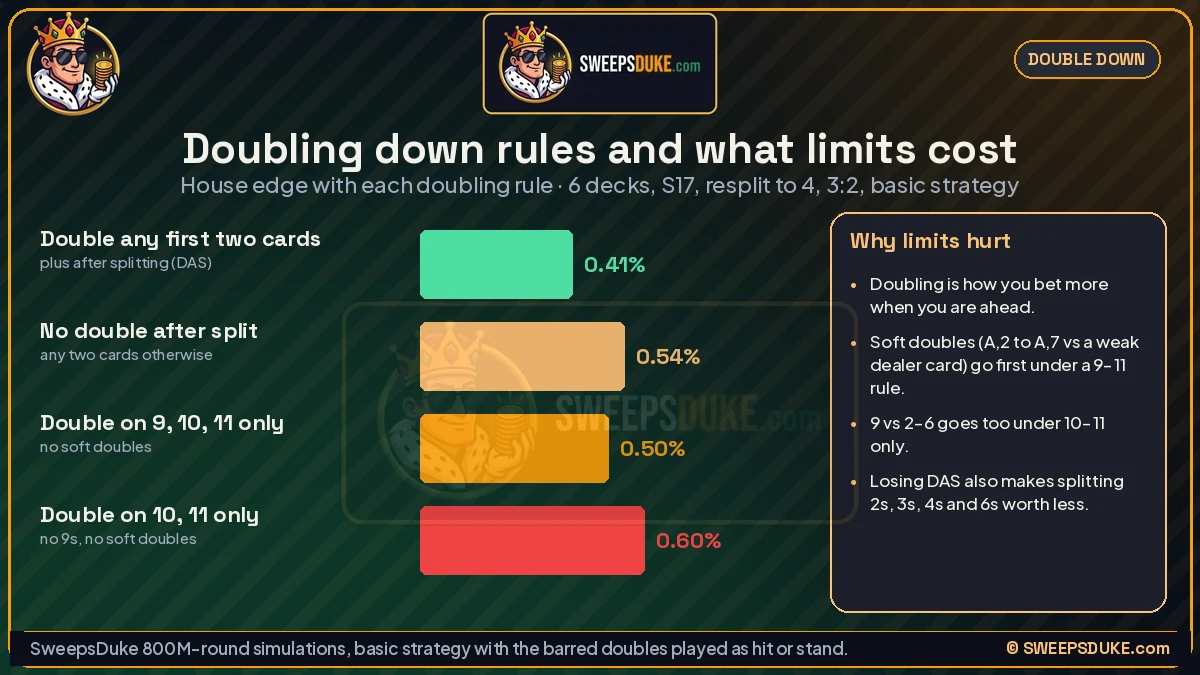
Doubling down means doubling your bet on the first two cards of a hand in exchange for exactly one more card. You can't hit again after a double, and you can't double after hitting.
Doubling is the main way basic strategy gets more money on the table when you're the favourite, mostly 10 or 11 against a weaker dealer card, and soft hands like A,6 against a 3 to 6. That's why rules that limit it cost you:
| Doubling rule | House edge | Change vs standard |
|---|---|---|
| Any first two cards, and after splitting (standard) | 0.41% | — |
| Any first two cards, but no double after split | 0.54% | +0.14 points |
| Hard 9, 10 or 11 only | 0.50% | +0.10 points |
| Hard 10 or 11 only | 0.60% | +0.19 points |
Our simulations, 800 million rounds each, 6 decks, S17, 3:2. For the restricted games we used basic strategy with each barred double played as its fallback (hit or stand), which is how a player using the standard chart would adjust.
What you lose under each rule:
- 9 to 11 only takes away every soft double (A,2 to A,7 against weak dealer cards, and A,8 where H17 applies).
- 10 or 11 only also takes away 9 against a 3 to 6.
- No double after split (no DAS) stops you doubling a hand you got by splitting. Splitting 2s, 3s, 4s and 6s then pays less, and basic strategy splits fewer of them: hit 2,2 and 3,3 against a 2 or 3, 4,4 against a 5 or 6, and 6,6 against a 2. Some live-dealer games don't allow DAS, so check the panel.
Doubling on soft hands. At a standard table you can double any two cards, soft hands included. Doubling A,7 against a 4 is allowed and correct. It looks odd only because you're doubling a "made" 18.
Splitting rules: pairs, resplits and split Aces
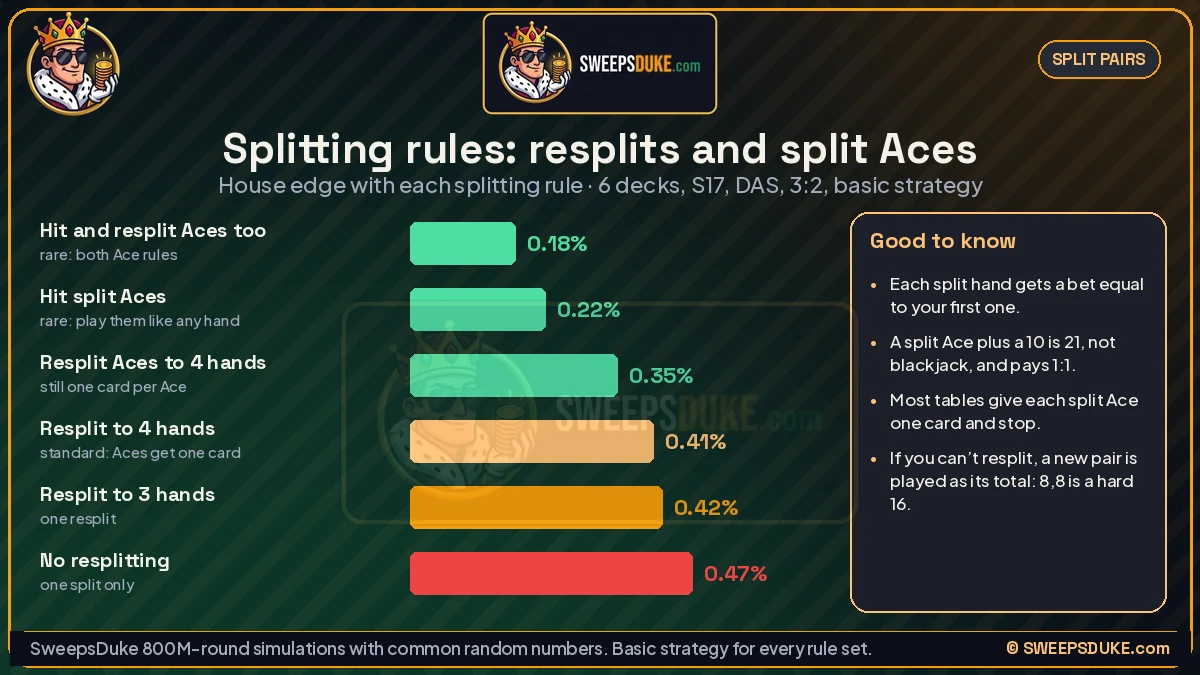
When your first two cards are a pair you can split them into two hands. You add a second bet equal to your first, and each card gets a new second card and is played as its own hand.
The standard rules and their variations:
- Which cards count as a pair. Two cards of the same rank always do. Whether two different 10-value cards (such as a King and a Jack) count as a pair depends on the game. Basic strategy never splits 10s, so this rarely matters.
- Resplitting. If a split hand gets another card of the same rank, many tables let you split again, usually up to 3 or 4 hands in total. If you can't, the new pair is just its total: 8,8 becomes a hard 16 and you play it that way.
- Split Aces. At almost every table, each split Ace gets one card only, and an Ace and a 10 on a split hand count as 21, not blackjack. They pay 1 to 1. Rarer rules let you resplit Aces if you draw another Ace, or even hit split Aces.
- Doubling after a split (DAS) is covered in the doubling section above.
What each rule is worth, measured from the standard game (resplit to 4 hands, Aces one card each, no resplitting Aces):
| Splitting rule | House edge | Change |
|---|---|---|
| No resplitting (one split only) | 0.47% | +0.06 points |
| Resplit to 3 hands | 0.42% | +0.01 points |
| Resplit to 4 hands (standard) | 0.41% | — |
| Resplit Aces, up to 4 hands | 0.35% | −0.06 points |
| Hit split Aces | 0.22% | −0.18 points |
| Resplit and hit split Aces | 0.18% | −0.23 points |
Our simulations, 800 million rounds each, 6 decks, S17, DAS, 3:2, basic strategy, with each rule run on the same cards as the base game so small effects are measured precisely.
Why are the Ace rules worth so much? Two Aces are the best starting cards in the game when you split them: each new hand starts on 11. Under the one-card rule you can't do anything with a weak card like a 5 (soft 16). If you could hit it, you'd turn many of those hands into winners.
Worked example. You bet 10 on 8,8 against a dealer 10. You split (20 coins in play), and draw a 3 on the first 8 for 11. With DAS you double that hand to 20 coins and draw a 9 for 20. The second 8 draws another 8; with resplitting allowed you split again, now 40 coins across three hands. Splitting 8s against a 10 is about losing less: 16 against a 10 is one of the worst hands in the game, and two hands starting on 8 lose less on average than one 16.
Surrender: late and early
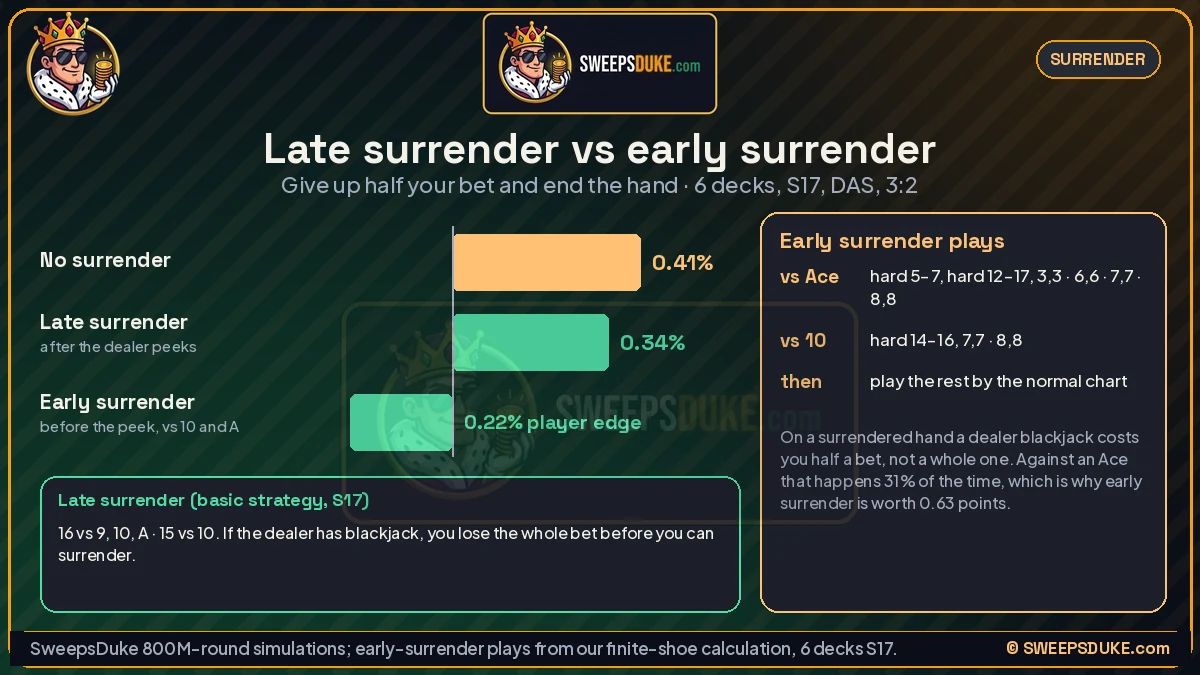
Surrender lets you give up half your bet and end the hand right away. It's only allowed as your first decision, before you hit, double or split. There are two versions, and the difference between them is large.
Late surrender (the common version) comes after the dealer has checked for blackjack. If the dealer has blackjack, the hand is already over and you lose your full bet. Surrender is only on offer when the dealer doesn't have one. Basic strategy surrenders very few hands. In a 6-deck S17 game it's 16 against a 9, 10 or Ace, and 15 against a 10. If you play these hands out, you lose more than half a bet on average, so giving up exactly half is the cheaper option.
Early surrender comes before the dealer checks. That means you can escape a dealer blackjack for half your bet, which is why it is worth so much more. It's rare today. Against an Ace, the dealer has blackjack 30.9% of the time. Our finite-shoe calculation gives the early-surrender plays for 6 decks, S17:
| Dealer shows | Surrender early with |
|---|---|
| Ace | Hard 5, 6, 7; hard 12 to 17; 3,3; 6,6; 7,7; 8,8 |
| 10 | Hard 14, 15, 16; 7,7; 8,8 |
Play everything else by the normal chart. Under that strategy you surrender about 10% of all hands, and the game swings:
| Surrender rule | House edge | Change |
|---|---|---|
| None | 0.41% | — |
| Late surrender | 0.34% | −0.07 points |
| Early surrender against 10 and Ace | 0.22% player edge | −0.63 points |
Our simulations, 800 million rounds each, 6 decks, S17, DAS, 3:2.
Surrendering hard 5 against an Ace looks strange. You can't bust a 5, but it starts so far behind a dealer Ace, and loses so often to a blackjack, that half a bet is the cheaper way out. The figure shows how valuable it is to get out of a hand before a dealer blackjack takes the whole bet.
Surrender rules to check: whether surrender is offered at all, whether it's late or early, and whether it applies against an Ace. Some games call it "late surrender" in the rules panel; others just show a surrender button.
Insurance and even money
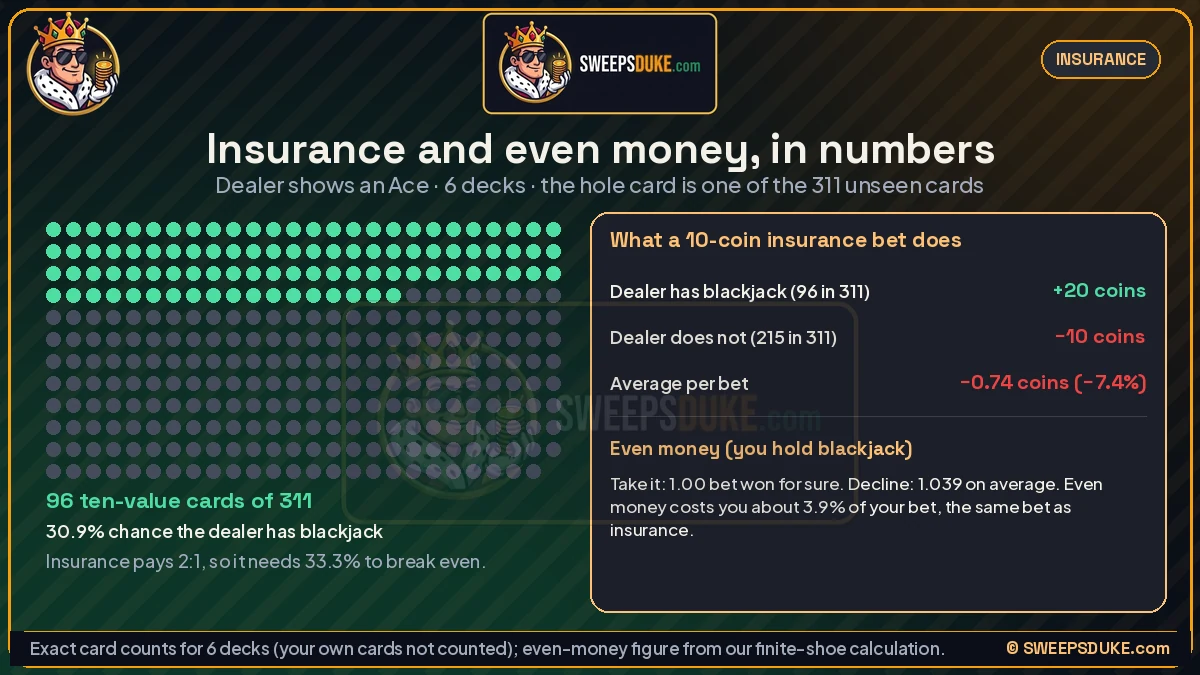
When the dealer shows an Ace, you're offered insurance: a side bet of up to half your original bet that pays 2 to 1 if the dealer's hole card is a 10-value card. It's settled at the peek, separately from your hand.
The maths fits in one line. With an Ace showing in a 6-deck shoe, 311 cards are unseen and 96 of them are 10s, so the dealer has blackjack 30.9% of the time. A bet that pays 2 to 1 breaks even only if it wins one time in three (33.3%). It falls short, so on average:
(96 × 2 − 215 × 1) ÷ 311 = −7.4% of the insurance bet
| 10-coin insurance bet | Chance | Result |
|---|---|---|
| Dealer has blackjack | 96 in 311 | +20 coins |
| Dealer doesn't | 215 in 311 | −10 coins |
| Average | −0.74 coins |
The name is misleading. It doesn't protect your hand; it's a separate bet on the hole card. "Insuring a good hand" makes no difference to the maths. Your own cards do shift the odds a little: if you hold two non-10 cards, the 10s make up slightly more of what's left, and insurance loses about 6.8% instead of 7.4%. Still a losing bet. Our strategy guide shows what always insuring adds to the house edge in a full game.
Even money is the same bet offered when you hold a blackjack. Instead of risking a push, you're paid 1 to 1 straight away. Our finite-shoe calculation, 6 decks:
- Take even money: you win exactly 1 bet.
- Decline: you win 1.5 bets when the dealer doesn't have blackjack and push when they do. That's worth 1.039 bets on average.
So even money costs you about 3.9% of your bet every time you take it. It's mathematically the same as taking full insurance on your blackjack, which loses 7.8% of the insurance stake here, because your blackjack leaves fewer 10s for the dealer. Decline it unless you'd rather lock in the win, and know what that choice costs.
The dealer peek and no-hole-card games
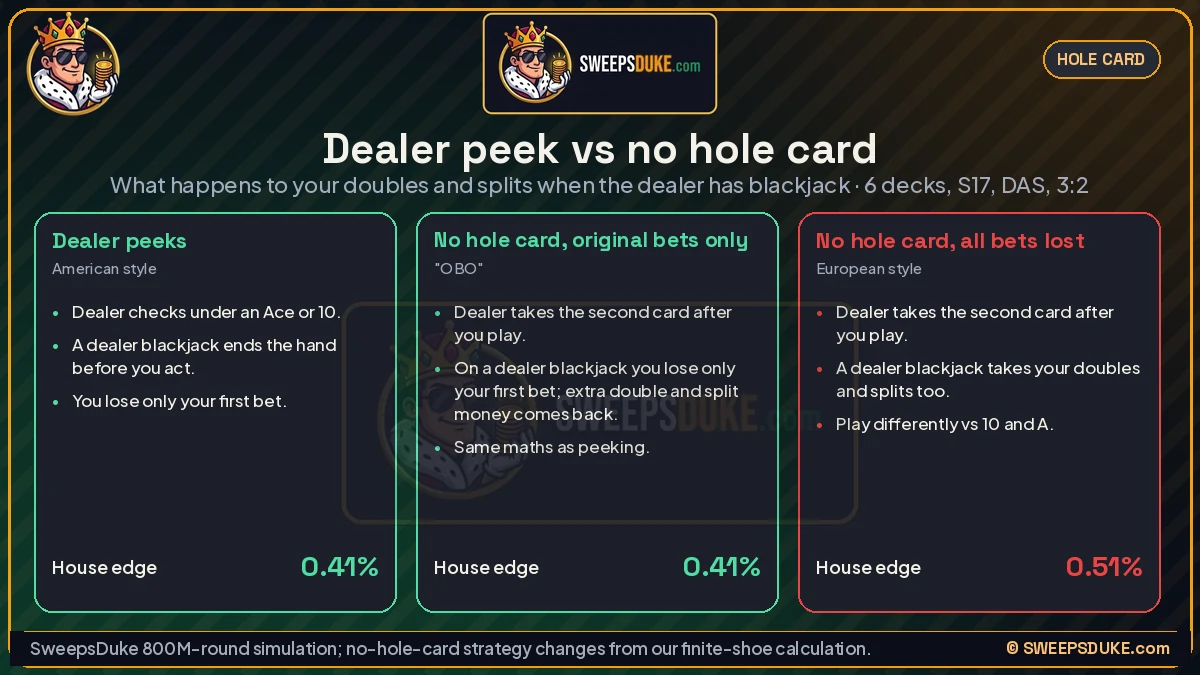
In American-style blackjack the dealer peeks: with an Ace or 10 up, they check the hole card before anyone plays and end the hand at once if it's a blackjack. You can only ever lose your original bet to a dealer blackjack, because you never get the chance to double or split into one.
Some games, usually called European style, deal no hole card. The dealer takes their second card only after all players have finished. There are two versions, and the difference matters:
- Original bets only (OBO). If the dealer turns up blackjack, you lose only your original bet; any extra money from doubling or splitting is returned. For the maths this is the same as a peek game, so the house edge is unchanged at 0.41% and you play the normal chart.
- All bets lost (ENHC, short for European no hole card). A dealer blackjack takes your doubles and splits as well. This adds about 0.11 points to the house edge (0.51% in our simulation), even after you adjust your strategy.
The strategy changes for all-bets-lost games come from our finite-shoe calculation for 6 decks, S17. Each one avoids putting more money out against a card that might already make blackjack:
| Hand | Peek or OBO | No hole card, all bets lost |
|---|---|---|
| 11 vs 10 | Double | Hit |
| 8,8 vs 10 | Split | Hit |
| 8,8 vs A | Split | Hit |
| A,A vs A | Split | Hit |
Every other cell stays as it is. A pair of 8s against a 10 is the clearest case. Splitting means two bets exposed to a dealer blackjack that comes 7.7% of the time, and that tips the balance to hitting 16. The rules panel will usually say "dealer peeks", "no hole card", or describe what happens to doubles and splits if the dealer has blackjack. If it says nothing, check a live hand: if the dealer has only one card while you play, it's a no-hole-card game.
Number of decks
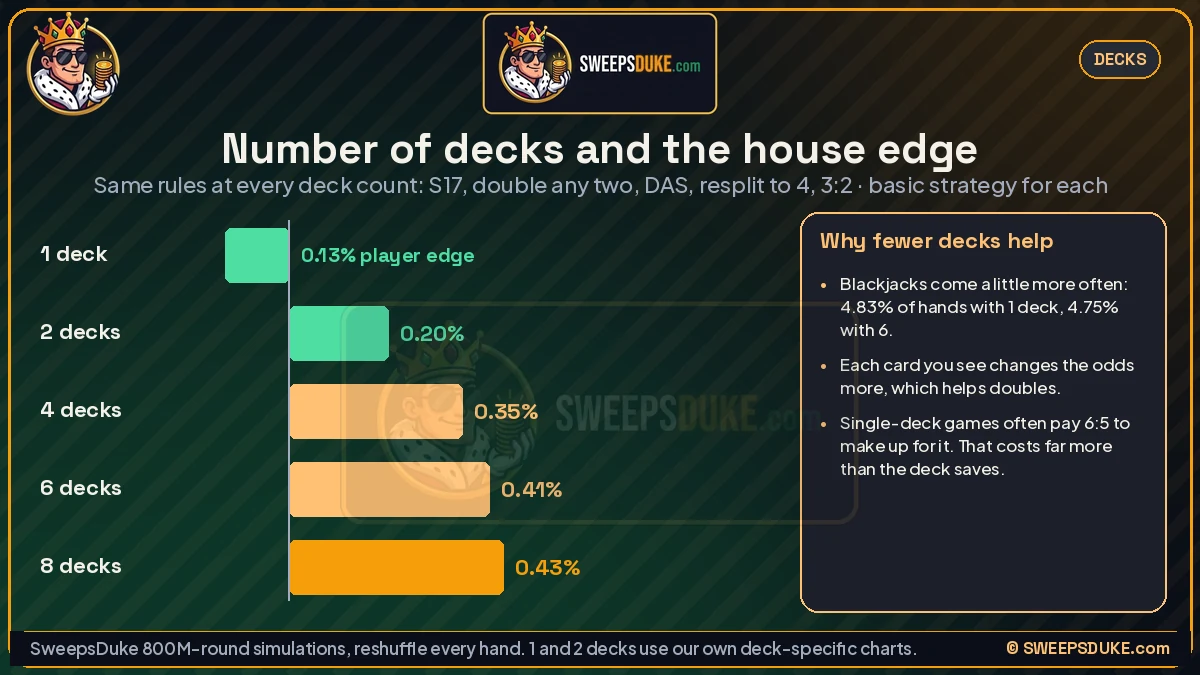
Fewer decks are better for you, other rules being equal. We ran every deck count with the same rules (S17, double any two, DAS, resplit to 4, 3:2, reshuffle every round) and the right basic strategy for each:
| Decks | House edge | Change vs 6 decks |
|---|---|---|
| 1 | 0.13% player edge | −0.54 points |
| 2 | 0.20% | −0.21 points |
| 4 | 0.35% | −0.06 points |
| 6 | 0.41% | — |
| 8 | 0.43% | +0.03 points |
Our simulations, 800 million rounds each. 1- and 2-deck games use our own deck-specific charts; 4, 6 and 8 decks use the 6-deck chart, which our calculation showed is also correct for 8 decks.
Why decks matter, in plain terms. With fewer cards, every card you and the dealer hold changes what's left by more. A blackjack becomes slightly more likely: it needs an Ace and a 10, and taking one out makes the other relatively more common. That's 4.83% of hands with one deck against 4.75% with six. Doubles also improve a little: when you double 11 holding a 6 and a 5, those small cards are no longer in a single deck, so a 10 is a bit more likely.
That single-deck player edge is exactly why you rarely see this rule set. Single-deck games usually come with offsets: 6:5 blackjack (+1.36 points), H17, no DAS, or doubling on 10 and 11 only. Always add up the whole rules panel, not just the deck count. Online RNG games shuffle every round anyway, so deck count only affects the edge, not your ability to count cards.
Every rule change, ranked
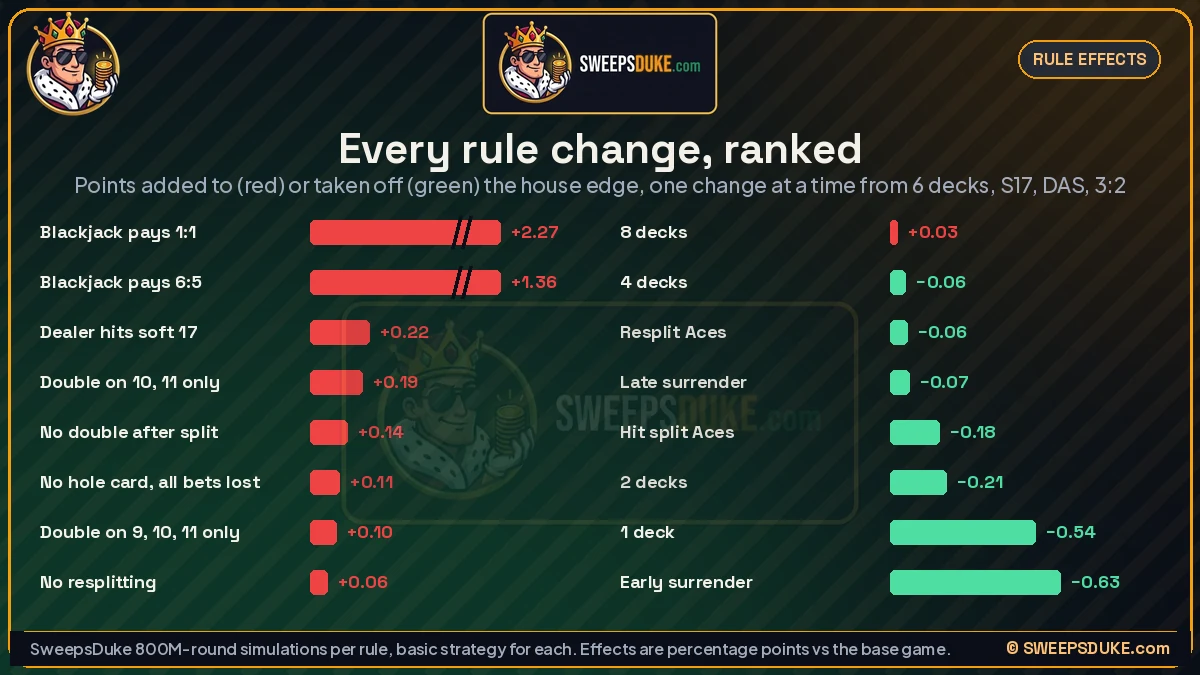
Here is every variation from this page in one table, measured one change at a time from our base game (6 decks, S17, double any two, DAS, resplit to 4, split Aces one card, no surrender, dealer peeks, 3:2). A plus sign is worse for you, a minus sign better.
| Rule change | Effect on house edge | House edge with this change |
|---|---|---|
| Blackjack pays 1:1 | +2.27 | 2.67% |
| Blackjack pays 6:5 | +1.36 | 1.77% |
| Dealer hits soft 17 | +0.22 | 0.62% |
| Double on 10 and 11 only | +0.19 | 0.60% |
| No double after split | +0.14 | 0.54% |
| No hole card, all bets lost | +0.11 | 0.51% |
| Double on 9, 10 and 11 only | +0.10 | 0.50% |
| No resplitting | +0.06 | 0.47% |
| 8 decks instead of 6 | +0.03 | 0.43% |
| Resplit to 3 hands instead of 4 | +0.01 | 0.42% |
| 4 decks instead of 6 | −0.06 | 0.35% |
| Resplit Aces | −0.06 | 0.35% |
| Late surrender | −0.07 | 0.34% |
| Hit split Aces | −0.18 | 0.22% |
| 2 decks instead of 6 | −0.21 | 0.20% |
| 1 deck instead of 6 | −0.54 | 0.13% player edge |
| Early surrender against 10 and Ace | −0.63 | 0.22% player edge |
Our simulations, 800 million rounds per rule set, basic strategy for each game. Statistical error is about ±0.01 points on most effects.
Effects add up, roughly. To size up a table, start at 0.41% and add the effect of each rule that differs. We checked this on two full tables. A 6-deck H17 game with 6:5, no DAS, no resplitting and doubling on 10 and 11 only adds up to 2.38%; simulated as one game it came out at 2.34%. The example in the next section adds up to 2.17% and simulated at 2.16%. Adding is accurate to a few hundredths of a point, which is plenty for choosing a table. Our house edge guide explains where the edge comes from and what it means over a session.
What matters most, in order: the blackjack payout, then soft 17, then doubling and splitting limits. Deck count matters less than most players think, unless it's one or two decks with no offsetting rules.
Edge cases and rulings
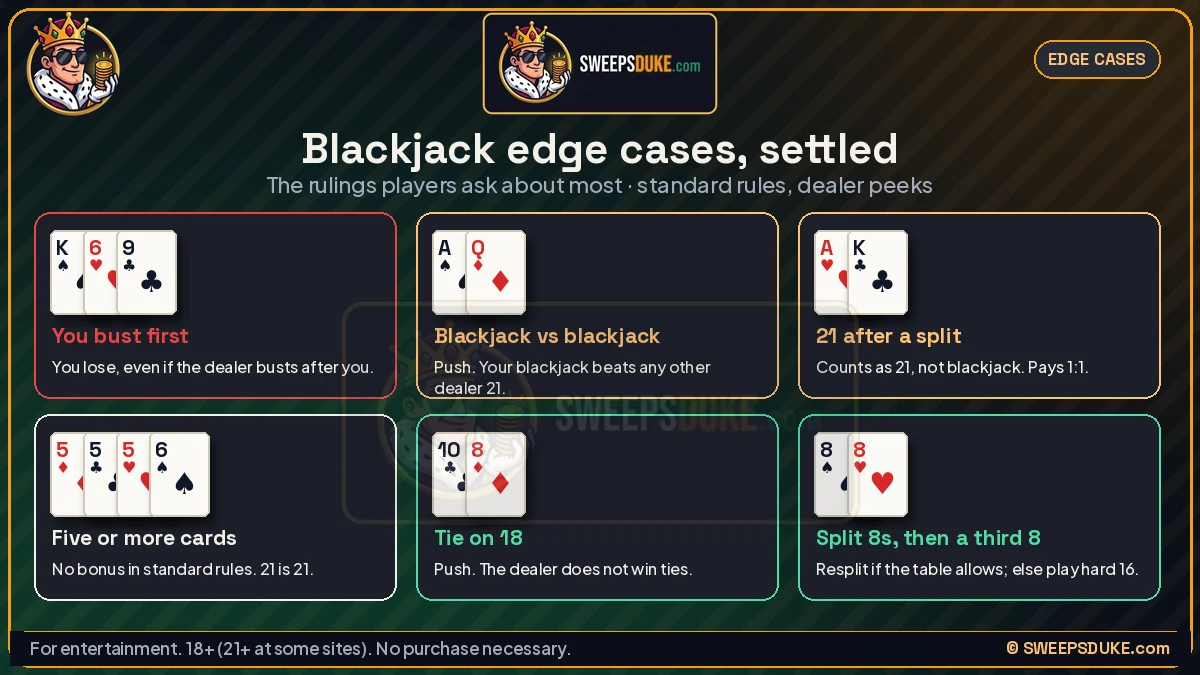
These are the situations players most often ask about. Each ruling is for standard rules with a dealer peek.
- You bust, then the dealer busts. You lose. Your hand was settled the moment you went over 21. This is where the house edge comes from.
- You have blackjack, the dealer has blackjack. Push. With an Ace up, this is when even money is offered.
- You have blackjack, the dealer makes 21 with three or more cards. You win 3 to 2. A blackjack beats every other 21.
- You have 21 with three cards, the dealer has blackjack. In a peek game this never gets played out: the dealer's blackjack ends the hand before you draw, and you lose only your original bet. In a no-hole-card game you can make 21 and still lose to the dealer's blackjack.
- An Ace and a 10 after splitting. That's 21, not blackjack, and it pays 1 to 1. The same goes for a 10 split and dealt an Ace.
- Ties. Any equal total pushes, whether 17 against 17 or 20 against 20. The dealer doesn't win ties in standard rules.
- The dealer busts. Every hand still in play wins 1 to 1, whatever its total. A 12 you stood on wins as much as a 20.
- Everyone busts or surrenders. The dealer doesn't draw. There's nothing left to play against.
- Five or more cards. No bonus. A "five-card Charlie" (an automatic win for five cards without busting) isn't a standard rule.
- Doubling after hitting, or surrendering after hitting. Not allowed. Both are first-decision options only (split hands get their own first decision for doubling where DAS applies).
- Splitting unequal 10s. Depends on the table. Some allow K,J; some require two of the same rank.
- Changing your bet mid-hand. Not allowed, except by doubling or splitting.
Rules that mean a different game. Some tables add rules like "dealer 22 pushes", "dealer wins ties", bonus payouts for certain 21s, or play without 10s in the deck. These aren't variations of standard blackjack; they're different games with their own maths and strategy, usually under their own names. None of the figures on this page apply to them. Read the rules panel and treat them as new games.
How to read an online rules panel
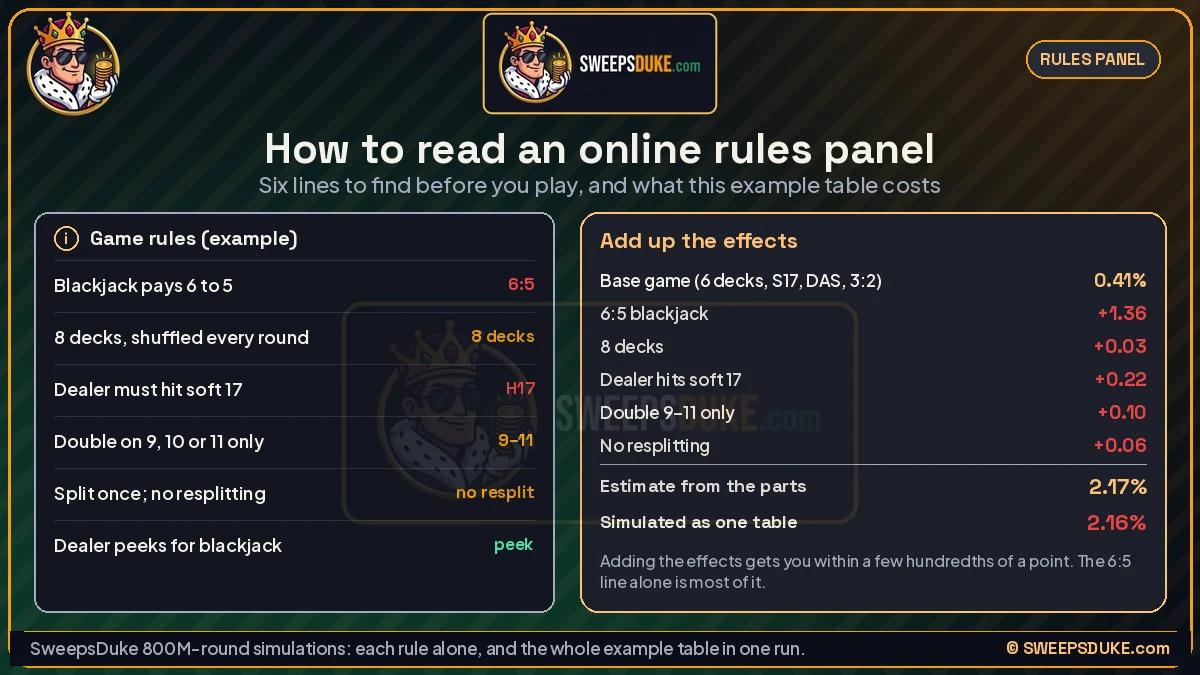
Every online and live-dealer blackjack game has a rules or info screen, usually behind an "i", "?" or "Help" button. It takes a minute to read, and it tells you more about the cost of the game than anything else. These are the lines to find and what they mean:
| The panel says | What it means | Good or bad |
|---|---|---|
| "Blackjack pays 3 to 2" | Standard payout | Good |
| "Blackjack pays 6 to 5" | Short payout | Bad: +1.36 points |
| "Dealer stands on all 17s" / "Dealer stands on soft 17" | S17 | Good |
| "Dealer hits soft 17" / "Dealer must draw on soft 17" | H17 | Bad: +0.22 points |
| "Double on any two cards" | No doubling limit | Good |
| "Double on 9, 10, 11 only" / "10 and 11 only" | Doubling limited | Bad: +0.10 / +0.19 |
| "Double after split allowed" | DAS | Good (missing: +0.14) |
| "Split up to 3 times" / "4 hands" | Resplits allowed | Standard |
| "Split once only" | No resplitting | Bad: +0.06 |
| "Surrender" / "Late surrender" | Late surrender | Good: −0.07 |
| "Dealer peeks for blackjack" | Peek game | Standard |
| "No hole card" + "all bets lost to dealer blackjack" | ENHC | Bad: +0.11 |
| "Number of decks: 6" / "8" | Deck count | Small effect |
| "Theoretical RTP 99.59%" | Return with best play | Check what it assumes |
Worked example. The panel in the image reads: blackjack pays 6 to 5, 8 decks shuffled every round, dealer hits soft 17, double on 9, 10 or 11 only, split once with no resplitting, dealer peeks. Add the effects to the 0.41% base: +1.36 (6:5), +0.03 (8 decks), +0.22 (H17), +0.10 (doubling limit), +0.06 (no resplit). That comes to about 2.17%. Our simulation of that exact table gave 2.16%. That's more than five times the cost of the standard game, and more than three-quarters of the extra comes from the 6:5 line.
About RTP figures. Some panels quote a return to player (RTP), which is 100% minus the house edge: our base game's 0.41% edge is an RTP of about 99.59%. RTP figures in game panels normally assume perfect strategy, so your return is lower if you play by feel. If a panel's RTP and its listed rules don't match the numbers on this page, the panel may assume different rules or a different strategy. Treat the rules list as the thing to check.
Shuffling. Our figures assume a fresh shuffle every round, as in online RNG games. In a shoe dealt down to a cut card, our earlier simulation put the basic-strategy edge only about 0.02 points higher, so the same numbers work for live-dealer and shoe games too.
Blackjack rules at sweepstakes casinos
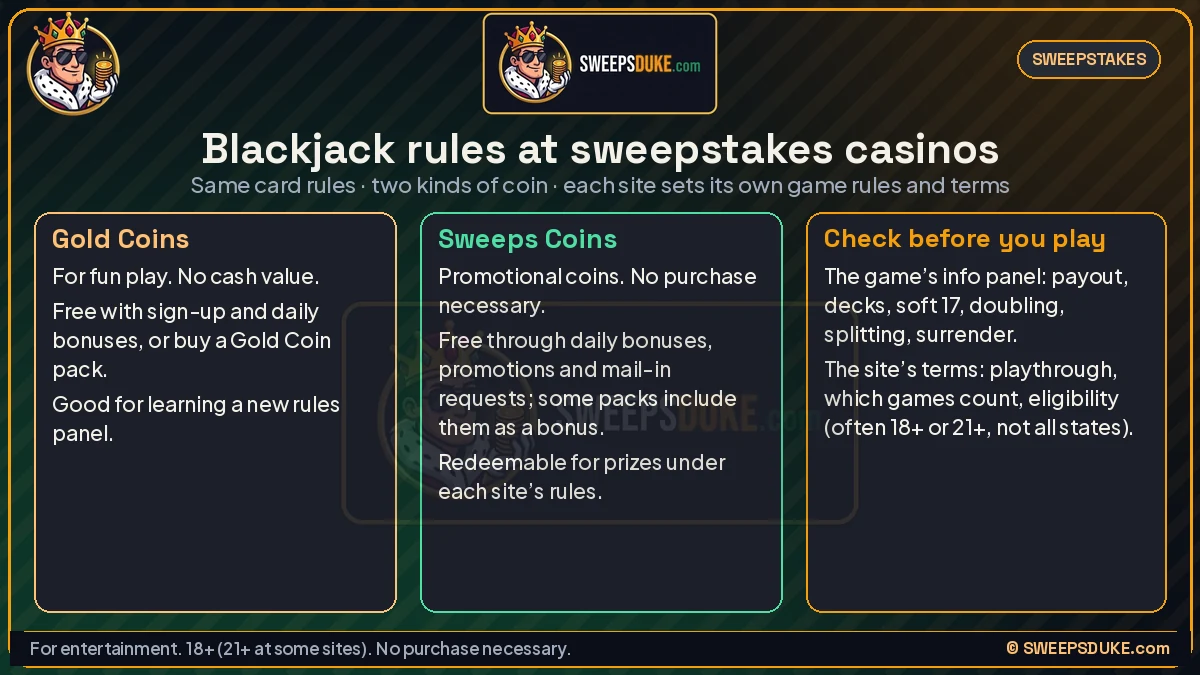
At a sweepstakes casino the card rules are the same as anywhere else: card values, the order of play, the dealer's rule and the payouts all work as described on this page. The game's own rules panel is still where you check the table rules. What's added is a second layer of rules about the coins you play with.
- Gold Coins are for fun play and have no cash value. You get them free through sign-up and daily bonuses, or you can buy a Gold Coin pack. They're a good way to try a new game and read its rules panel before anything is at stake.
- Sweeps Coins are promotional coins, and no purchase is necessary to get them. Sites give them free through daily bonuses, social promotions and a mail-in request (often called AMOE, alternative method of entry), and some include them as a free bonus with a Gold Coin pack. Under each site's rules, Sweeps Coins won in play can be redeemed for prizes. Our guides cover what Sweeps Coins are, what Gold Coins are, how to get free Sweeps Coins, mail-in requests and redemption methods.
Rules to check in the site's terms, beyond the table rules:
- Playthrough. Sweeps Coins usually need to be played through before they can be redeemed. Check whether blackjack counts toward it and at what rate. The table's house edge decides the average cost of that playthrough: at 0.41%, playing 1,000 Sweeps Coins through costs about 4 on average; at a 6:5 table (1.77%) it's about 18.
- Redemption terms. Sites set minimums, verification steps and processing times for prizes.
- Eligibility. Sweepstakes casinos set their own age rules, typically 18+ or 21+, and aren't available in every state. Only play where the terms say you're eligible.
- Game variants. A site may offer several blackjack games with different rules. Check the rules panel of each one, not just the first.
The house edge applies to every coin you bet, in either currency. Choosing a 3:2, S17 table and skipping bad rules lowers the average cost; it doesn't make blackjack a way to earn money. More guides are in our blackjack hub.
Blackjack rules FAQ
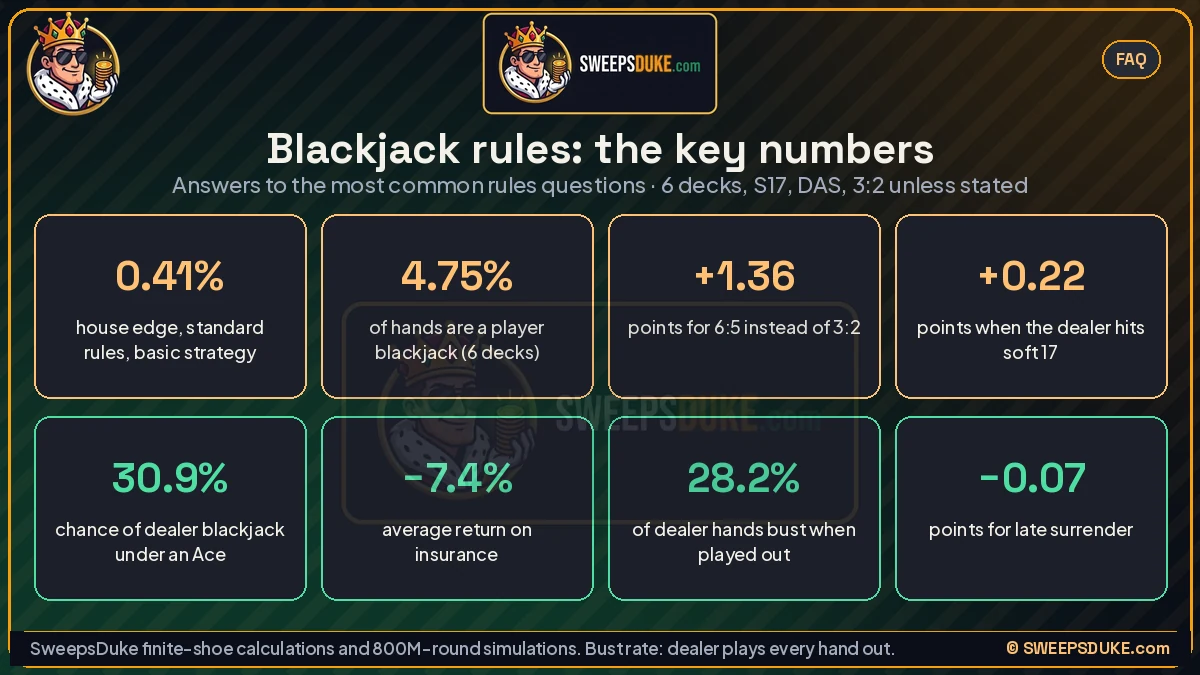
What are the basic rules of blackjack?
Get closer to 21 than the dealer without going over. Cards 2 to 10 count their number, face cards count 10 and Aces count 1 or 11. You play first; if you bust you lose. The dealer then draws to 17. Wins pay 1 to 1, a blackjack (Ace plus a 10-value card as your first two cards) pays 3 to 2, and ties push.
Does the dealer have to hit on 16?
Yes. The dealer must hit 16 or less and stand on 17 or more. The only variation is soft 17: at H17 tables the dealer hits it, at S17 tables the dealer stands. H17 adds about 0.22 points to the house edge.
Who wins if the player and dealer both have 21?
It's a push if both have 21 made the same way. A blackjack beats a multi-card 21, so your blackjack against a dealer's three-card 21 wins 3 to 2. A dealer blackjack beats your multi-card 21, although in a peek game the hand ends before you can draw to 21.
Is a split Ace and a 10 a blackjack?
No. After a split, an Ace and a 10 count as 21 and pay 1 to 1. Only the first two cards dealt to your original hand can make a blackjack.
What does 6:5 blackjack mean?
A blackjack pays 6 for every 5 you bet, so 12 on a 10-coin bet instead of 15. It adds about 1.36 points to the house edge, taking a standard 0.41% game to 1.77%. On its own it costs more than all the other bad rules on this page put together, apart from a 1:1 payout.
Should I take insurance or even money?
Not as a strategy. With an Ace showing in 6 decks, the dealer has blackjack 30.9% of the time, but insurance needs 33.3% to break even, so it loses about 7.4% of what you put on it. Even money costs about 3.9% of your bet compared with playing on.
What is the difference between late and early surrender?
Late surrender comes after the dealer checks for blackjack, so you can't use it to escape one. It takes about 0.07 points off the house edge. Early surrender comes before the check and is worth much more, about 0.63 points in our simulation, enough to give the player a small edge at otherwise standard 6-deck rules. Early surrender is rare.
Can you double after splitting?
At most tables, yes. The rule is called DAS (double after split). Without it, the house edge rises by about 0.14 points and basic strategy splits low pairs less often. Check the rules panel; live-dealer games sometimes don't allow it.
Do more decks make blackjack harder?
Slightly. With the same rules, 8 decks add 0.03 points to the 6-deck edge, while 2 decks take off 0.21 and one deck 0.54. Single-deck games usually come with worse rules that more than cancel that, such as 6:5 blackjack.
Are the rules different at sweepstakes casinos?
The card rules are the same. Each game has its own table rules in its info panel, and the site adds coin rules: Gold Coins are for fun play; Sweeps Coins are promotional coins with no purchase necessary and have playthrough and redemption terms. Eligibility, typically 18+ or 21+, depends on the site and your state.
How we got these numbers: every rule effect on this page comes from our own blackjack simulator, run on 2026-10-26 with 800 million rounds per rule set, a fresh shuffle every round, and basic strategy for each game. We measured each rule change on the same cards as the base game (common random numbers), so small effects are precise to about ±0.01 points. For restricted games we used the standard chart with barred plays replaced by their fallback. Our base result, a 0.41% house edge for 6 decks with S17, DAS and 3:2, agrees with our own finite-shoe calculation (0.40%). The soft-17, double-after-split, late-surrender and 8-deck effects come from the same 800-million-round runs used across our blackjack guides. Dealer bust rates, insurance and even money come from exact card-removal maths. So do the early-surrender and no-hole-card plays, computed for 6 decks with the dealer standing on soft 17. Our effects agree with published rule-variation tables to within about 0.05 points for most rules. The largest gaps are no resplitting (+0.06 here against about +0.10 published) and a single deck (−0.54 here, using a single-deck chart, against about −0.46 published). Basic strategy itself goes back to Baldwin, Cantey, Maisel and McDermott (Journal of the American Statistical Association, 1956).
18+ (21+ at many sweepstakes sites). Play for fun, not income. Blackjack has a house edge, and no strategy, system or count turns a sweepstakes or casino game into a way to make money. Set a time and spend limit before you start. Need help? Call or text 1-800-GAMBLER or see our responsible gaming page.