



Blackjack Cheat Sheet
Printable blackjack cheat sheets for 6, 2 and 1 decks, with and without late surrender, dealer hits or stands on soft 17, plus a mistake-cost map and quiz.
On this page
A blackjack cheat sheet is the whole of basic strategy squeezed onto one card: your hand down the side, the dealer's upcard across the top, and the right play where they meet. This page gives you six of them, one for each common rule set, so you never have to guess which cells apply to the table in front of you.
There's the standard 6-deck sheet in two versions, without surrender and with late surrender, the same pair for tables where the dealer hits soft 17, and sheets for double-deck and single-deck games. After those come a no-double sheet for hands you've already hit, a colour map of which cells cost the most to get wrong, ten memory lines, a rules checklist and a 12-hand quiz. Every cell is computed from the card maths for the stated rules and checked against published charts.
Affiliate disclosure: SweepsDuke may earn a commission if you sign up through some links on this site. That never changes our charts, math or verdicts. How we make money.
How to use this cheat sheet
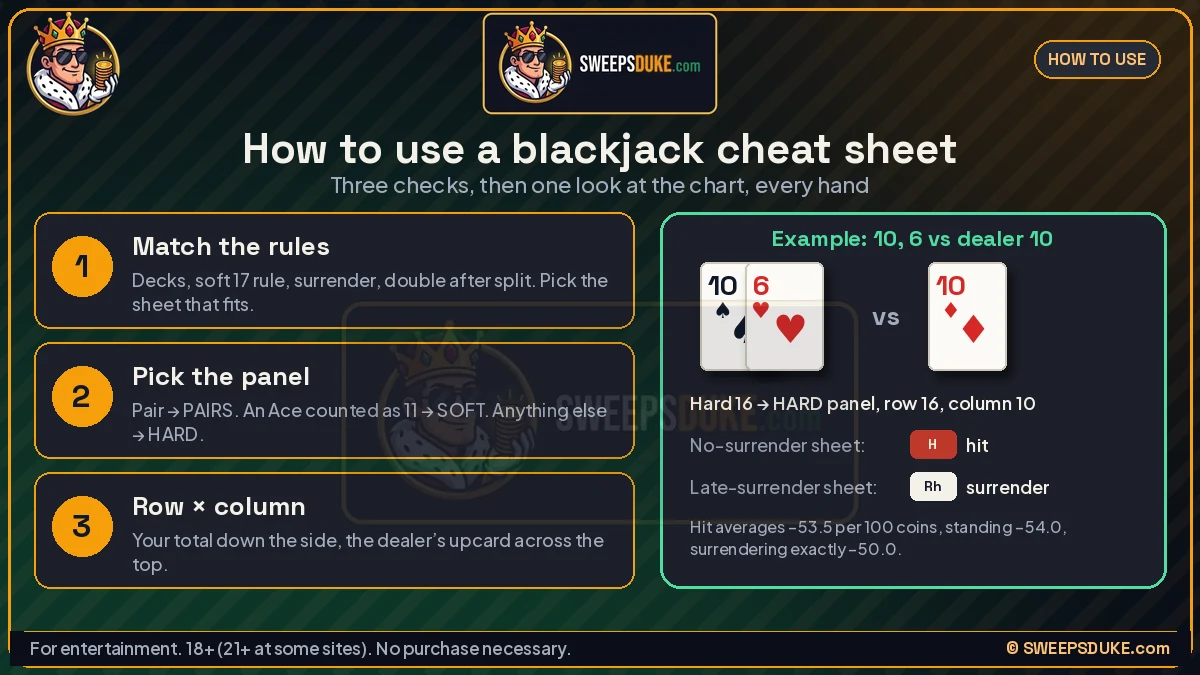
Using a cheat sheet takes three looks, and after a few sessions you only need the last one.
- Match the rules. Open the game's rules or info screen and note four things: how many decks, whether the dealer hits or stands on soft 17, whether late surrender is offered, and whether you can double after splitting. Those four answers tell you which sheet below to use. The next section walks you through it.
- Pick the panel. Every sheet has three panels. A pair (two cards of the same rank) goes to PAIRS. A hand with an Ace you can count as 11 without busting goes to SOFT TOTALS. Everything else goes to HARD TOTALS. A 10 and a King count as a pair of 10s.
- Read row × column. Find your hand down the left side and the dealer's upcard across the top. The letter in that cell is your play.
Worked example. You hold 10, 6 and the dealer shows a 10. That's a hard 16, so go to the hard panel, row 16, column 10. On the no-surrender sheet the cell says H: hit. On the late-surrender sheet it says Rh: surrender if you can, otherwise hit. The numbers explain why. Per 100 coins bet, hitting averages −53.5, standing −54.0, and surrendering gives back half your bet for an exact −50.0. When surrender is on the menu it's the least-bad option. When it isn't, hitting edges standing by half a coin.
The codes. H = hit. S = stand. Dh = double if you're allowed, otherwise hit. Ds = double if allowed, otherwise stand. P = split. Ph = split if you can double after splitting, otherwise hit. Pd (single deck only) = split if you can double after splitting, otherwise double. Rh / Rs / Rp = surrender if it's offered, otherwise hit, stand or split. Because the surrender codes carry their fallback, a surrender sheet still works at a table without surrender. We give you both versions of the 6-deck sheets anyway, so there's nothing to translate mid-hand.
Printing it. Each sheet is a 1200 × 675 image. Print it landscape on A4 or US Letter at "fit to page" and the cells come out about 6 to 7 mm wide, large enough to read at arm's length. Print only the sheet that fits your table. Carrying the wrong one is worse than carrying none, because it makes you confident about the wrong cells.
Which cheat sheet fits your table?
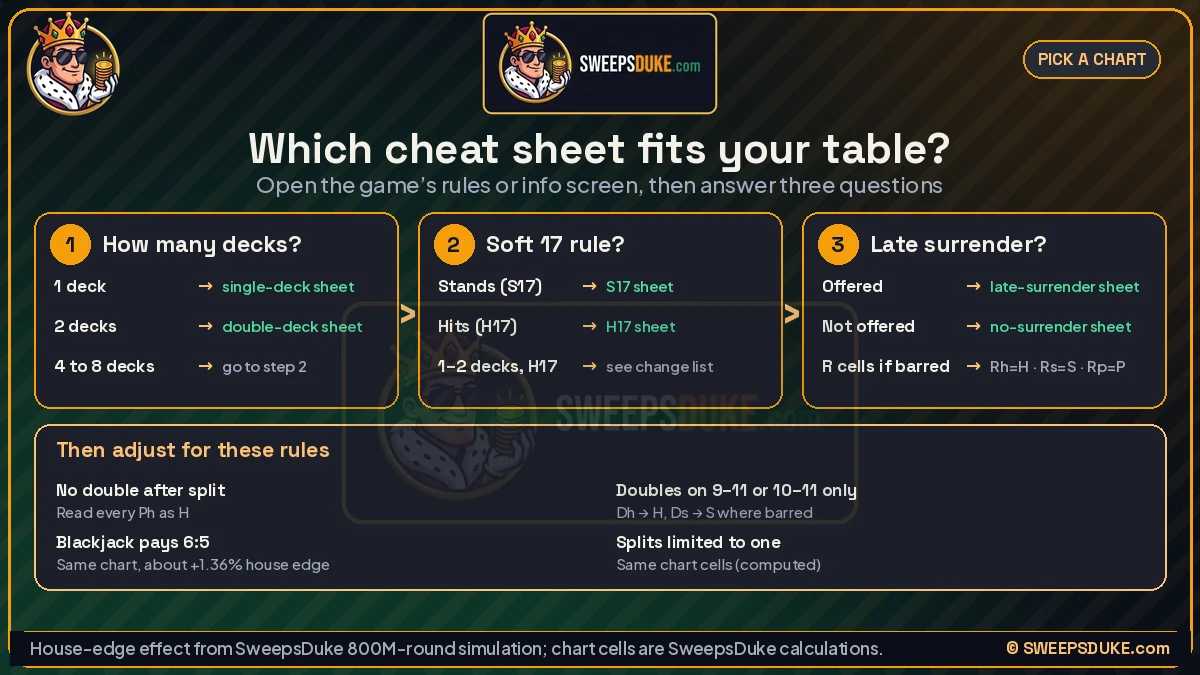
Most rules screens state the deck count and soft 17 rule in the first lines ("Dealer must stand on all 17s", "Dealer hits soft 17"). Surrender and double-after-split rules are usually listed under the player options. Work through three questions:
| Question | Answer | Use |
|---|---|---|
| 1. How many decks? | 1 | Single-deck sheet |
| 2 | Double-deck sheet | |
| 4 to 8 | Go to question 2 | |
| 2. Soft 17 rule? | Dealer stands (S17) | S17 sheets |
| Dealer hits (H17) | H17 sheets | |
| 3. Late surrender? | Offered | The late-surrender version |
| Not offered | The no-surrender version |
Then make the small adjustments the sheets can't show:
- No double after split. Read every Ph as H. That changes exactly seven cells on the 6-deck sheet: 2,2 and 3,3 against a 2 or 3, 4,4 against a 5 or 6, and 6,6 against a 2. Every other split stays.
- Doubling only on 9 to 11, or 10 and 11. Where the table bars the double, take the fallback: Dh means hit and Ds means stand. The soft doubles all fall into this group.
- Only one split per hand. Keep the same sheet. We recomputed an 8-deck game with no double after split and a single split, a rule set many live-dealer tables use, and every cell matched our 6-deck no-DAS chart (the S17 sheet with Ph read as H).
- 6:5 blackjack payout. The sheet barely changes, but the effect on the house edge is about +1.36 percentage points in our simulation. That's more than three times the whole 0.41% edge of the 3:2 game. No chart fixes a 6:5 table, so look for a 3:2 one.
Fewer decks than four, plus H17? Use the 1- or 2-deck S17 sheet and the short H17 change list printed under it.
Cheat sheet 1: 6 decks, dealer stands on soft 17, no surrender
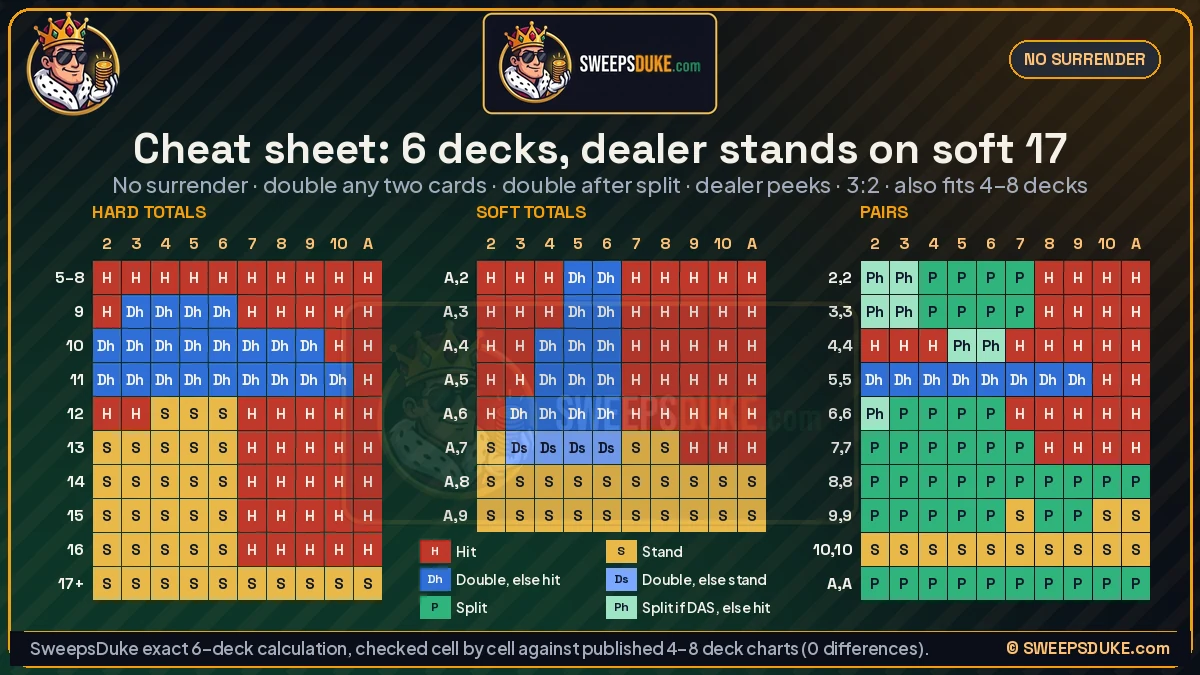
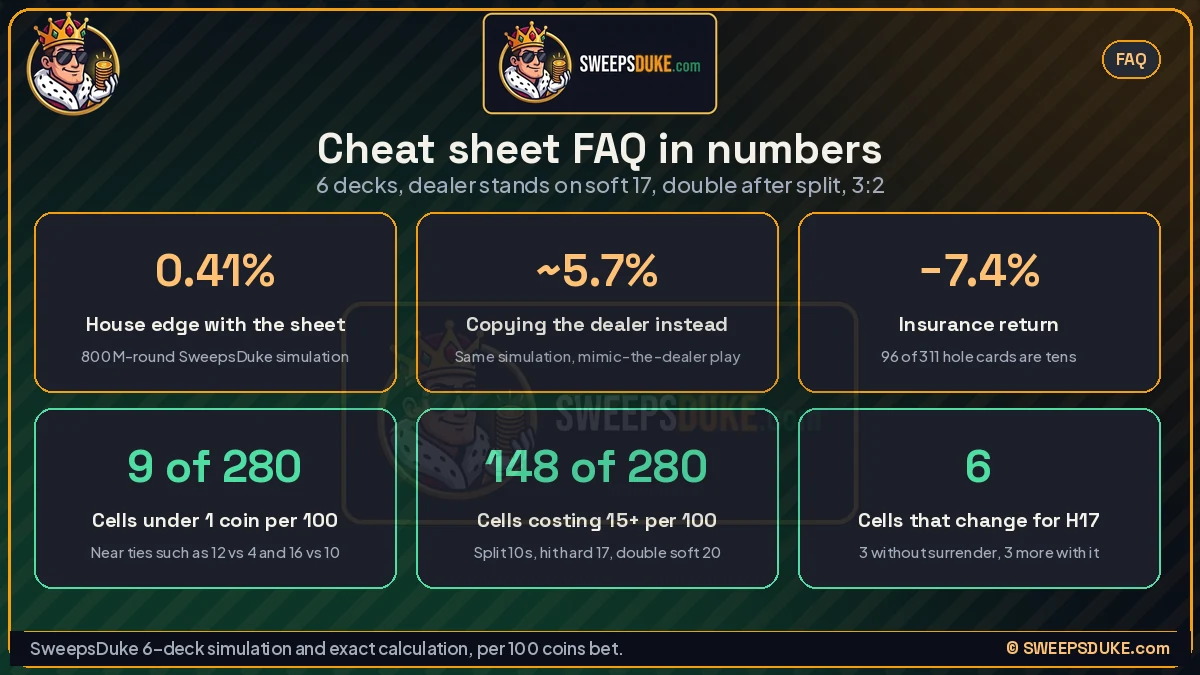
This is the sheet to print if you print only one. It fits the most common shoe game: 4 to 8 decks, the dealer stands on all 17s, you can double any first two cards and double after splitting, and blackjack pays 3:2. Played perfectly at these rules, our 800-million-round simulation puts the house edge at 0.41%. For comparison, copying the dealer (hit to 17, never double or split) gives the house about 5.7%.
The same chart holds for 4, 6 and 8 decks. Our 8-deck recomputation matched the 6-deck sheet in every cell, and the published 4-to-8-deck chart matches it in every cell we compared. Deck count only starts to move cells below four decks.
How to get the most out of this version:
- Three rows decide most hands. Hard 12 to 16, soft 18 and the 9 to 11 doubles are where hunch players lose most. The mistake map further down shows which cells are expensive and which are near coin flips.
- The two odd cells in hard 12. Hit 12 against a 2 or 3, stand against 4 to 6. Against a 2 hitting averages −25.3 per 100 coins versus −29.3 for standing. Against a 4 standing wins by only 0.3 coins (−20.9 vs −21.2), and that tiny margin is the reason the line falls where it does.
- Soft 18 has three answers. Stand against 2, 7 and 8, double against 3 to 6, hit against 9, 10 and Ace. Against a 2 it's close: standing averages +12.4 and doubling +12.1, so the sheet says stand. Against a 9, hitting (−9.8) beats standing (−18.3) by more than 8 coins, because 18 loses to the dealer's most likely total of 19.
- Pairs with an asterisk. The light green Ph cells only split if double after split is allowed. Check before you play, not mid-hand.
For the reasoning behind every cell, hand by hand, read our full basic strategy guide. This page is the quick-reference companion to it.
Cheat sheet 2: 6 decks, S17, late surrender
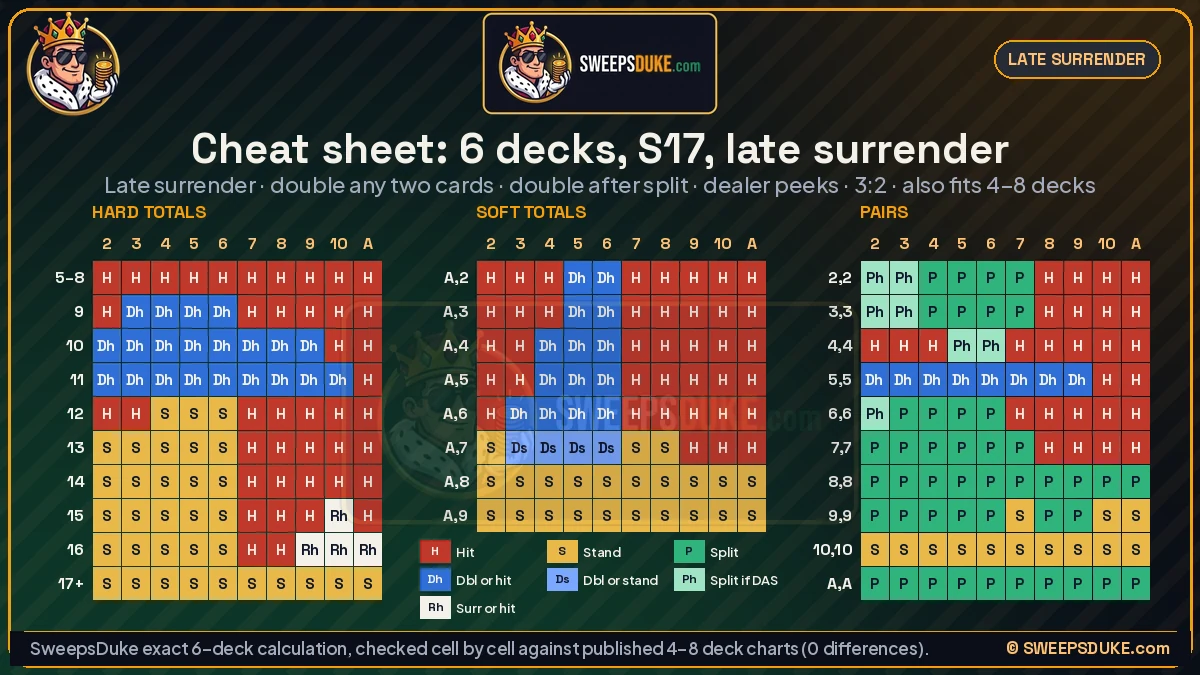
Late surrender means you can give up half your bet after the dealer has checked for blackjack, before you take any other action. It's only worth it when a hand loses more than half its bet on average, and at these rules that happens in exactly four cells, all shown in white:
| Hand | Dealer | Best other play (per 100 coins) | Surrender | Saved per 100 coins |
|---|---|---|---|---|
| Hard 16 | 10 | Hit −53.5 | −50.0 | 3.5 |
| Hard 16 | Ace | Hit −51.5 | −50.0 | 1.5 |
| Hard 16 | 9 | Hit −50.5 | −50.0 | 0.5 |
| Hard 15 | 10 | Hit −50.3 | −50.0 | 0.3 |
Three things this version makes clear:
- 8,8 against a 10 is still a split, not a surrender. Splitting averages −47.5 per 100 coins, better than giving up −50.0.
- Hard 15 against an Ace stays a hit at S17 (−48.1, better than −50.0), and hard 17 against an Ace stays a stand (−47.6). Both turn into surrenders only when the dealer hits soft 17. See cheat sheet 4.
- Surrender is the first thing you check. Once you hit, split or double, it's gone. So look for an R before anything else on these sheets.
The published effect of late surrender at these rules is small, about 0.07 percentage points off the house edge, because the four cells are uncommon hands.
Cheat sheet 3: 6 decks, dealer hits soft 17, no surrender
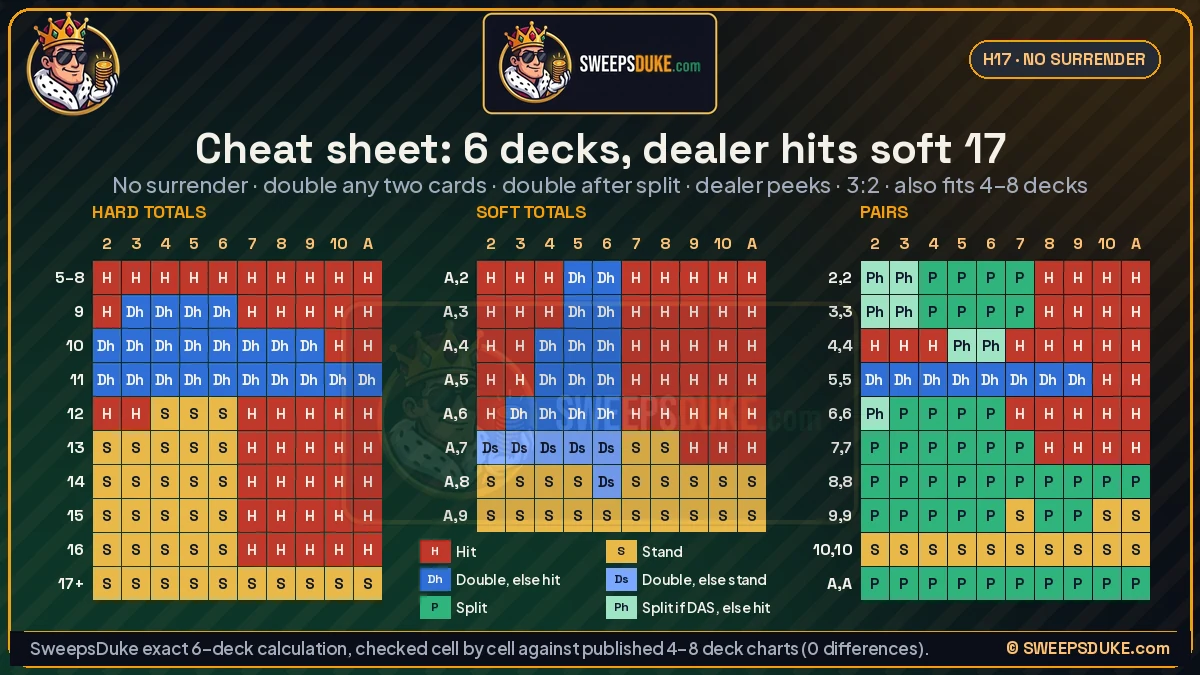
When the dealer hits soft 17 (an Ace plus cards totalling 6), the dealer improves some weak hands and busts more often with a small upcard. The published cost to you is about 0.22 percentage points of house edge. Three cells change from cheat sheet 1, all of them doubles:
| Hand | Dealer | S17 sheet | H17 sheet | Why (H17, per 100 coins) |
|---|---|---|---|---|
| Hard 11 | Ace | H | Dh | Double +11.8 beats hit +10.7 |
| Soft 18 (A,7) | 2 | S | Ds | Double +11.6 edges stand +11.3 |
| Soft 19 (A,8) | 6 | S | Ds | Double +46.2 beats stand +45.2 |
The pattern is the same in all three: an H17 dealer busts more often. With an Ace up, it busts 20.1% of the hands that pass the blackjack check instead of 16.7%, and with a 6 up 43.9% instead of 42.3%. More dealer busts make doubling worth more. None of the margins is large, so a player using the S17 sheet at an H17 table gives up only a little on these cells. The bigger cost is the rule itself.
Cheat sheet 4: 6 decks, H17, late surrender
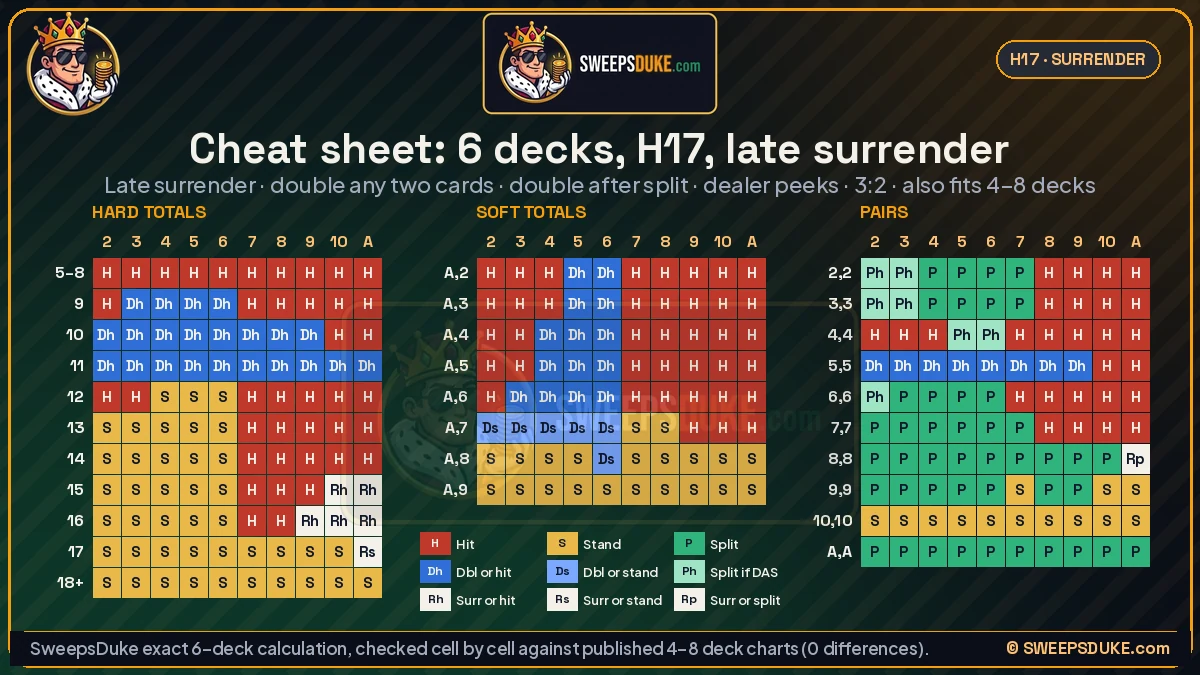
Add late surrender to an H17 game and you get the busiest version of the sheet: seven surrender cells instead of four. The four from cheat sheet 2 are joined by three Ace cells:
| Hand | Dealer | Without surrender (per 100 coins) | Surrender |
|---|---|---|---|
| Hard 15 | Ace | Hit −50.8 | Rh: −50.0 |
| Hard 17 | Ace | Stand −51.3 | Rs: −50.0 |
| 8,8 | Ace | Split −51.5 | Rp: −50.0 |
Hard 17 against an Ace is the one people miss. At an S17 table standing averages −47.6, so you keep the hand. At an H17 table the dealer's soft 17s keep drawing, standing drops to −51.3, and surrender becomes the better play. Because the hard panel has an extra row for 17, the sheet prints "17" and "18+" separately.
If surrender isn't offered at an H17 table, use cheat sheet 3 rather than reading the codes. It's the same answer, but there's less to think about.
Double-deck cheat sheet, dealer stands on soft 17
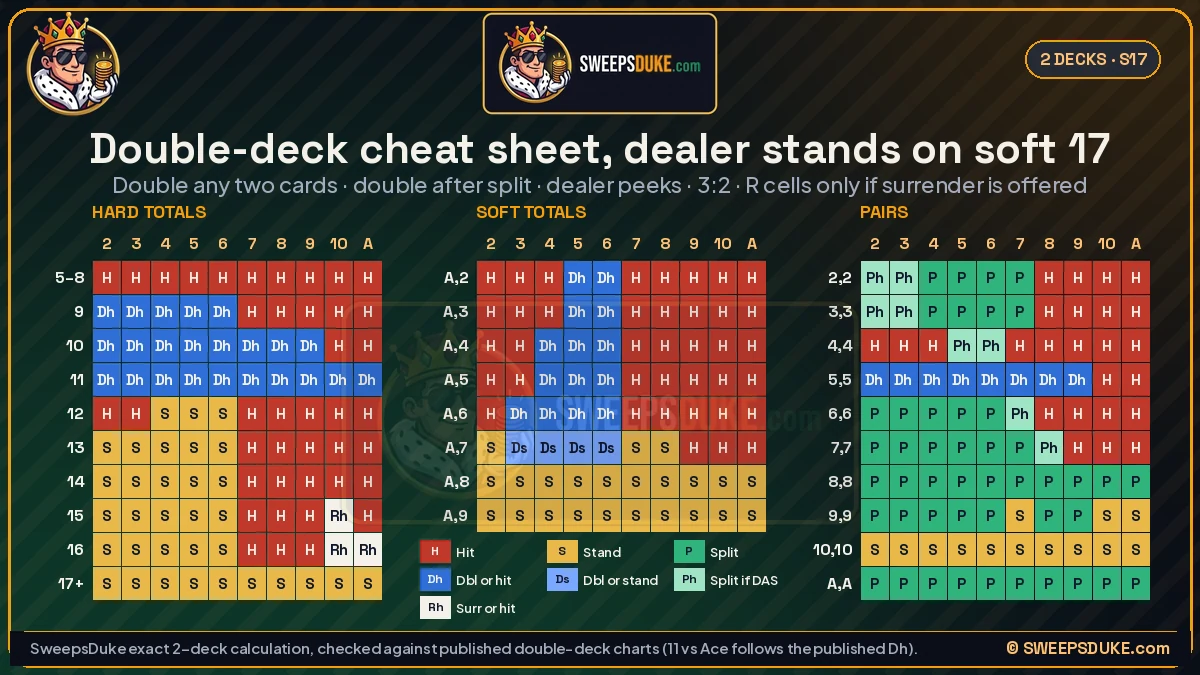
With only two decks, each card dealt shifts the odds of the rest a little more, and five cells move compared with the 6-deck sheet:
- Hard 9 against a 2: double (Dh), where the 6-deck sheet says hit.
- Hard 11 against an Ace: double (Dh). This is a near tie in our calculation: hit +15.4, double +15.2 per 100 coins. Published double-deck charts double here, and so does this sheet.
- 6,6 against a 2: split even without double after split (P, not Ph).
- 6,6 against a 7 and 7,7 against an 8: split if you can double after splitting (Ph), otherwise hit.
Surrender cells (white) apply only if the table offers late surrender: 16 against 10 and Ace, and 15 against 10. 16 against a 9 drops out of the list at two decks.
If the double-deck dealer hits soft 17, change these cells:
- Without surrender: soft 14 (A,3) against a 4 becomes Dh (double +8.71 vs hit +8.65 per 100 coins, a dead heat that tips to double), soft 18 against a 2 becomes Ds (double +12.0 vs stand +11.9), and soft 19 against a 6 becomes Ds (double +46.4 vs stand +45.0). Hard 11 against an Ace is already a double on this sheet and gets clearer (double +14.7 vs hit +11.6).
- With surrender, also: hard 15 against an Ace Rh, hard 17 against an Ace Rs, and 8,8 against an Ace Rp. That last one is a published play. In our calculation splitting (−49.6) and surrendering (−50.0) are within half a coin of each other.
Single-deck cheat sheet, dealer stands on soft 17
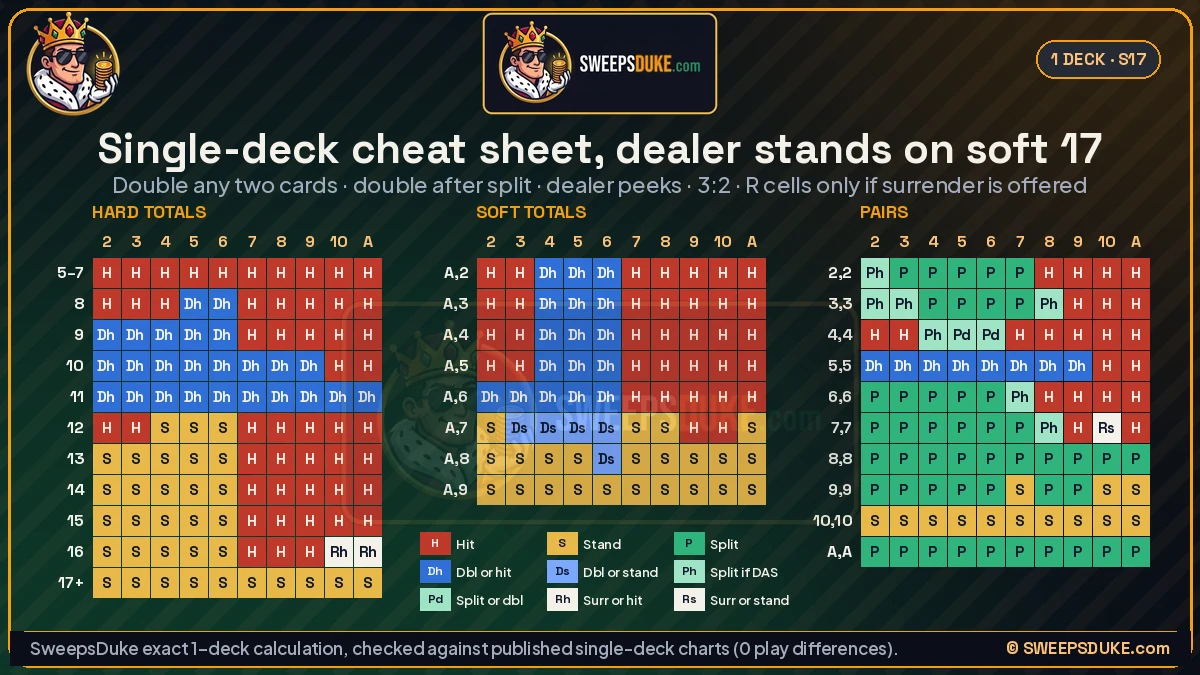
A single deck changes the most cells, because the two cards in your hand and the dealer's upcard are already 3 of only 52. Hard 5 to 7 and hard 8 get separate rows on this sheet, because 8 doubles against a 5 and 6. Compared with the 6-deck sheet:
- More doubles: 8 against 5 and 6; 9 against a 2; 11 against an Ace; soft 13 and 14 (A,2 and A,3) against a 4; soft 17 (A,6) against a 2; soft 19 (A,8) against a 6 (Ds).
- Soft 18 against an Ace: stand. In our calculation standing averages −10.1 per 100 coins versus −10.6 for hitting.
- More splits: 2,2 against a 3; 6,6 against a 2; 3,3 against an 8 and 4,4 against a 4 if you can double after splitting; 6,6 against a 7 and 7,7 against an 8 with DAS too.
- 4,4 against a 5 or 6 is Pd: split with double after split, otherwise double (a single-deck hard 8 doubles against 5 and 6).
- 7,7 against a 10: surrender if you can (Rs). Otherwise stand, because a two-card 14 made of 7s leaves fewer 7s to draw.
If the single-deck dealer hits soft 17, change these cells:
- Without surrender: soft 18 against an Ace becomes a hit (hit −17.0 vs stand −22.4), and 9,9 against an Ace becomes Ps (split with DAS, otherwise stand). The 9,9 cell is the published play. In our calculation standing (−18.6) and splitting (−19.2) are within a coin of each other.
- With surrender, also: hard 15 against an Ace Rh, hard 17 against an Ace Rs, and 7,7 against an Ace Rh (hitting averages −51.8, so surrender's −50.0 is better).
Single-deck games often come with other rule cuts, such as 6:5 blackjack or doubling only on 10 and 11, and those can easily cost more than the extra deck saves. Run the rules check before you assume a single-deck table is the better game.
After you hit: the no-double cheat sheet
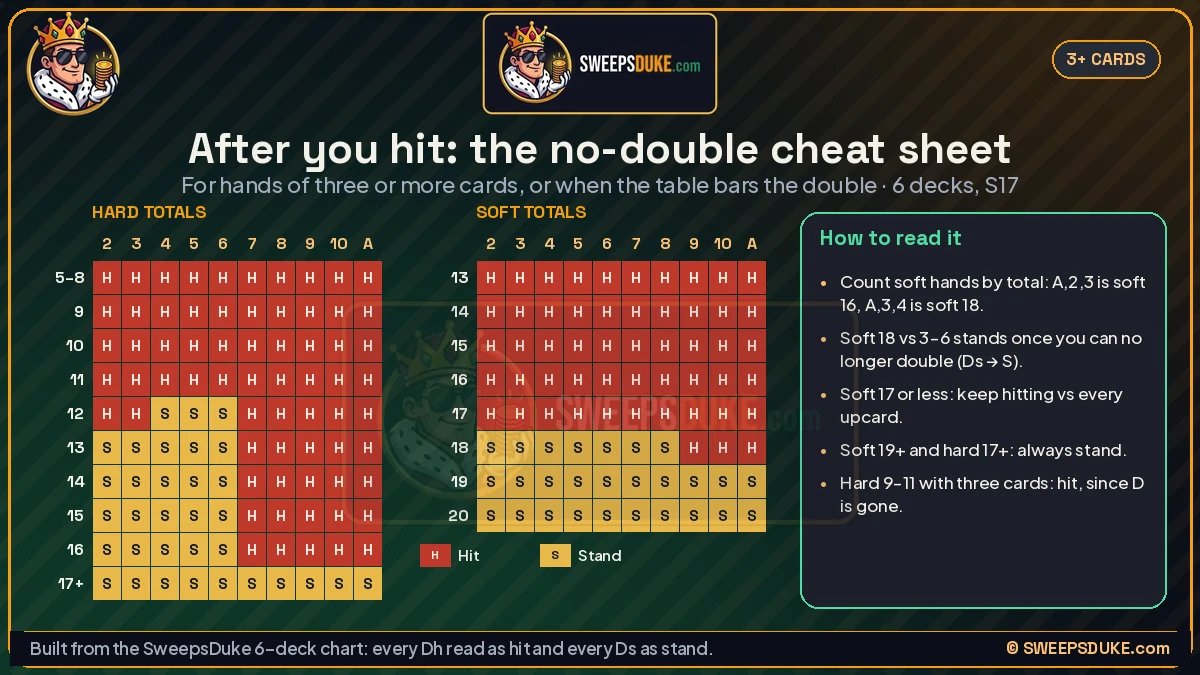
Every printed chart is built for your first two cards, but plenty of decisions come later. You hit A,2 against a 9 and draw a 3: what now? You can't double any more, so the D cells no longer apply. This sheet removes them. Every Dh becomes H and every Ds becomes S, and the soft panel is labelled by total, not by the two-card hand.
How to use it:
- Count soft hands by total. A,2,3 is soft 16, so read the soft 16 row: hit against everything. A,3,4 is soft 18: stand against 2 to 8, hit against 9, 10 and Ace.
- Soft 18 against 3 to 6 stands once doubling is gone. Against a 6, standing averages +28.0 per 100 coins and hitting +19.1, so hitting a three-card soft 18 there is a real mistake.
- A soft hand that turns hard moves panels. A,6 + 9 is hard 16 (the Ace now counts as 1). Go back to the hard panel.
- The same sheet covers tables that bar soft doubles or limit doubling to 10 and 11. Use the cells it shows wherever your table bars the double.
One fine point the sheet doesn't show: with a multi-card 16 against a 10 (say 4, 4, 8 or 5, 5, 6), standing is very slightly better than hitting, because the small cards you hold are cards the shoe no longer has. With 10, 6 or 9, 7, hitting stays ahead. In our 6-deck calculation the gap is under 0.7 coins per 100 either way, so the sheet's H is a perfectly good default.
Which cheat-sheet cells cost the most to get wrong?
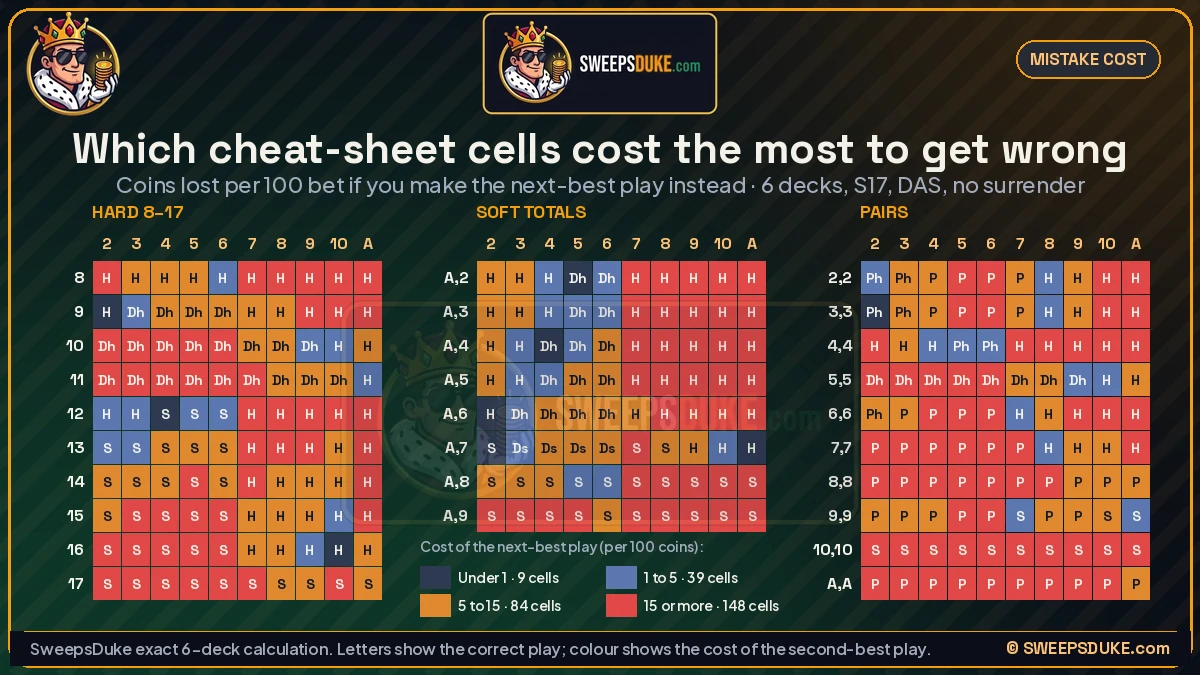
Not every cell is equally important. For every cell on the 6-deck S17 sheet (no surrender), we calculated how much you give up per 100 coins bet if you make the second-best play instead of the right one. The colours on the map show the result:
| Cost of the next-best play | Cells | Examples |
|---|---|---|
| Under 1 coin per 100 | 9 of 280 | 12 vs 4, 16 vs 10, soft 18 vs 2, soft 13 vs 5 |
| 1 to 5 coins | 39 | 13 vs 2, 11 vs Ace, 7,7 vs 8, 2,2 vs 8 |
| 5 to 15 coins | 84 | 16 vs 7, 9,9 vs 9, soft 18 vs 9 |
| 15 coins or more | 148 | Split 10s, hit hard 17, double soft 20 |
The nine near-tie cells are 12 vs 4, 16 vs 10, soft 13 (A,2) vs 5, soft 15 (A,4) vs 4, soft 17 (A,6) vs 2, soft 18 vs 2, soft 18 vs Ace, 9 vs 2 and 3,3 vs 2. These are the cells where players argue the most and where it matters least. Get them right, but don't lose sleep over them.
The expensive end is the opposite. Splitting 10s against a 9 costs 97 coins per 100 bet compared with standing on 20, because you break up a hand that averages +75.6 per 100 coins and replace it with two hands that each start from 10. Hitting a hard 17 against a 6 costs 51 coins per 100. Taking a card on 8,8 against a 7 instead of splitting costs 73. The common hunch mistakes are in this group too: standing on 16 against a 7 costs 6.8, and hitting 11 against a 6 instead of doubling costs 33.9.
How to study with it: learn the red cells first, because they're the hands that drain the most coins, then the orange cells, then the rest. Near the start, a chart you check for every hand beats a chart you half-remember.
Ten lines that cover the whole sheet
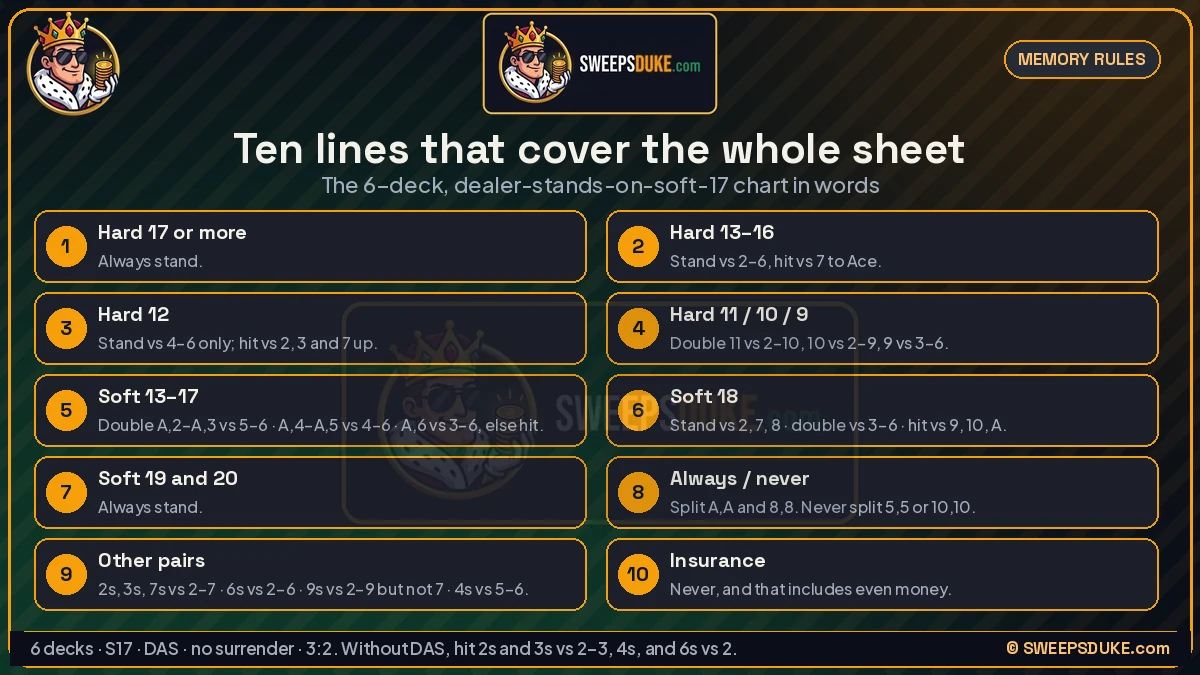
Once you've used the 6-deck S17 sheet for a while, these ten lines are enough to play it from memory:
- Hard 17 or more: always stand.
- Hard 13 to 16: stand against 2 to 6, hit against 7 to Ace.
- Hard 12: stand against 4 to 6 only. Hit against 2, 3 and 7 up.
- Hard 11, 10, 9: double 11 against 2 to 10, 10 against 2 to 9, 9 against 3 to 6. Otherwise hit.
- Soft 13 to 17: double A,2 and A,3 against 5 and 6, A,4 and A,5 against 4 to 6, and A,6 against 3 to 6. Otherwise hit.
- Soft 18: stand against 2, 7 and 8, double against 3 to 6, hit against 9, 10 and Ace.
- Soft 19 and 20: always stand.
- Always split Aces and 8s. Never split 5s (play them as hard 10) or 10s.
- Other pairs: split 2s, 3s and 7s against 2 to 7; 6s against 2 to 6; 9s against 2 to 9 except 7; 4s only against 5 and 6. Without double after split, hit 2s and 3s against 2 and 3, hit 4s, and hit 6s against a 2.
- Insurance: never, and that includes even money.
Line 10 is the easiest line on the sheet to follow. In a 6-deck shoe, when the dealer shows an Ace, 96 of the 311 unseen cards are 10-value. An insurance bet pays 2 to 1 and wins only when the hole card is one of them, so it returns about −7.4% on what you put up, or −6.8% if your own two cards aren't 10s. With a blackjack of your own, declining even money averages 1.039 times your bet against the guaranteed 1.0, so taking even money gives up about 3.9 coins per 100 bet.
Check these rules before you play
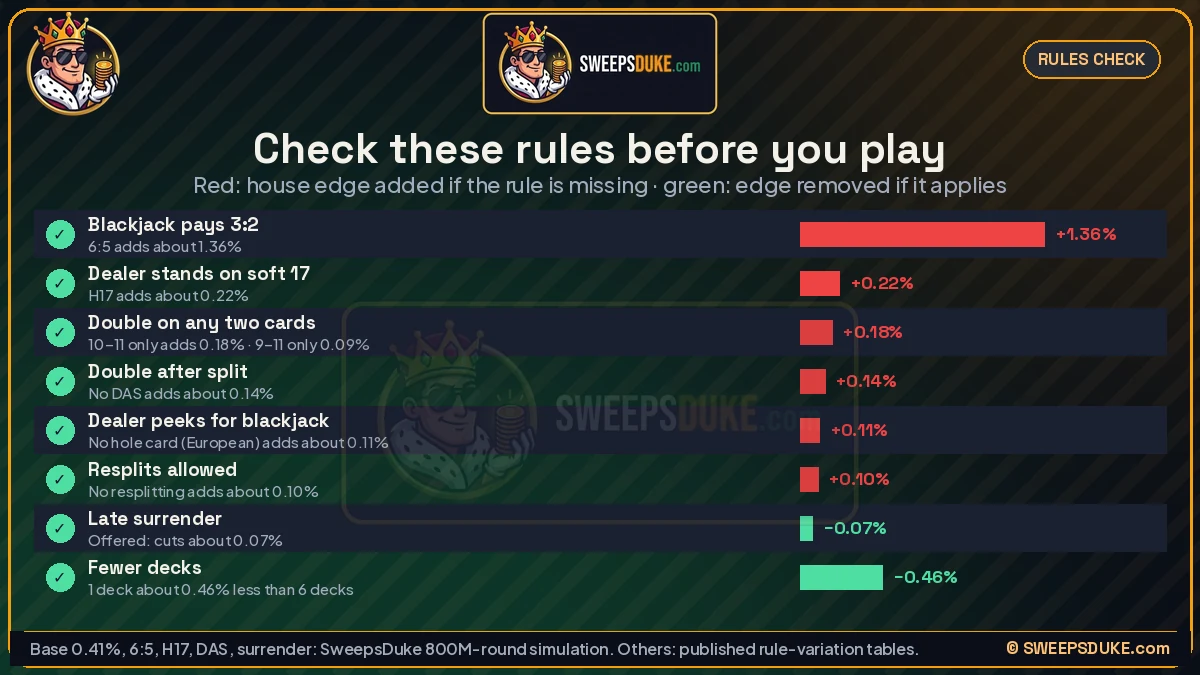
A cheat sheet only gets you the house edge the table's rules allow. These are the rules worth checking, with the effect of each against a 6-deck base game. The payout, soft 17, double-after-split and surrender lines are from our own simulation; the rest are published rule-variation figures. The figures are approximate, change a little with deck count, and add roughly when combined.
| Check for | If it's missing or worse | Effect on the house edge |
|---|---|---|
| Blackjack pays 3:2 | Pays 6:5 | +1.36 points |
| Dealer stands on soft 17 | Dealer hits soft 17 | +0.22 |
| Double on any first two cards | 10 and 11 only (9 to 11 only) | +0.18 (+0.09) |
| Double after split | Not allowed | +0.14 |
| Dealer peeks for blackjack | No hole card (European style) | +0.11 |
| Resplitting allowed | No resplits | +0.10 |
| Late surrender | Offered | −0.07 |
| Fewer decks | 1 deck instead of 6 (2 decks) | −0.46 (−0.17) |
Read the table like this. Start at 0.41% for 6 decks, S17, DAS and 3:2. A table that hits soft 17 and bars doubling after splits is about 0.41 + 0.22 + 0.14 = 0.77%. Make it pay 6:5 and you're above 2%. That's why the payout line comes first: no other rule comes close.
"Dealer peeks" matters for a second reason. Our sheets assume the dealer checks for blackjack before you act, so you never lose a double or split to a dealer natural. In a no-hole-card game you lose those extra bets, and the right play is to double and split a little less against a 10 or Ace. The rules guide explains each rule in plain words, and the house edge guide shows how they combine.
Test yourself: 12 hands
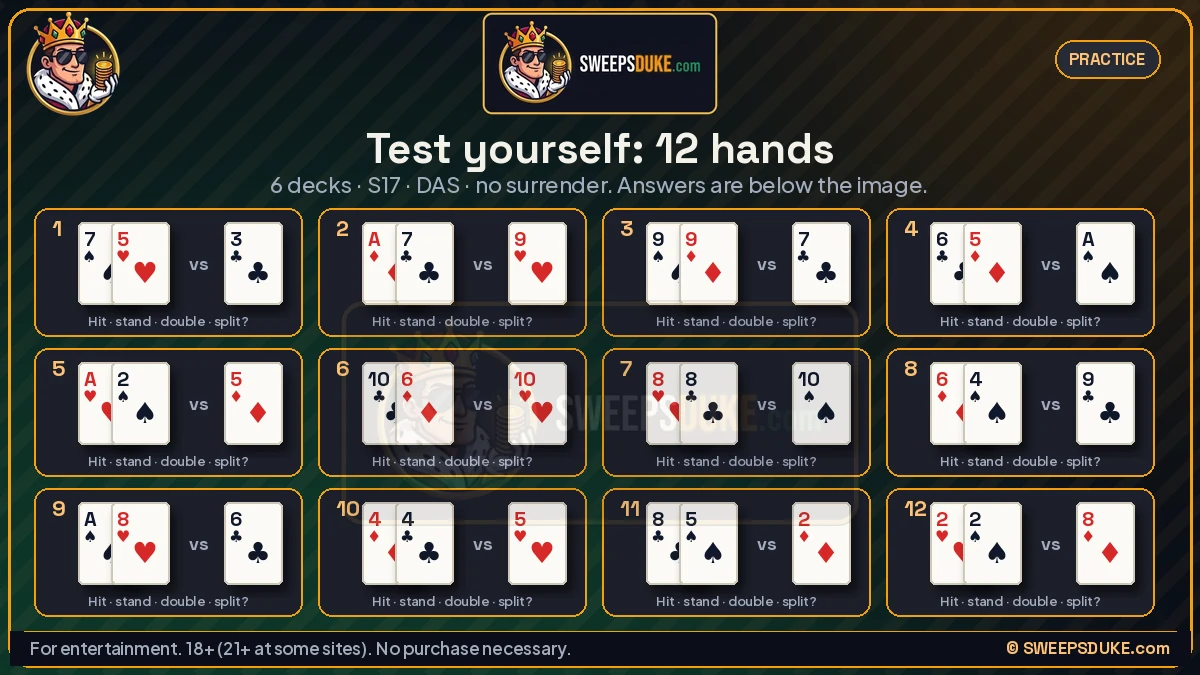
Cover the answers, use the 6-deck S17 no-surrender sheet in your head, and check yourself. All twelve hands come from the cells players miss most often.
| # | Hand | Dealer | Answer | Why (per 100 coins) |
|---|---|---|---|---|
| 1 | 7, 5 (hard 12) | 3 | Hit | Hit −23.2 vs stand −25.2 |
| 2 | A, 7 (soft 18) | 9 | Hit | Hit −9.8 vs stand −18.3 |
| 3 | 9, 9 | 7 | Stand | Stand +40.0 vs split +36.4. Your 18 beats the dealer's likely 17 |
| 4 | 6, 5 (hard 11) | Ace | Hit | Hit +14.7 vs double +12.3 (double if the dealer hits soft 17) |
| 5 | A, 2 (soft 13) | 5 | Double | Double +14.0 vs hit +13.7, a near tie |
| 6 | 10, 6 (hard 16) | 10 | Hit (surrender if offered) | Hit −53.5 vs stand −54.0, surrender −50.0 |
| 7 | 8, 8 | 10 | Split | Split −47.5 vs hit −53.5 |
| 8 | 6, 4 (hard 10) | 9 | Double | Double +14.7 vs hit +11.7 |
| 9 | A, 8 (soft 19) | 6 | Stand | Stand +49.4 vs double +48.0 (double if H17) |
| 10 | 4, 4 | 5 | Split (with DAS) | Split +11.0 vs hit +8.4. Without DAS, hit |
| 11 | 8, 5 (hard 13) | 2 | Stand | Stand −29.3 vs hit −30.8 |
| 12 | 2, 2 | 8 | Hit | Hit −15.7 vs split −17.7 |
Scored 12 out of 12? Try it with the H17 sheet: hands 4 and 9 flip to doubles. Missed some? Hands 2, 3 and 9 are all soft-total or 18-versus-the-dealer questions, so they're worth an extra look on the sheet. If any of the moves themselves (splitting, doubling, surrender) are unclear, our how to play guide walks through each one.
Using a cheat sheet at sweepstakes casinos
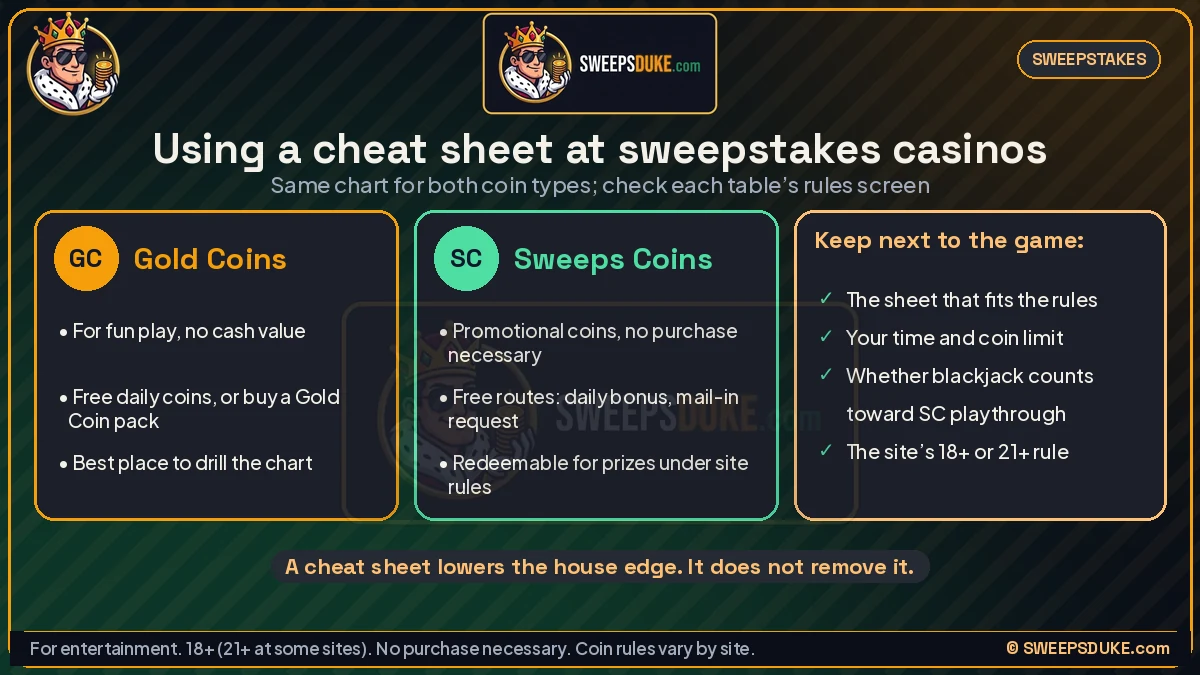
The cheat sheet works the same whichever coins you play with, because the cards don't know the difference. What changes is how you use each coin type:
- Gold Coins are for fun play and have no cash value. You get free Gold Coins from daily logins and promotions, or you can buy a Gold Coin pack. They're the best way to drill the sheet: play with it open, and note every hand you had to look up.
- Sweeps Coins are promotional coins. No purchase is necessary to get them: sites give them out through daily bonuses, mail-in requests and other free routes, and sometimes as a free bonus with Gold Coin packs. Sweeps Coins you've played through can be redeemed for prizes under each site's rules. Check the playthrough requirement and whether blackjack counts toward it, because table games can count differently from slots.
- Rules still vary. Sweepstakes blackjack games use the same rule variations as any other table: deck count, soft 17, surrender and the payout. Open the rules screen and pick the matching sheet before you play your first hand.
Playing online on your own screen, you can keep the cheat sheet open in another window or printed beside you. A chart uses no hidden information, only the cards everyone can see. If you're ever unsure, the site's terms are what count. You must be 18 or older to play, and 21 at many sites.
Blackjack cheat sheet FAQ
Is using a blackjack cheat sheet allowed?
A strategy chart isn't a cheating device. It only tells you the best play for cards that are face up for everyone. Online, the sheet sits on your own screen or desk. In a land casino policies vary, so ask the dealer or floor before you put a card on the table.
Which cheat sheet should I use if I don't know the rules?
Use cheat sheet 1 (6 decks, S17, no surrender). It's the most common shoe game. At a 4-to-8-deck table where the dealer hits soft 17, the three cells it gets wrong (without surrender) each cost about a coin per 100 bet or less. Then check the rules screen and switch when you can.
Does a cheat sheet let me beat the house?
No. With every cell right at the best common rules, the house still keeps about 0.41% of what you bet over time, and you'll still have losing sessions. The sheet makes sure you don't pay more than that, compared with about 5.7% for copying the dealer.
Why does the chart sometimes say to hit when I'll probably bust?
Because the alternative is worse. Hard 16 busts on about 62% of single hits, but standing on 16 only wins if the dealer busts, which happens 23% of the time behind a 10 upcard. Over many hands hitting loses slightly less. The mistake map shows that cell is a near tie either way.
Why are there separate late-surrender and no-surrender sheets?
So you don't have to translate codes mid-hand. The late-surrender sheet marks the cells where giving up half your bet loses less than playing on. The no-surrender sheet has the fallback play already filled in. Both are correct for their own rules.
Do I need a different sheet for 8 decks?
No. Our 8-deck calculation matched the 6-deck sheet in every cell, for the S17 rules and for the no-DAS, one-split rules many live-dealer tables use (read Ph as H). Only one and two decks need their own sheets.
What's the difference between this page and the basic strategy guide?
This page is the reference card: the charts for each rule set, the cells that matter, and the checks to make. The basic strategy guide is the explanation, with the maths and worked hands behind each part of the chart.
Every chart cell and figure on this page comes from our own finite-shoe calculation for the stated rules. It uses exact card-removal maths for standing, hitting, doubling and splitting, with the dealer's hole card conditioned on no blackjack. Our 6-deck S17 and H17 sheets matched the published 4-to-8-deck charts in all 330 cells compared, our 8-deck results matched our 6-deck sheets, and the no-DAS one-split 8-deck chart matched our 6-deck no-DAS chart. Our 1- and 2-deck sheets differed from the published charts only in near-tie cells, and there we follow the published play and say so. Mistake costs are the gap between the best and second-best play in each cell, per 100 coins bet. The 0.41% and 5.7% figures come from our 800-million-round simulation, which also gives the effects of 6:5, soft 17, double after split and late surrender. Other rule effects come from published rule-variation tables. Basic strategy itself goes back to Baldwin, Cantey, Maisel and McDermott (Journal of the American Statistical Association, 1956).
18+ (21+ at many sweepstakes sites). Play for fun, not income. Blackjack has a house edge, and no strategy, system or count turns a sweepstakes or casino game into a way to make money. Set a time and spend limit before you start. Need help? Call or text 1-800-GAMBLER or see our responsible gaming page.