



What Is Blackjack?
What is blackjack? A card game against the dealer: get closer to 21 without busting. Card values, a full round, payouts, the 0.41% house edge, variants and history.
On this page
Blackjack is a card game you play against the dealer. You and the dealer each build a hand, and the hand closer to 21 wins, as long as it doesn't go over. Number cards count their number, Jacks, Queens and Kings count 10, and an Ace counts 1 or 11. An Ace plus a 10-value card as your first two cards is a blackjack, which usually pays 3 to 2.
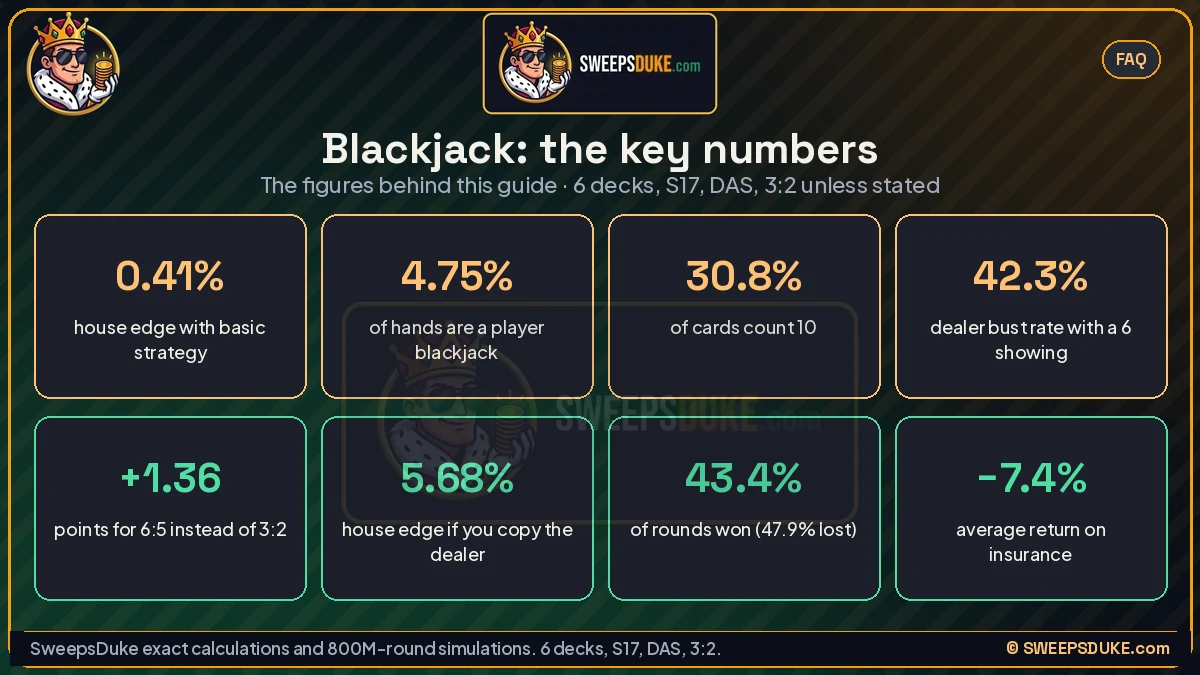
What makes blackjack different from almost every other casino game is that your decisions matter. The dealer follows a fixed rule. You choose when to hit, stand, double, split or surrender, and those choices decide how much the game costs you. Played by the chart, a standard game has a house edge of about 0.41%. Copy the dealer instead and it is 5.68%. This guide explains how the game works, why the dealer still wins in the long run, what each choice is worth, and how variants, online games and sweepstakes play change the picture. Every number on this page comes from our own simulations and exact calculations.
Affiliate disclosure: SweepsDuke may earn a commission if you sign up through some links on this site. That never changes our charts, math or verdicts. How we make money.
What is blackjack? The game at a glance
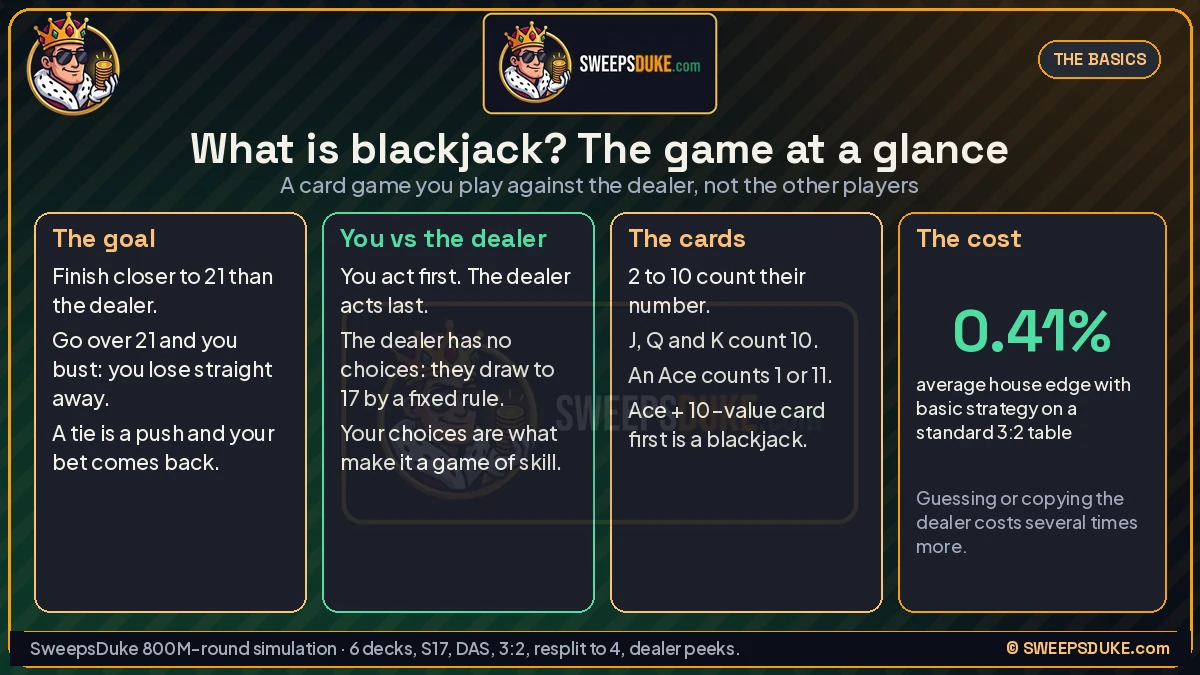
Blackjack, also called twenty-one, is a comparing card game between each player and the dealer. Here is the whole game in a few lines. Our blackjack rules guide covers every rule and edge case in full.
- The goal is to beat the dealer. You win when your final total is closer to 21 than the dealer's, or when the dealer goes over and you don't. Reaching 21 is not the goal in itself. A 17 that beats a dealer 16 wins just as much as a 21.
- Going over 21 is a bust. A busted hand loses at once, even if the dealer busts later.
- Ties push. If you and the dealer finish on the same total, your bet comes back. A blackjack beats any other 21, including a three-card 21.
- You play against the dealer only. Every seat is a separate contest with the dealer's hand. Other players are not your opponents.
- The dealer has no choices. The dealer draws to 17 and then stops, following the table's posted rule. You make all the decisions.
- Wins pay 1 to 1, blackjack pays 3 to 2. On a 10-coin bet a normal win pays 10 and a blackjack pays 15. Some tables pay only 6 to 5 for blackjack, which costs a lot more than it looks.
Why blackjack is called a game of skill
In roulette or a slot, nothing you do changes the house edge. In blackjack the same table can cost you 0.41% or 6% of what you bet, depending only on how you play. That gap comes from the information you have: you see one of the dealer's cards before you decide, and the best play changes with it. Basic strategy is the set of decisions that gets the most out of that information. It doesn't make blackjack a winning game, but it makes it one of the cheapest games in a casino.
Card values and hand totals
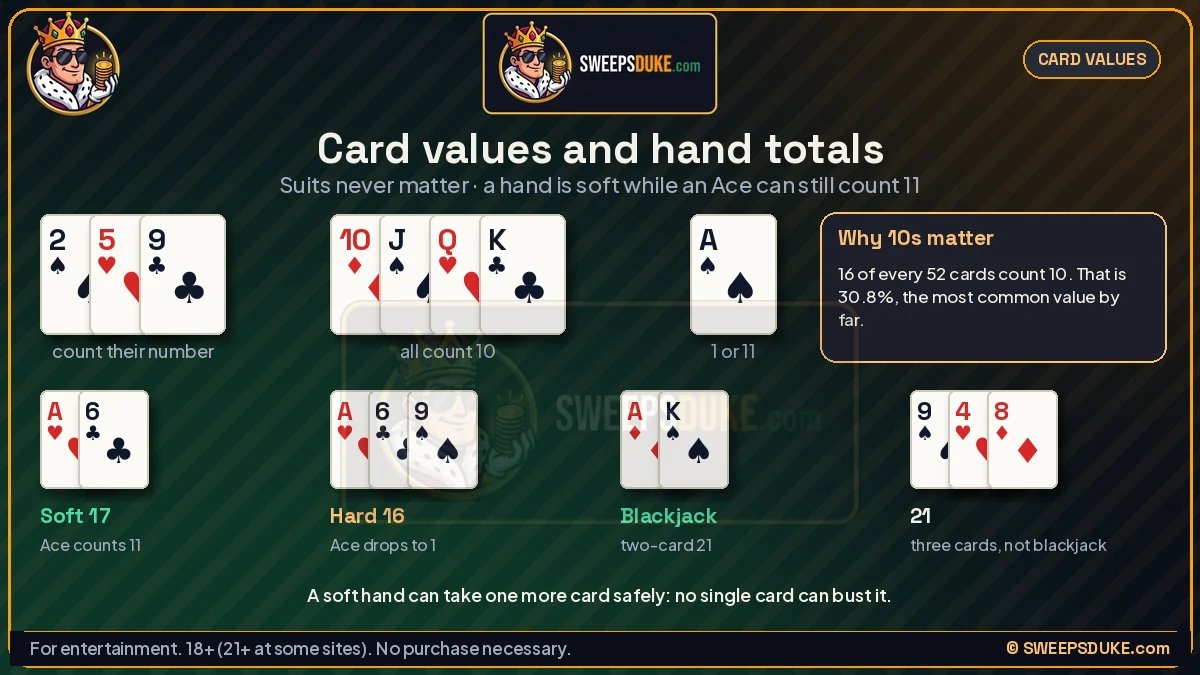
Suits never matter in blackjack. Only the values count.
| Card | Value |
|---|---|
| 2 to 10 | Face value |
| Jack, Queen, King | 10 |
| Ace | 1 or 11, whichever helps the hand |
Four ranks are worth 10 (10, J, Q, K), so 16 of every 52 cards, or 30.8%, count 10. That one fact explains much of basic strategy. When you guess at the dealer's hidden card, a 10-value card is the single most likely answer, even though it is still less likely than not.
Hard and soft hands
A hand is soft when it holds an Ace that is still counted as 11. A+6 is soft 17. It is called soft because no single card can bust it: if a big card would take it over 21, the Ace drops to 1 and the hand carries on. Draw a 9 to A+6 and you have hard 16 (1 + 6 + 9), not a bust.
A hand is hard when it has no Ace, or when every Ace in it has to count as 1. 10+6 is hard 16. A+6+9 is also hard 16, because counting the Ace as 11 would make 26.
This matters for two reasons. First, you can play soft hands more aggressively. Hitting soft 17 is never a risk to bust, so the chart hits or doubles it every time. Second, the dealer's rule on soft 17 is one of the most important table rules. Some dealers stand on soft 17 and some hit it. A dealer who hits soft 17 adds about 0.22 points to the house edge.
Edge cases
- Two Aces. A+A is soft 12, because only one Ace can count 11 at a time (11 + 11 = 22). That is why you split them.
- Blackjack versus 21. Blackjack means exactly two cards: an Ace and a 10-value card. A+5+5 is 21 but not a blackjack. It pays 1 to 1 and loses to a dealer blackjack.
- Blackjack after a split. An Ace and a 10 on a split hand counts as 21, not a blackjack, at almost every table. It pays 1 to 1.
- How often you get one. With 6 decks, a blackjack comes on 4.75% of your first two cards, about one hand in 21. With a single deck it is 4.83%.
One round of blackjack, start to finish
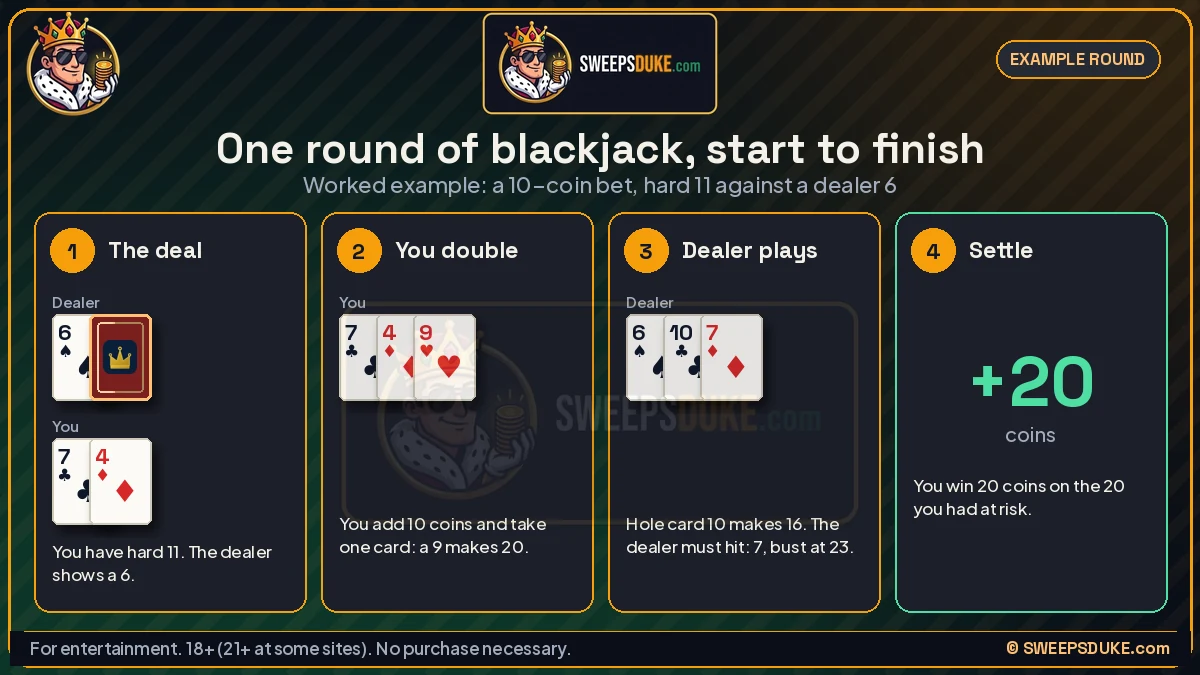
Every round follows the same order. The how to play blackjack guide walks through your first hands at a table. Here is the order and one fully worked round.
- Bets. Every player places a bet before any card is dealt.
- The deal. Each player gets two cards, usually face up. The dealer gets one face-up card, the upcard, and one face-down card, the hole card.
- The peek. If the upcard is an Ace or a 10, the dealer checks the hole card for blackjack. If it is a blackjack, the round ends at once and you lose your bet unless you also have a blackjack, which pushes. Before the peek with an Ace up, you are offered insurance.
- Your turn. You play your hand: hit, stand, double, split or surrender. Each player finishes before the next one starts.
- The dealer's turn. The dealer turns over the hole card and draws until reaching 17 or more. There are no choices.
- Settling. Every hand still in play is compared with the dealer's. Wins are paid, losses are taken and ties push.
Worked example: a 10-coin bet
You bet 10 coins. You are dealt 7 and 4, hard 11. The dealer shows a 6.
The deal. A 6 is one of the dealer's weakest upcards. The dealer busts 42.3% of the time with a 6 showing, and you have 11, which can't bust with one card. Any 10 makes 21.
You double. You put out another 10 coins and get exactly one more card. It is a 9, so you finish on 20 with 20 coins at risk. Doubling here is clearly right: our exact calculation gives +0.677 per coin of starting bet for doubling, against +0.338 for just hitting. Per 100 coins of starting bets, doubling is worth 33.8 coins more than hitting.
The dealer plays. The hole card is a 10, so the dealer has 16. The rule says draw to 17, so the dealer must hit. The card is a 7, making 23. Bust.
Settle. You win 1 to 1 on everything at risk: 20 coins. Had the dealer drawn a 4 or 5, a 20 or 21, you would have pushed or lost, and that would still have been the right play. Good decisions are judged by their average result, not by one hand.
Your choices and what each one is worth
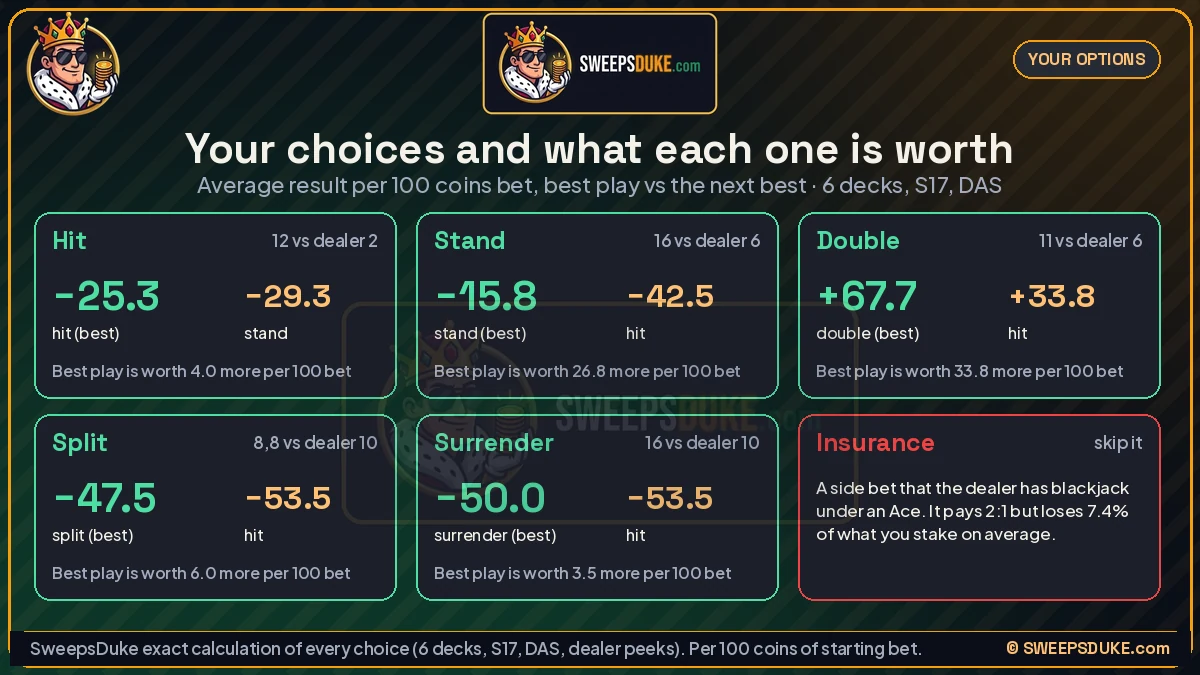
You have up to six choices on a hand. Each has a price, and the best one is the one with the highest average result. The figures below come from our exact calculation for 6 decks with the dealer standing on soft 17, as an average result per 100 coins of starting bet.
| Choice | What it means | Example | Best play | Next best |
|---|---|---|---|---|
| Hit | Take another card | 12 vs dealer 2 | Hit: −25.3 | Stand: −29.3 |
| Stand | Take no more cards | 16 vs dealer 6 | Stand: −15.8 | Hit: −42.5 |
| Double | Double your bet, take exactly one card | 11 vs dealer 6 | Double: +67.7 | Hit: +33.8 |
| Split | Split a pair into two hands, add an equal bet | 8,8 vs dealer 10 | Split: −47.5 | Hit: −53.5 |
| Surrender | Give up the hand, get half your bet back | 16 vs dealer 10 | Surrender: −50.0 | Hit: −53.5 |
| Insurance | Side bet that the dealer has blackjack | Dealer Ace up | Skip it | Insure: −7.4% of the side bet |
Why these plays are right
- Hit 12 against a 2. It looks wrong to hit a hand that can bust on a 10. But a dealer 2 only busts 35.4% of the time, so standing on 12 loses too often. Hitting busts on 10s (30.8% of cards) but improves you the rest of the time. The gap is small, 4.0 coins per 100, but it is real. Against a 4, 5 or 6 the dealer busts more often, so the chart stands.
- Stand on 16 against a 6. A dealer 6 busts 42.3% of the time. If you hit 16, more than half the deck busts you. Standing and letting the dealer take the risk is worth 26.8 coins per 100 more.
- Double 11 against a 6. You are likely to finish strong and the dealer is likely to bust. A double puts more money on the table exactly when you are the favourite. Doubling makes +67.7 per 100 coins of starting bet, double the +33.8 from hitting.
- Split 8s against a 10. Hard 16 is the worst hand in blackjack. Two hands starting from 8 are each worse than average, but together they lose less than one 16 does: −47.5 against −53.5 for hitting.
- Surrender 16 against a 10. Where it is allowed, giving up half your bet (−50.0) beats playing on (−53.5 for the best of hitting or standing). It is one of the few hands where losing half is the good result.
- Skip insurance. Insurance pays 2 to 1 if the dealer has blackjack. With 6 decks and an Ace showing, the hole card is a 10 only 30.9% of the time (96 of the 311 unseen cards), so the bet loses 7.4% on average. Our simulation of a player who always takes it shows the cost: the house edge rises from 0.41% to 0.68%.
Edge cases and close calls
Some decisions are very close, and that is useful to know when you forget the chart.
- 16 against a 10 without surrender. Hitting (−53.5) is only slightly better than standing (−54.0). Either way it is a bad hand. The chart says hit.
- 12 against a 4. Standing (−20.9) barely beats hitting (−21.2). The chart says stand.
- 11 against an Ace. In 6 decks with the dealer standing on soft 17, hitting (+14.7) beats doubling (+12.3), because the dealer peeks first and an Ace upcard is strong. Many tables where the dealer hits soft 17 flip this to a double.
- Even money. If you have a blackjack and the dealer shows an Ace, you may be offered even money: 1 to 1 now instead of risking a push. It is the same as insurance and costs about 3.9% of your bet. Declining is worth 1.039 bets on average, against exactly 1 for even money.
How the dealer plays
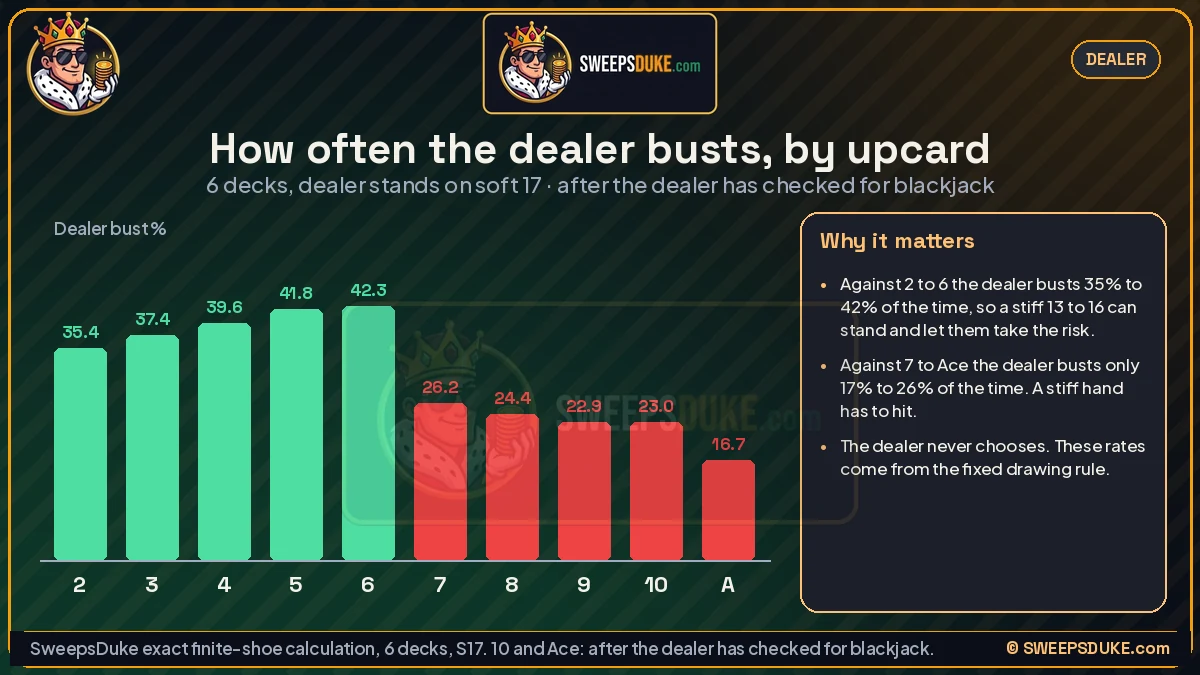
The dealer plays after everyone else and follows one fixed rule: hit until reaching 17 or more, then stop. The only variation is soft 17. Most tables print it on the felt or in the rules panel: "Dealer stands on soft 17" (S17) or "Dealer hits soft 17" (H17). The dealer can't double, split or surrender, and never makes a choice based on your hand.
Because the rule is fixed, the dealer's chance of busting depends only on the upcard. Our exact calculation for 6 decks with the dealer standing on soft 17 gives these figures. For a 10 or Ace, they are after the dealer has checked for blackjack and doesn't have one, which is the situation you are in when you play your hand.
| Dealer upcard | 2 | 3 | 4 | 5 | 6 | 7 | 8 | 9 | 10 | A |
|---|---|---|---|---|---|---|---|---|---|---|
| Dealer busts | 35.4% | 37.4% | 39.6% | 41.8% | 42.3% | 26.2% | 24.4% | 22.9% | 23.0% | 16.7% |
What this means for you
- 2 to 6 are the bust cards. The dealer has to draw at least one more card from a weak total, and a stiff total of 12 to 16 busts on a big card. Against these upcards the chart stands on most stiff hands and doubles freely.
- 7 to Ace are strong cards. A 7 makes 17 with a 10 underneath. The dealer finishes with 17 to 21 three times out of four or more, so you need a real hand. That is why the chart hits stiff hands against them.
- Why a 6 busts more than a 5. One reason: with a 6 the dealer can't reach 17 to 21 on one card, except by drawing an Ace for soft 17, and then stops. With a 5, an Ace makes soft 16, which has to keep drawing. Over all upcards the dealer busts 28.2% of the time when standing on soft 17.
- Soft 17. When the dealer hits soft 17, the bust rate with a 6 up goes from 42.3% to 43.9% and the overall rate from 28.2% to 28.6%. But the dealer also turns some 17s into 18 to 21. Overall, hitting soft 17 adds about 0.22 points to the house edge.
Where the house edge comes from
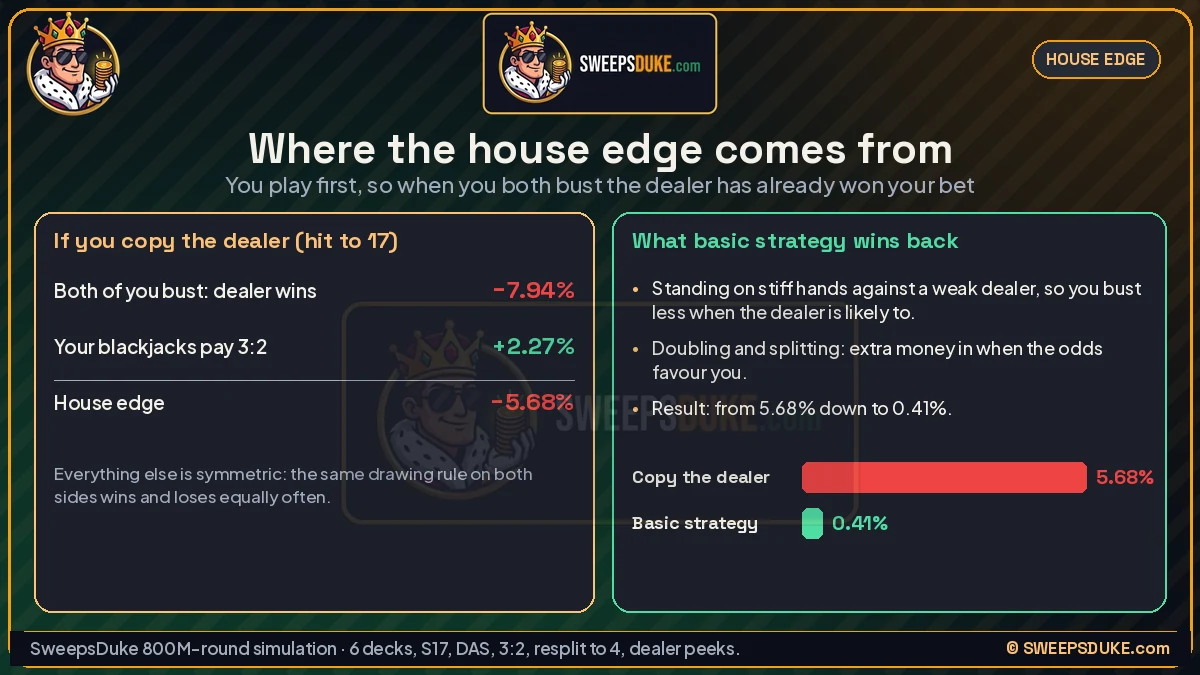
If the dealer follows a fixed rule and you could follow the same rule, why does the casino win? The answer is the order of play.
You act first. If you bust, you lose straight away, and the dealer doesn't need to play. If the dealer busts later in the same round, your bet is already gone. So whenever you both would have busted, the dealer wins. That is the whole source of the house edge.
Worked example: copying the dealer
Imagine a player who copies the dealer exactly: hit to 17, never double, never split. Our simulation of this player over 800 million rounds gives a house edge of 5.68%. Here is where it comes from:
| Effect | Value per round, starting bets |
|---|---|
| Hands where you both bust: the dealer wins | −7.94% |
| Your blackjacks pay 3 to 2, not 1 to 1 | +2.27% |
| Everything else (same rule on both sides) | 0 |
| House edge | −5.68% |
The blackjack bonus is 0.5 extra units on the 4.53% of rounds where you get a blackjack the dealer doesn't match: 0.5 × 4.53% = 2.27%. Adding that back to the 5.68% edge gives the cost of the double busts: 7.94%. As a cross-check, the dealer busts 28.19% of the time, and a player using the same rule busts about as often, so both bust in about 28.19% × 28.19% = 7.95% of rounds. The two routes agree.
How basic strategy wins it back
Basic strategy uses the two things the dealer doesn't have: information and options.
- Information. You see the dealer's upcard. Against a 2 to 6 you stand on stiff hands, so you bust less in exactly the rounds where the dealer is likely to bust. That attacks the double-bust problem directly.
- Options. You can double and split. Those put extra money on the table when you are the favourite, such as 11 against a 6. The dealer can never do that.
Together they bring the edge down from 5.68% to 0.41%. They can't remove it, because you still have to act first. Our blackjack house edge guide goes deeper into how the edge is measured and what moves it.
Edge case: per starting bet or per coin wagered?
The 0.41% is measured per starting bet. Because you sometimes double and split, the average round puts 1.13 starting bets at risk. Measured per coin actually wagered, the edge is 0.41 ÷ 1.13 = 0.36%. Both are correct, but most published figures, including ours, use the starting bet, because that is what you choose before the cards come.
How often you win, lose and push
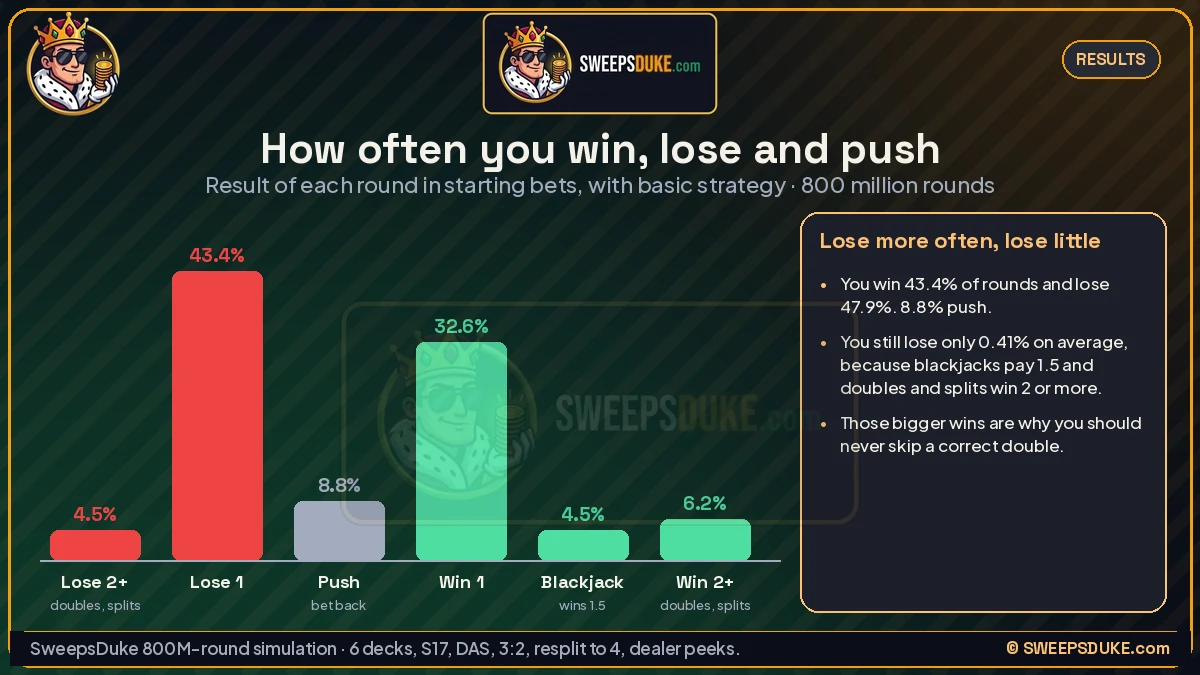
Even with perfect basic strategy you lose more rounds than you win. Our 800-million-round simulation of the standard game counts each round's result in starting bets:
| Result of the round | Share of rounds |
|---|---|
| Lose 3 or more bets | 0.26% |
| Lose 2 bets | 4.20% |
| Lose 1 bet | 43.41% |
| Push | 8.78% |
| Win 1 bet | 32.64% |
| Win 1.5 bets (blackjack) | 4.53% |
| Win 2 bets | 5.86% |
| Win 3 or more bets | 0.33% |
Overall you win 43.4% of rounds, lose 47.9% and push 8.8%. That is 4.5 points more losses than wins. Yet the edge is only 0.41%.
Why you lose more often but only lose a little
Two kinds of round pay more than one unit:
- Blackjacks. You get one in 4.53% of rounds where the dealer doesn't also have one, and they pay 1.5.
- Doubles and splits. You double on 10.4% of rounds and split on 2.8%, and the chart only does that when you are the favourite. So more of the two-bet results are wins (5.86%) than losses (4.20%).
Those bigger wins almost cancel out the extra losing rounds. This is also why skipping a correct double costs so much. Doubling is where the game gives back the most.
What blackjack pays
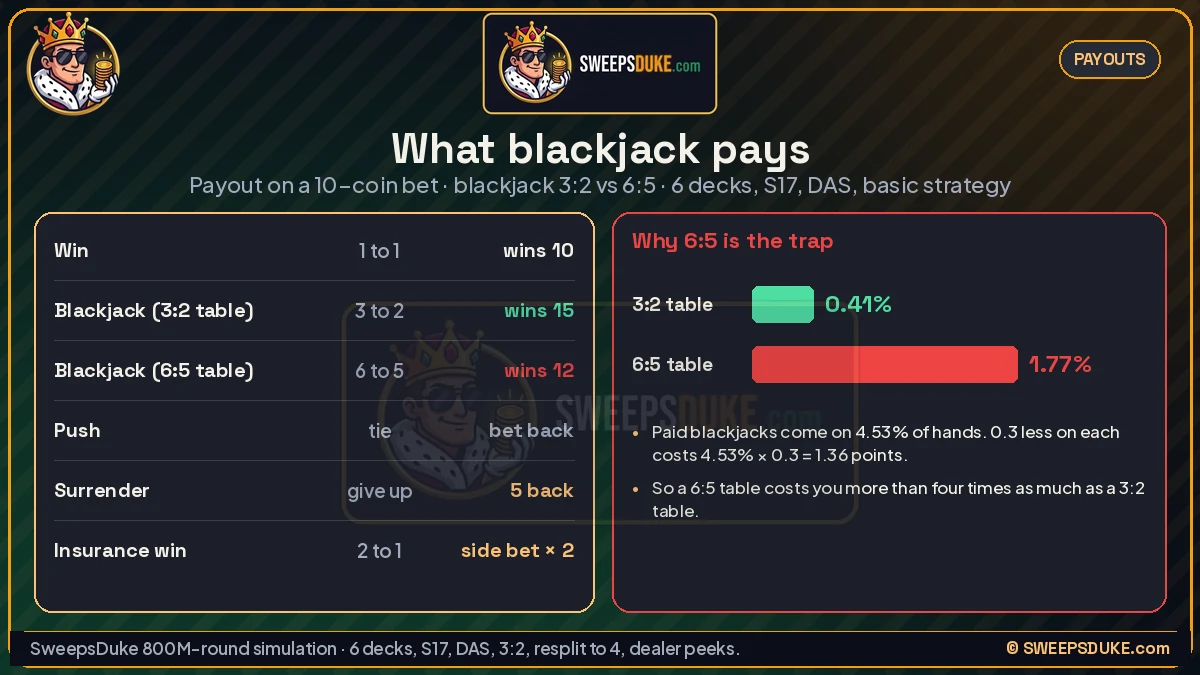
| Result | Pays | On a 10-coin bet |
|---|---|---|
| Win | 1 to 1 | Win 10 |
| Blackjack, 3:2 table | 3 to 2 | Win 15 |
| Blackjack, 6:5 table | 6 to 5 | Win 12 |
| Push | Bet back | 0 |
| Surrender | Half back | Lose 5 |
| Insurance (side bet, up to half your bet) | 2 to 1 | Win 10 on a 5-coin side bet |
| Doubled or split hand | 1 to 1 on each bet | Win 20 on a doubled 10-coin hand |
Why 6:5 is the trap
A 6 to 5 payout sounds close to 3 to 2. It isn't. A 3:2 blackjack pays 1.5 times your bet, a 6:5 blackjack 1.2 times. You lose 0.3 of a bet on every paid blackjack, and paid blackjacks come on 4.53% of rounds: 4.53% × 0.3 = 1.36 points. Our simulation measures it directly: 0.41% at 3:2 and 1.77% at 6:5. A 6:5 table costs you more than four times as much as the same table at 3:2. Pair it with a dealer who hits soft 17 and the edge is 1.98%. Even-money blackjack (1 to 1) is worse still, adding 2.27 points.
Check the payout line before your first hand. It is usually printed on the felt or at the top of the game's rules panel.
Edge cases
- Blackjack against a dealer blackjack is a push. You get your bet back, not 3 to 2.
- Blackjack on a split hand pays 1 to 1 at almost every table.
- Surrender returns half your bet. You can't surrender after hitting or after the dealer has shown a blackjack.
- Insurance is a separate bet of up to half your main bet. If the dealer has blackjack, insurance wins 2 to 1 and your main bet loses (unless you have a blackjack too). The two roughly cancel, which is why players think it "protects" them. It doesn't. It just loses 7.4% on average.
Skill matters: house edge by playing style
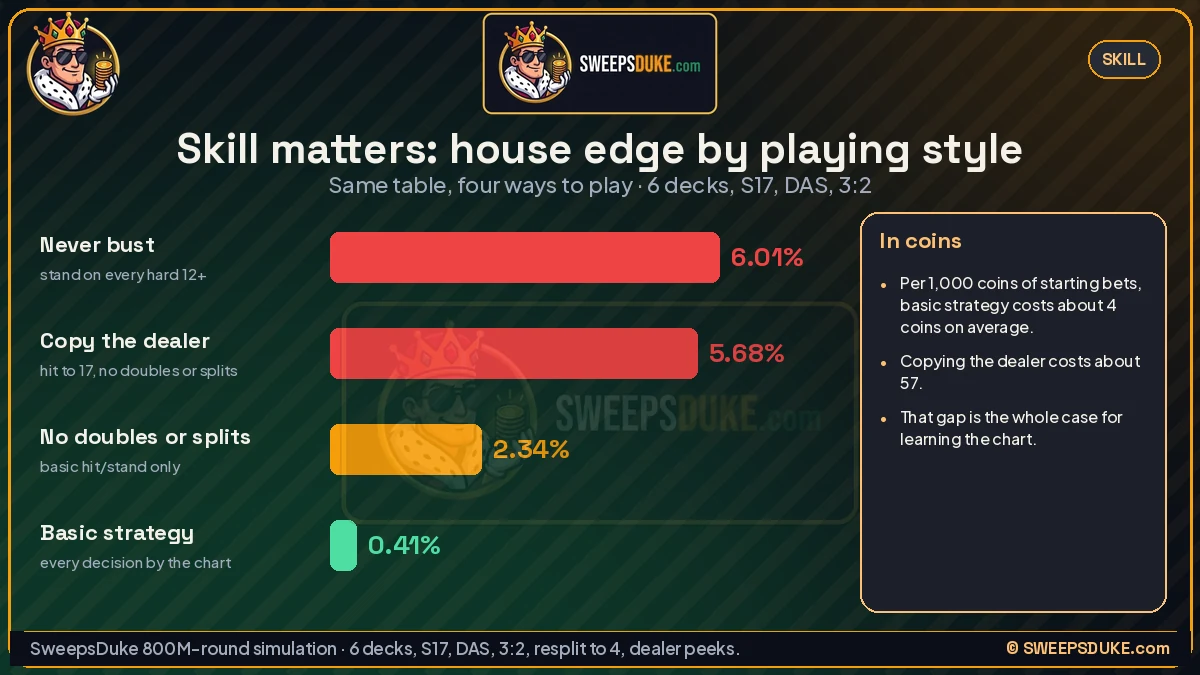
To show how much skill matters, we simulated four players at the same table: 6 decks, dealer stands on soft 17, double after split, 3:2. Each one played 800 million rounds (400 million for the no-doubles player).
| Playing style | What they do | House edge |
|---|---|---|
| Never bust | Stand on every hard 12 or more | 6.01% |
| Copy the dealer | Hit to 17, never double or split | 5.68% |
| No doubles or splits | Basic strategy for hitting and standing only | 2.34% |
| Basic strategy | Every decision by the chart | 0.41% |
Per 1,000 coins of starting bets, basic strategy costs about 4 coins on average. Copying the dealer costs about 57, and never busting about 60. The difference between the last two rows, about 1.9 points, is the value of doubling and splitting correctly. The difference between the first two and the third is the value of standing and hitting by the dealer's upcard.
Beginner mistakes that cost the most
Each of these comes from our exact calculation. The cost is in coins per 100 coins of starting bet, every time the hand comes up.
| Mistake | Right play | Cost of the mistake |
|---|---|---|
| Hitting 16 against a 6 | Stand | 26.8 |
| Splitting 10s against a 6 | Stand on 20 | 24.8 |
| Standing on soft 18 (A,7) against a 9 | Hit | 8.4 |
| Not splitting 8s against a 10 | Split | 6.0 |
| Not doubling 11 against a 10 | Double | 5.9 |
| Standing on 12 against a 2 | Hit | 4.0 |
| Splitting 9s against a 7 | Stand on 18 | 3.6 |
| Not doubling 10 against a 9 | Double | 3.1 |
Some of these surprise players. Soft 18 against a 9 looks like a good hand, but a dealer 9 makes 19 or better often, and soft 18 can't bust on one card, so hitting is right. 9,9 against a 7 is a stand because 18 already beats the dealer's most likely result: with a 7 up, the dealer finishes on exactly 17 in 36.9% of hands. The basic strategy guide explains every cell of the chart.
Blackjack vs other casino games
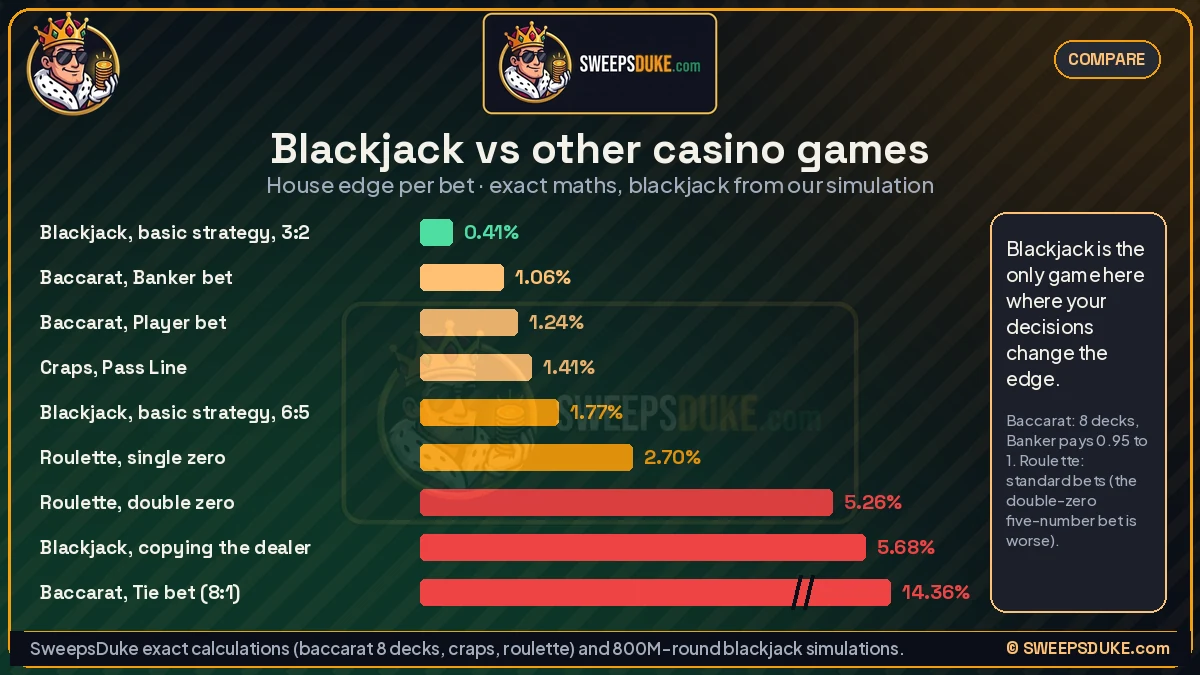
How cheap is blackjack compared with other table games? We calculated the other games exactly from their payouts and probabilities.
| Game and bet | House edge | How it is calculated |
|---|---|---|
| Blackjack, basic strategy, 3:2 | 0.41% | Our 800M-round simulation |
| Baccarat, Banker (8 decks, 5% commission) | 1.06% | Exact: Banker wins 45.86%, Player 44.62%, Tie 9.52% |
| Baccarat, Player | 1.24% | Same exact probabilities |
| Craps, Pass Line | 1.41% | Exact: 7/495 |
| Blackjack, basic strategy, 6:5 | 1.77% | Our simulation |
| Roulette, single zero | 2.70% | Exact: 1/37 |
| Roulette, double zero | 5.26% | Exact: 2/38 |
| Blackjack, copying the dealer | 5.68% | Our simulation |
| Baccarat, Tie at 8 to 1 | 14.36% | Same exact probabilities |
Blackjack with basic strategy is the cheapest game in this list. But the same game played badly is worse than double-zero roulette. Blackjack is the only game here where your decisions change the edge. In roulette, craps or baccarat the edge on a bet is fixed by the payout.
Edge cases
- Roulette. Every standard single-zero bet has the same 2.70% edge. In double-zero roulette every bet is 5.26% except the five-number bet (0, 00, 1, 2, 3), which is 7.89%.
- Baccarat Banker. The Banker bet wins more often than Player, so it pays 0.95 to 1 (a 5% commission). Without the commission it would favour the player.
- Speed. A lower edge is not the whole story. What you lose on average is edge × total amount bet, so fast games with many rounds cost more per hour at the same edge.
Basic strategy: the whole chart
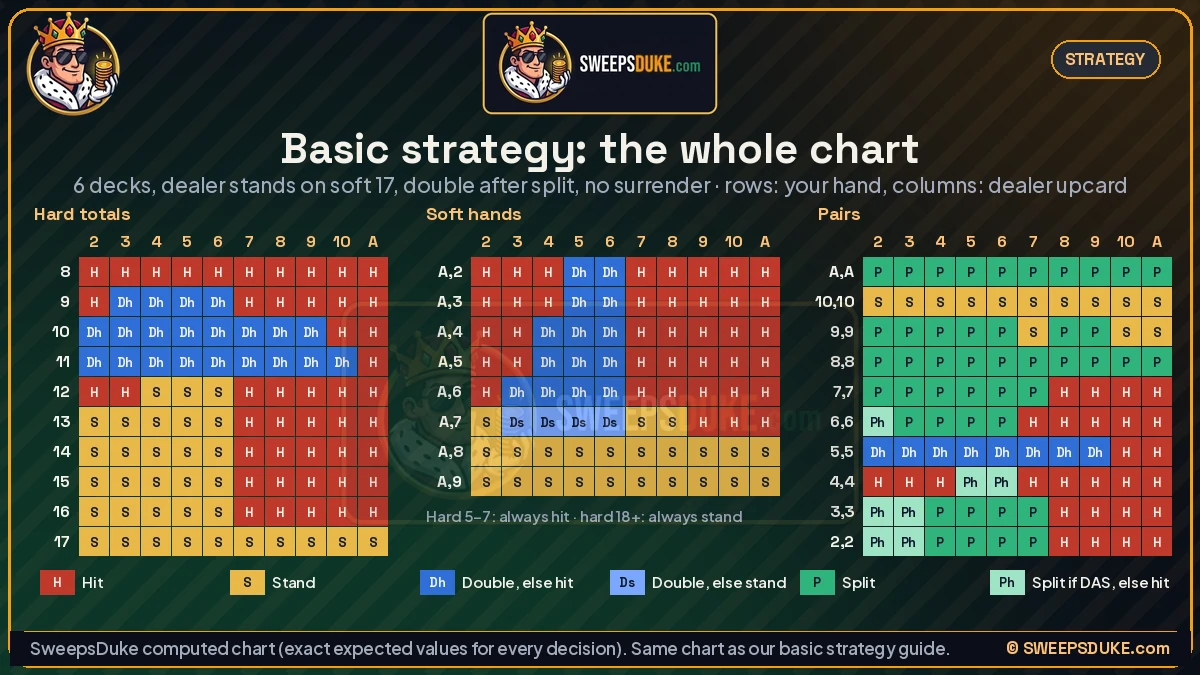
Basic strategy is the best decision for every hand against every dealer upcard, using only your cards and the upcard. It was first worked out by Baldwin, Cantey, Maisel and McDermott in 1956 and has since been checked by computers. Ours comes from an exact calculation of every decision for 6 decks, dealer stands on soft 17, double after split and no surrender. The chart above is that whole chart.
How to read it
Find your hand on the left and the dealer's upcard along the top.
- H hit, S stand.
- Dh double if allowed, otherwise hit. Ds double if allowed, otherwise stand.
- P split. Ph split if double after split is allowed, otherwise hit.
- Check pairs first, then soft hands, then hard totals. Hard 5 to 7 always hits and hard 18 or more always stands.
The ideas behind it
You don't have to memorise the chart cell by cell. Most of it follows from five ideas:
- Stand on stiff hands (12 to 16) against a dealer 2 to 6, hit them against a 7 to Ace. The exceptions are 12 against a 2 or 3, which hit, because those dealer cards bust less often.
- Double 10 and 11 against most upcards, and 9 against a 3 to 6. You are likely to finish on a strong total with one card.
- Always split Aces and 8s. Never split 10s or 5s. Two Aces are a weak soft 12 but two great starts. Two 8s are 16, the worst hand. Two 10s are already 20. Two 5s are 10, better doubled.
- Double soft hands against a weak dealer. A soft hand can't bust on one card, so the chart doubles A,2 to A,7 against a 5 or 6, A,4 to A,7 against a 4 too, and A,6 and A,7 against a 3 as well.
- Stand on soft 19 and above, hit soft 18 against a 9, 10 or Ace.
The basic strategy guide has the charts for other rule sets and explains every cell. The blackjack cheat sheet has printable versions. Our blackjack strategy guide covers what comes after basic strategy, including counting and betting systems.
Edge case: different tables need slightly different charts
The chart changes a little with the rules. When the dealer hits soft 17, 11 against an Ace becomes a double and soft 18 against a 2 becomes a double. With late surrender, you surrender 16 against a 9, 10 or Ace and 15 against a 10. Use the chart for the table you are at. The differences are small but real.
Table rules that change the house edge
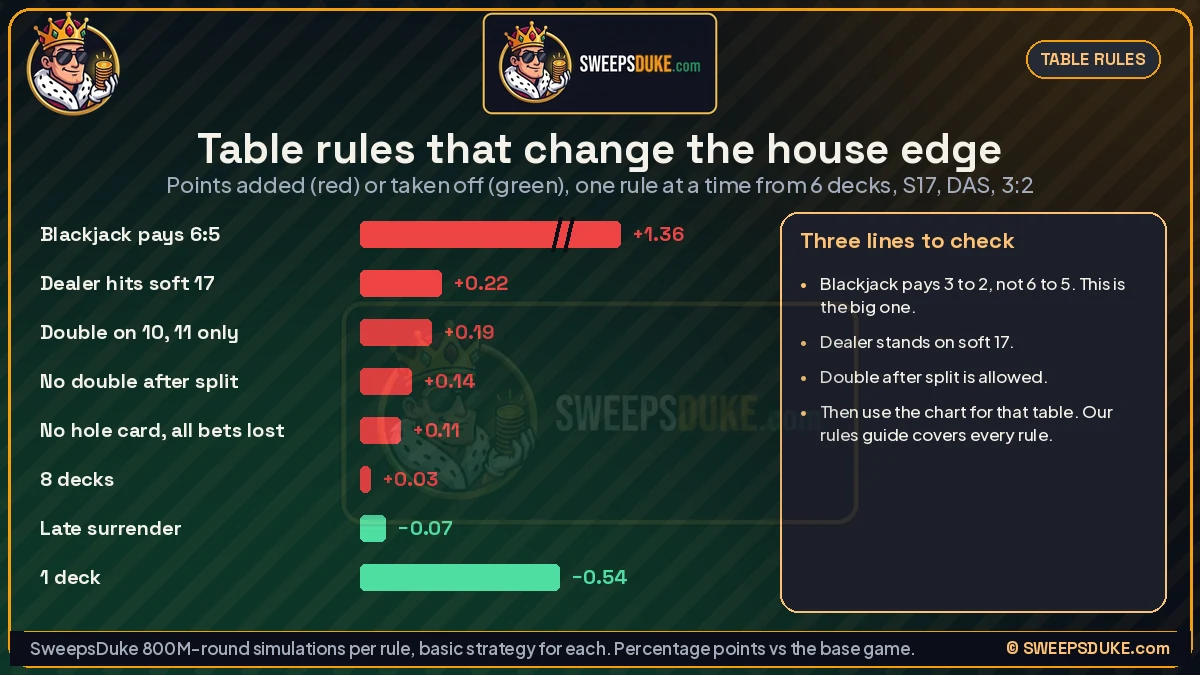
The card rules are the same everywhere. The table rules aren't, and each one moves the house edge. We measured every rule change one at a time from the standard game (6 decks, S17, DAS, 3:2) in 800-million-round simulations, with basic strategy for each game.
| Rule change | Effect on the house edge |
|---|---|
| Blackjack pays 1 to 1 | +2.27 points |
| Blackjack pays 6 to 5 | +1.36 points |
| Dealer hits soft 17 | +0.22 points |
| Double on 10 and 11 only | +0.19 points |
| No double after split | +0.14 points |
| No hole card, all bets lost to a dealer blackjack | +0.11 points |
| Double on 9 to 11 only | +0.10 points |
| No resplitting | +0.06 points |
| 8 decks instead of 6 | +0.03 points |
| Late surrender | −0.07 points |
| 2 decks instead of 6 | −0.21 points |
| 1 deck instead of 6 | −0.54 points |
| Early surrender | −0.63 points |
The three lines to check at any table are the blackjack payout (3:2, not 6:5), the soft 17 rule (stand is better for you) and double after split. Those three are most of the difference between a good and a bad table. Our blackjack rules guide explains every rule in this table with examples.
Worked example: comparing two tables
Table A: 8 decks, dealer hits soft 17, double after split, 3:2. Table B: 6 decks, dealer stands on soft 17, double after split, 6:5.
- Table A: 0.41 + 0.03 + 0.22 = about 0.66%.
- Table B: 0.41 + 1.36 = about 1.77%.
More decks and a dealer who hits soft 17 sound worse, but the 6:5 payout dwarfs both. Table A is the better table by more than a full point. (Adding rule effects one at a time is a close approximation, not an exact figure, because rules interact slightly.)
Short sessions are mostly luck
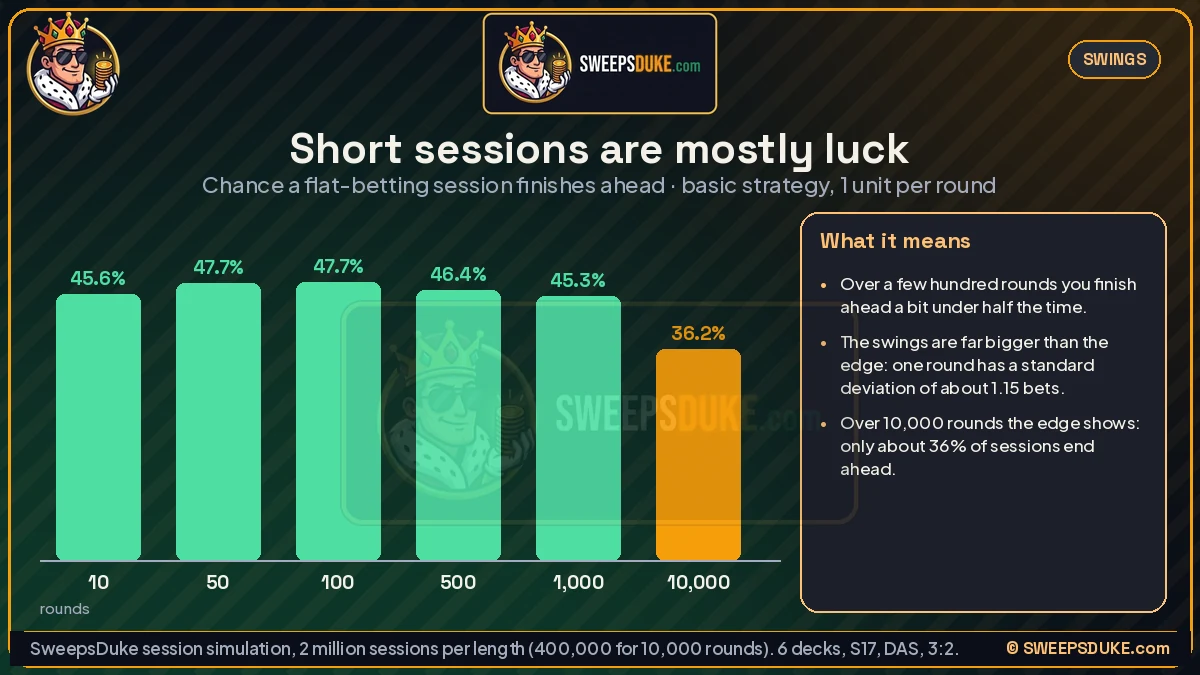
A 0.41% edge is tiny compared with the swings. One round has a standard deviation of about 1.15 starting bets, nearly 300 times the average loss per round. To see what that means in practice, we simulated 2 million flat-betting sessions of each length (400,000 for 10,000 rounds), betting 1 unit per round with basic strategy.
| Session length | Finished ahead | Average result | Middle 90% of sessions |
|---|---|---|---|
| 10 rounds | 45.6% | −0.04 units | −6 to +6 |
| 50 rounds | 47.7% | −0.20 units | −13.5 to +13.5 |
| 100 rounds | 47.7% | −0.40 units | −19.5 to +18.5 |
| 500 rounds | 46.4% | −2.0 units | −44.5 to +40.5 |
| 1,000 rounds | 45.3% | −4.0 units | −64 to +56 |
| 10,000 rounds | 36.2% | −40.2 units |
"Finished ahead" means strictly up. Pushes and break-even sessions count as not ahead, which is why short sessions show less than 50% even though the edge has barely had time to act.
What this tells you
- Over a few hundred rounds, results are mostly luck. Almost half of sessions finish ahead. A good session doesn't mean you played well, and a bad one doesn't mean you played badly.
- The edge wins over time. The expected loss grows with the number of rounds, but the swings grow only with its square root. By 10,000 rounds, the average loss is about 40 units and only 36% of sessions are ahead. That matches the normal approximation: 40.6 ÷ (1.15 × √10,000) ≈ 0.35 standard deviations, about 36%.
- No system changes this. Raising and lowering your bet changes the size of the swings, not the edge on each coin you bet.
Treat blackjack as entertainment with a small price, not as a way to make money.
Blackjack variants: what each one changes
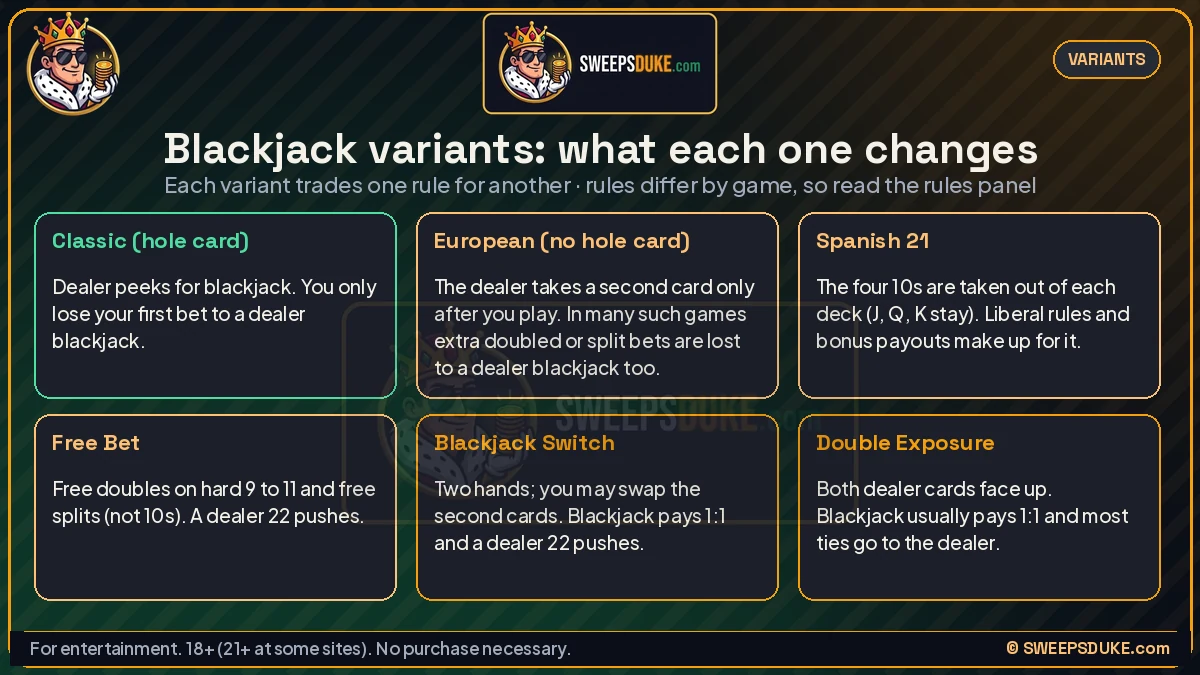
Many games are sold as blackjack with a twist. Most add something you like and take something back. Rules vary from one version to the next, so always read the rules panel of the exact game you play.
| Variant | What's different | The catch |
|---|---|---|
| Classic (hole card) | Dealer takes a hole card and peeks for blackjack with an Ace or 10 up | None: this is the standard game on this page |
| European / no hole card | Dealer takes the second card only after you play | In many such games extra doubled or split bets are lost to a dealer blackjack too. Measured as all bets lost: +0.11 points |
| Spanish 21 | All four 10s removed from each deck (Jacks, Queens and Kings stay) | Removing 10s hurts you. Player-friendly rules such as player 21 always winning, late surrender and doubling on any number of cards make up for part or all of it |
| Free Bet | Free doubles on two-card hard 9 to 11 and free splits of pairs except 10s | A dealer total of 22 pushes the hands still in play. The dealer usually hits soft 17 |
| Blackjack Switch | You play two hands and may swap their second cards | Blackjack pays 1 to 1 and a dealer 22 pushes |
| Double Exposure | Both dealer cards are dealt face up | Blackjack usually pays 1 to 1 and most ties go to the dealer |
The standard chart is only right for the classic game and close relatives. Spanish 21, Free Bet, Switch and Double Exposure each need their own strategy. With no hole card, the standard chart is nearly right, but you should not double or split against a 10 or Ace as freely, because a dealer blackjack would take the extra bets.
Edge cases
- Five Card Charlie (an automatic win with five cards that don't bust) is not a standard rule. Some variants and home games use it. If a table offers it, the rules panel will say so.
- Side bets such as Perfect Pairs or 21+3 are separate bets with their own, usually much higher, house edge. They don't change the main game.
RNG blackjack vs live-dealer blackjack
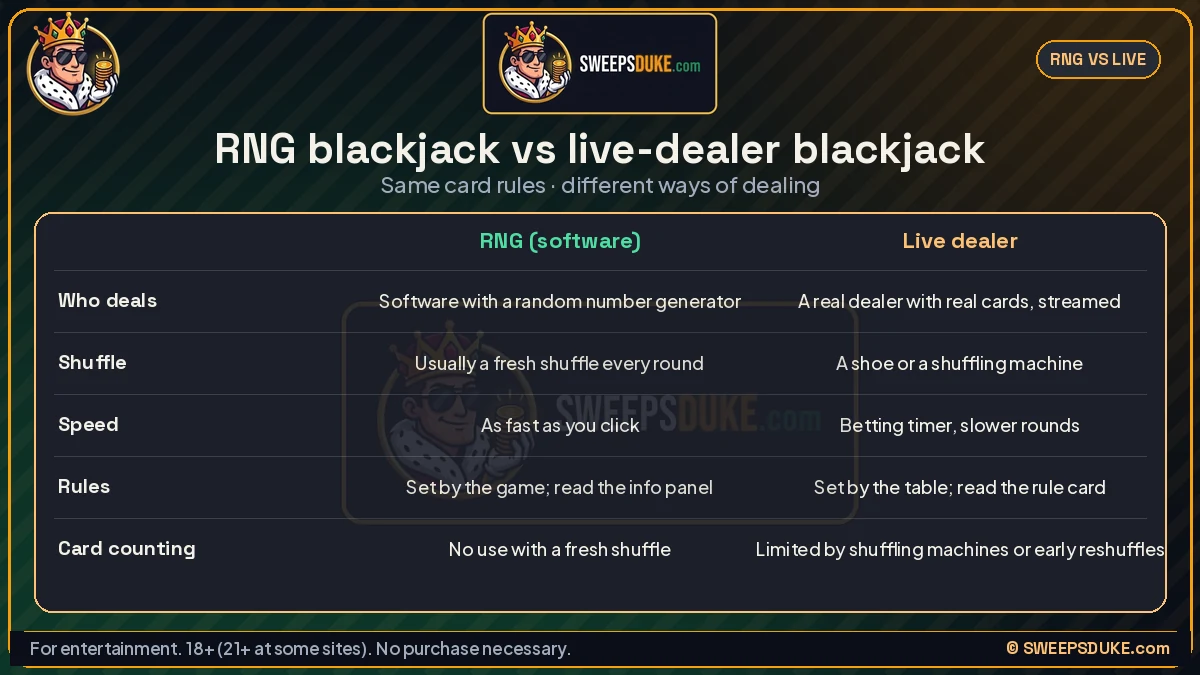
Online blackjack comes in two forms. The card rules are the same. The way the cards are dealt is not.
| RNG (software) | Live dealer | |
|---|---|---|
| Who deals | Software with a random number generator | A real dealer with real cards, streamed |
| Shuffle | Usually a fresh shuffle every round | A shoe dealt down to a cut card, or a shuffling machine |
| Speed | As fast as you click | Rounds on a betting timer, slower |
| Rules | Set by the game: read the info panel | Set by the table: read the rule card |
| Card counting | No use with a fresh shuffle each round | Limited by early reshuffles and shuffling machines |
What it means for you
- The chart is the same. Basic strategy depends on the rules, not on whether a person or software deals. Use the chart for the posted rules.
- Fresh shuffle every round. Most software games reshuffle the virtual deck for every round, so the cards from one round tell you nothing about the next. Our figures on this page assume exactly that.
- Speed changes your cost. Your average loss is edge × total amount bet. A fast RNG game plays far more rounds per hour than a live table, so it costs more per hour at the same edge and bet size.
- Rules differ by game. Two games with the same name at the same site can have different payouts, decks and soft 17 rules. Check before you play.
Blackjack at sweepstakes casinos
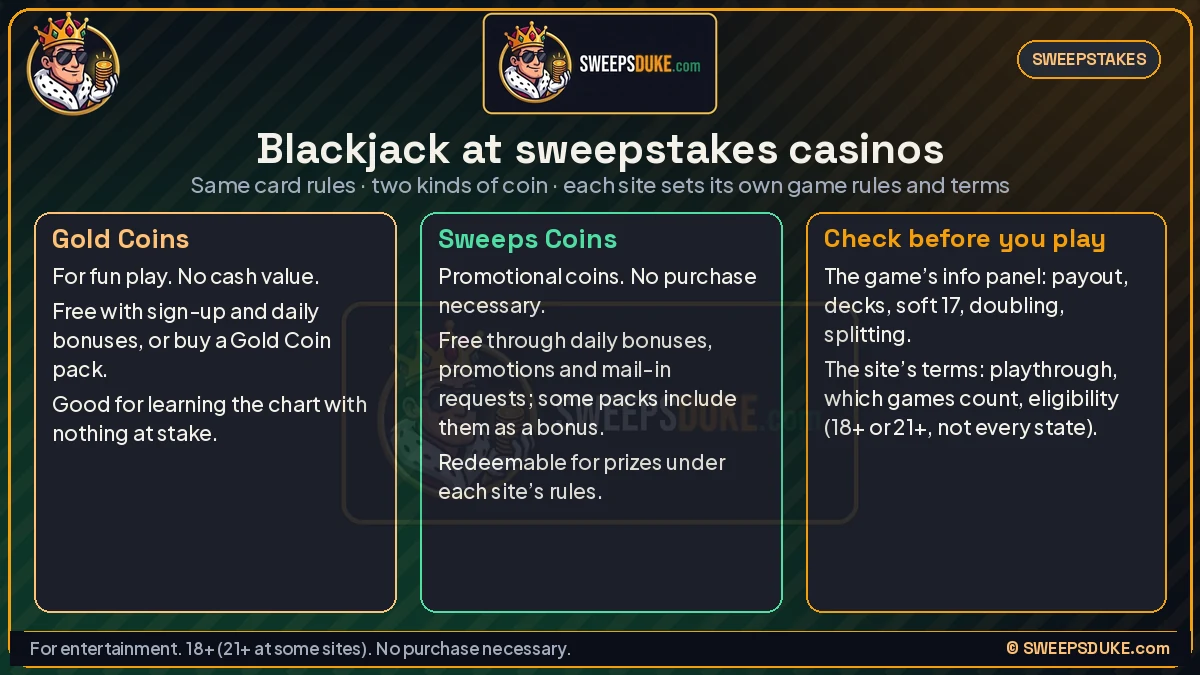
At sweepstakes casinos blackjack plays the same way: same cards, same chart. What's different is the coins.
- Gold Coins are for fun play and have no cash value. You get them free when you sign up and through daily bonuses, or you can buy a Gold Coin pack. They are the best way to practise the chart with nothing at stake. See what are Gold Coins.
- Sweeps Coins are promotional coins. No purchase necessary: they come free with daily bonuses, promotions and mail-in requests (AMOE), and some Gold Coin packs include them as a bonus. Sweeps Coins won in play can be redeemed for prizes, under each site's rules. See what are Sweeps Coins, how to get free Sweeps Coins and mail-in Sweeps Coins (AMOE).
What to check before you play
- The game's rules panel. Blackjack payout (3:2 or 6:5), number of decks, soft 17 rule, doubling and splitting limits, surrender. These set the house edge, exactly as in the table rules section above.
- Playthrough. Sweeps Coins usually have to be played through before they can be redeemed. Check whether blackjack counts in full, in part or not at all toward it.
- Redemption terms. Minimums, verification and methods are set by each site. See Sweeps Coin redemption methods.
- Eligibility. Sweepstakes casinos are typically 18+ or 21+ and are not available in every state. Check the site's terms for your state before you sign up.
The house edge works the same with Sweeps Coins as with any other coin. Over many rounds you will usually end with fewer coins than you played. Basic strategy only slows that down.
A short history of blackjack
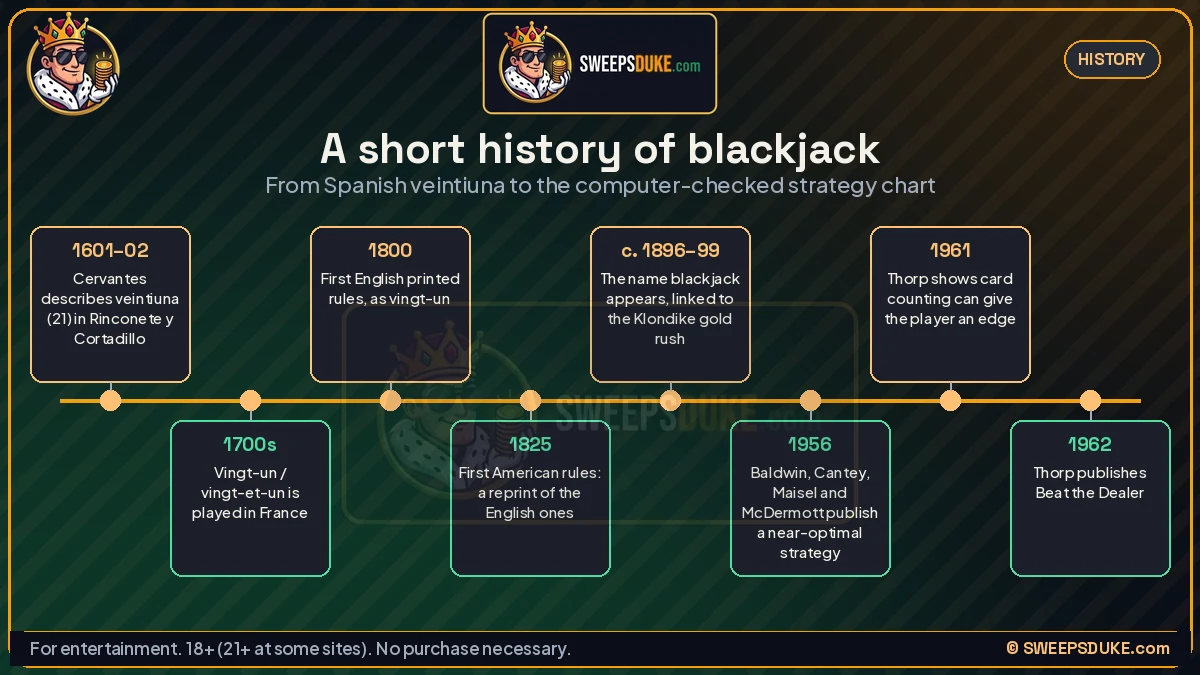
Blackjack grew out of a family of European "twenty-one" games. Card-game histories don't agree on every detail, so here is what the sources support.
| When | What happened | Source |
|---|---|---|
| Written c. 1601–02, published 1613 | Cervantes's story Rinconete y Cortadillo has two card cheats who play veintiuna (twenty-one) | Cervantes, Novelas ejemplares |
| 18th century | Vingt-un or vingt-et-un is played in France | Parlett, The Oxford Guide to Card Games |
| 1800 | First English printed rules, under the name vingt-un, in an edition of Hoyle | Published card-game histories |
| 1825 | First American printed rules, a reprint of the English ones | Published card-game histories |
| c. 1896–99 | The name "blackjack" appears in North America | Depaulis (2010) |
| 1956 | Baldwin, Cantey, Maisel and McDermott publish the first near-optimal basic strategy | Journal of the American Statistical Association 51, 429–439 |
| 1961 | Edward Thorp shows that card counting can give the player an edge | Proceedings of the National Academy of Sciences 47, 110–112 |
| 1962 | Thorp publishes Beat the Dealer | Blaisdell |
Where the name comes from
The popular story is that American casinos once paid a 10 to 1 bonus for an Ace of spades with a black Jack, and the name stuck after the bonus disappeared. It is repeated everywhere but no one has documented such a bonus. The card historian Thierry Depaulis traced the name instead to the 1890s and linked it to the Klondike gold rush (1896–99), possibly through "blackjack", a miners' name for a zinc ore. Treat the bonus story as legend.
What changed after Thorp
Once Thorp showed that tracking the cards could tip the odds in the player's favour, casinos made counting harder with earlier reshuffles and, later, shuffling machines. Software games went further and reshuffle every round. That is why counting has no use in most online blackjack.
Blackjack myths vs the maths
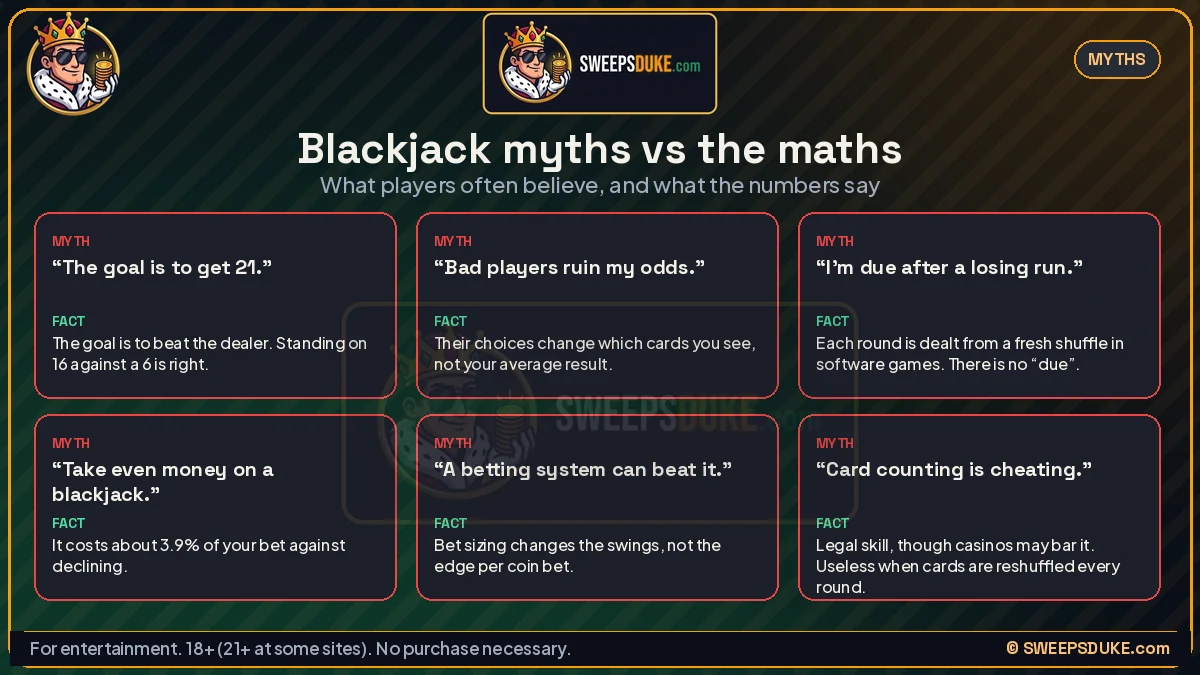
| Myth | What the maths says |
|---|---|
| "The goal is to get 21." | The goal is to beat the dealer. Standing on 16 against a 6 is right even though you can't make 21. |
| "Bad players at the table ruin my odds." | Their choices change which cards you get on a given hand, but they are just as likely to help as hurt. Your average result doesn't change. |
| "I'm due after a losing run." | In a game that reshuffles every round, every round is new. There is no "due". |
| "Always take even money on a blackjack." | Even money costs about 3.9% of your bet compared with declining. |
| "Never bust is a safe strategy." | Standing on every hard 12 or more gives the house a 6.01% edge, worse than copying the dealer. |
| "The dealer is due to bust after a run of good hands." | The dealer's bust rate depends on the upcard and the rule, not on earlier rounds. |
| "A betting system can beat it." | Bet sizing changes the swings, not the edge per coin bet. |
| "Card counting is cheating." | Keeping track of cards in your head is a legal skill, though casinos can refuse to deal to counters. It does nothing in a game that reshuffles every round. |
| "Insurance protects a good hand." | Insurance is a separate bet that loses about 7% on average in 6 decks, whatever your hand. |
The myth about other players is worth a closer look. If the player before you hits when the chart says stand, he might take the card that would have busted the dealer. He is just as likely to take the card that would have made the dealer 21. Over many hands, those cancel out.
Frequently asked questions
Is blackjack luck or skill?
Both. Each hand is luck, but your decisions set the long-run price. The same table costs 0.41% with basic strategy and 5.68% if you copy the dealer. Few casino table games reward skill as much, though basic strategy alone still leaves the house an edge.
What happens if the dealer and I both have 21?
It's a push and your bet comes back. The one exception is a natural blackjack, which beats any other 21. If you both have blackjack, it's a push.
How many decks are used?
Usually six or eight in a shoe, one or two in hand-held games, and in most software games a virtual shoe that is reshuffled every round. More decks raise the edge slightly: with the same rules, 8 decks add 0.03 points to the 6-deck edge and one deck takes off 0.54.
What is a soft 17?
A 17 that includes an Ace counted as 11, such as A+6. Whether the dealer hits or stands on soft 17 is one of the most important rules: hitting adds about 0.22 points to the house edge.
How often do you get a blackjack?
About once every 21 hands: 4.75% of hands with 6 decks and 4.83% with one deck.
What is the house edge in blackjack?
About 0.41% with basic strategy in the standard 6-deck game with S17, DAS and 3:2, from our 800-million-round simulation. Bad rules push it up: 1.77% at 6:5 and 1.98% at 6:5 with H17. Bad play pushes it up much more.
Can you beat blackjack?
Not with basic strategy. It makes blackjack one of the cheapest casino games but still leaves the house an edge. Card counting can give a small edge in a dealt shoe game, but not in games that reshuffle every round, and casinos can stop counters from playing. Read our blackjack strategy guide for the details.
Can you play blackjack for free?
Yes. Many games have demo modes, and at sweepstakes casinos you can play with Gold Coins, which are free and have no cash value. It is a good way to learn the chart.
Should I take insurance?
No. With 6 decks and an Ace showing, the dealer has blackjack only 30.9% of the time, and insurance pays 2 to 1, so it loses 7.4% on average. Even money on your own blackjack is the same bet and costs about 3.9% of your main bet.
What does the dealer do on 16?
The dealer always hits 16 and always stands on hard 17. The only rule that varies is soft 17. The dealer never looks at your hand to decide.
Is Five Card Charlie a real rule?
Not in standard blackjack. A few variants and home games use it. If a table has it, the rules panel will say so.
How we got these numbers: the house edges for basic strategy, copying the dealer, never busting, no doubles or splits and always insuring, and the win, loss and push rates, come from our own blackjack simulator, run on 2026-10-26 with 800 million rounds per playing style (400 million for no doubles or splits), a fresh shuffle every round and the standard game: 6 decks, dealer stands on soft 17, double after split, resplit to 4, dealer peeks, 3:2. Our 0.41% base result agrees with our own finite-shoe calculation (0.40%) and with published figures for these rules. Rule effects come from the same 800-million-round runs used on our blackjack rules page. The value of each decision, the basic strategy chart, the dealer bust rates, blackjack frequency, insurance and even money come from exact card-removal calculations for 6 decks. Session results come from 2 million simulated flat-betting sessions per length. The roulette, craps and baccarat house edges are exact calculations from each game's payouts and probabilities. Historical dates come from the published sources listed for this page. See our methodology for how we test and calculate.
18+ (21+ at many sweepstakes sites). Play for fun, not income. Blackjack has a house edge, and no strategy, system or count turns a sweepstakes or casino game into a way to make money. Set a time and spend limit before you start. Need help? Call or text 1-800-GAMBLER or see our responsible gaming page.